
Florida Drug Testing Laws: What Employees and Applicants Should Know
Florida does not force private employers to drug test, and it does not stop them either. Employers can test applicants and employees, and that includes testing for marijuana, even when the worker holds a medical marijuana card. Employers that adopt a state-recognized drug-free workplace program must follow specific steps on notice, collection, lab confirmation and your right to contest a result. Knowing those steps helps you prepare and protect yourself.
This guide walks through the statutes in plain English. It covers private employers, public employers, marijuana, your rights after a positive result and the 2026 changes worth watching.
TL;DR
- Florida law lets private employers test applicants and employees, and employers with a drug-free workplace program must follow the notice and testing rules in Section 440.102.
- Medical marijuana does not shield you from a workplace policy: the medical marijuana statute does not require employers to accommodate medical use at work.
- A positive screening result must be confirmed by a lab before an employer can act on it, and you generally have 5 working days to explain or contest a confirmed result.
- Public employers follow a separate statute, with random testing capped at 10 percent of the workforce.
- Preparation starts with knowing which test you face, when, and what your employer’s written policy says.
Table of Contents
- Is drug testing required in Florida?
- What private employers can test and when
- The written policy and your notice rights
- How the testing process works
- Your rights after a positive result
- Workers’ compensation and drug testing
- Florida marijuana testing laws
- Public employers follow different rules
- New Florida laws for 2026
- How to prepare for a Florida drug test
- Our perspective
- Find products matched to your test
- FAQ
- Sources
Is drug testing required in Florida?
No general rule requires every Florida employer to test. Section 440.102 describes what an employer must do if it chooses to run a drug-free workplace program. The statute does not impose a legal duty to request testing, and private employers are not prevented from random or other lawful testing, according to the 2026 Florida Statutes.
That has a practical meaning for you. Whether you get tested depends mostly on the company, the industry and the job. A warehouse, a construction firm, a hospital and a retail chain can each have different policies, and each is allowed to.
Some employers join the state program because of the workers’ compensation incentive. The Florida Department of Financial Services states in its employer’s guide that an employer implementing a drug-free workplace program and becoming carrier certified is eligible for a 5 percent credit on its workers’ compensation premium. That is a reason many Florida companies adopt testing, and why you will meet it on so many job applications.
What private employers can test and when
Under Section 440.102(4)(a), an employer running a drug-free workplace program must require job applicants to submit to a drug test. It may refuse to hire an applicant who refuses or who has a confirmed positive test. The same section sets out several kinds of testing:
| Type of test | What it means for you |
|---|---|
| Job applicant | Required for employers with a program; a refusal or confirmed positive can cost you the offer |
| Reasonable suspicion | Triggered when the employer has a grounded reason to suspect drug use |
| Routine fitness-for-duty | Part of a regular medical exam you were told about |
| Followup | Applies after rehabilitation or an employee assistance program |
| Random | Not prohibited for private employers, if lawful and in line with the policy |
The statute, as summarized in the 2026 Florida Statutes, also covers followup testing. If an employee enters an employee assistance program or a drug rehabilitation program, the employer must require followup testing at least once a year for 2 years after completion, unless the employee entered the program voluntarily. The employer may not give advance notice of a followup testing date.
If you are applying for a job, see our overview of preemployment drug testing for how these screens usually unfold. If you already work somewhere that tests, our page on drug testing on the job covers the common situations.
The written policy and your notice rights
An employer with a program must give you a written policy statement one time before testing begins. Under Section 440.102(3), that statement must cover:
- The types of testing the employer uses.
- The actions the employer may take after a positive result.
- Confidentiality of results.
- How to report the medications you take.
- The consequences of refusing a test.
- Your right to contest a result within 5 working days.
Read that document before any test. It tells you what kind of screen to expect and what the company considers a refusal. If you never received one and the company says it follows the state program, ask HR for it in writing.
How the testing process works
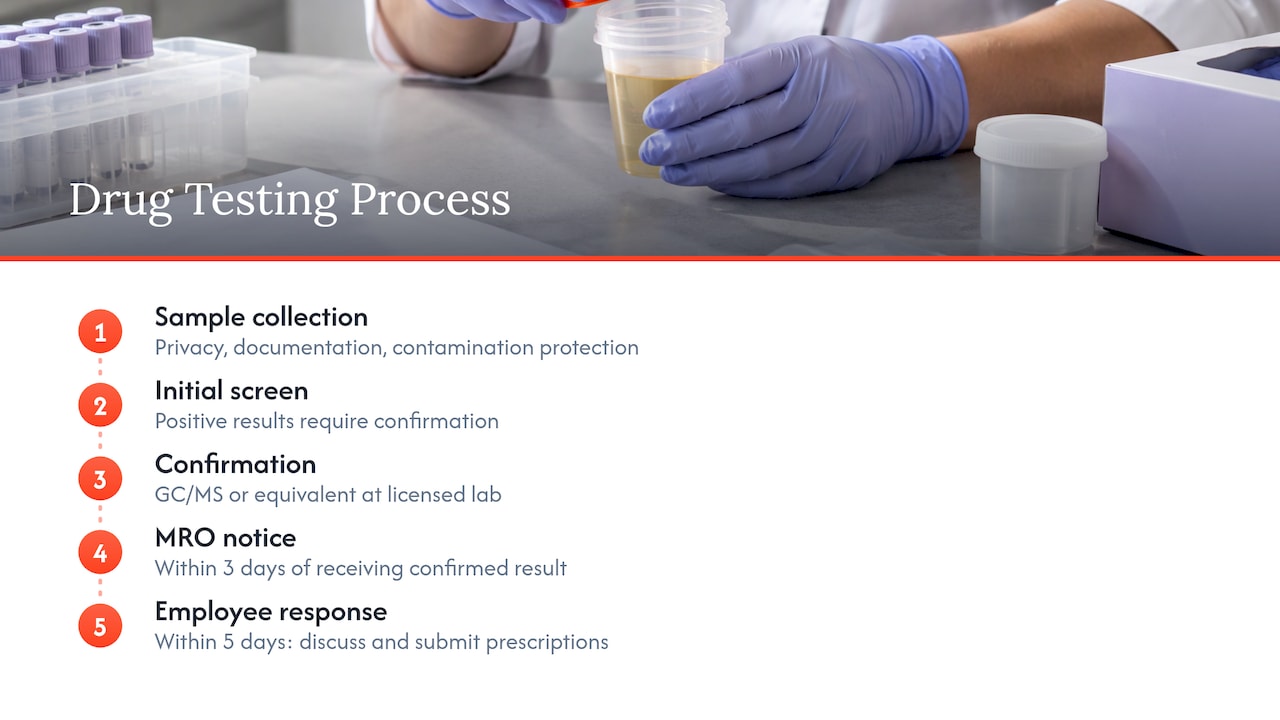
The statute sets out how a sample must be handled. Specimens must be collected with privacy, documented, and protected from contamination, according to the 2026 Florida Statutes. The first test is a screen. A positive screen is not the end of the story.
Under Section 440.102(6)©, all positive initial drug tests must be confirmed using gas chromatography/mass spectrometry (GC/MS) or an equivalent or more accurate method approved by the Agency for Health Care Administration or the U.S. Food and Drug Administration, as shown on Online Sunshine. Confirmation happens at a licensed laboratory.
Then a medical review officer, or MRO, steps in. Under Florida Administrative Code Rule 59A-24.008, the MRO must notify the employee or applicant of a confirmed positive within 3 days of receiving it from the laboratory. Within 5 days of notification, the employee gets an opportunity to discuss the result and submit documentation of prescriptions, according to the Legal Information Institute.
This is the stage where honest disclosure of your prescriptions matters. Gather your pharmacy records and your prescribers’ names before any test, so you can hand them over quickly. Our guide to the MRO process after a drug test explains the 5-day and 72-hour windows in more depth.
Your rights after a positive result
Florida gives employees in a drug-free workplace program several protections once a result comes back positive:
- No action on an unconfirmed result. Under Section 440.102(5)(k), an employer may not discharge, discipline, refuse to hire or discriminate against you solely because of a positive result that has not been verified by a confirmation test and by a medical review officer, as stated in the 2025 Florida Statutes.
- Written notice. Within 5 working days after the MRO reports a confirmed positive, the employer must tell you in writing of the result, the consequences and your options, and provide a copy of the results on request.
- A chance to explain. Within 5 working days of that notice, you may submit information explaining or contesting the result.
- A retest. You may request a retest at another licensed laboratory within 180 days, at your own expense.
- No automatic disability status. Under Section 440.102(7)(a), a positive result alone does not define you as having a handicap or disability under discrimination laws.
Write down the date the notice arrives, since the 5-day clock runs from it. Keep copies of everything. If a dispute escalates, an employment attorney licensed in Florida is the right person to consult, because remedies depend on your facts.
Workers’ compensation and drug testing
Drug testing in Florida is tied to workers’ compensation, which is why a positive test after a workplace injury can be costly. Under Section 440.101(2), if an employer implements a program in accordance with Section 440.102 and a drug or alcohol is found in an employee’s system at a level set by rule, the employee may be terminated and loses eligibility for medical and indemnity benefits, according to the 2025 Florida Statutes.
Section 440.102(12) also directs the employer to deny medical or indemnity benefits under the workers’ compensation chapter pursuant to the program, as shown on Online Sunshine. If you work in a physical job with post-accident testing, this is the rule that matters most to you.
Florida marijuana testing laws
The most common question we hear from Florida readers is about marijuana. The short answer: employers can test for it.
The medical marijuana statute, Section 381.986(15), says three things, as summarized in the 2025 Florida Statutes:
- It does not limit an employer’s ability to establish, continue or enforce a drug-free workplace program or policy.
- It does not require an employer to accommodate medical use of marijuana in any workplace, or an employee working while under the influence.
- It does not create a cause of action against an employer for wrongful discharge or discrimination.
It also says medical marijuana is not reimbursable under the workers’ compensation chapter.
The Florida Bar Journal reached a similar view early on. Attorneys Gregory A. Hearing and Matthew A. Bowles wrote in 2017 that the legislature did not intend medical marijuana to interfere with employers’ existing drug policies, as published in the Florida Bar Journal.
Medical cards and the Giambrone case
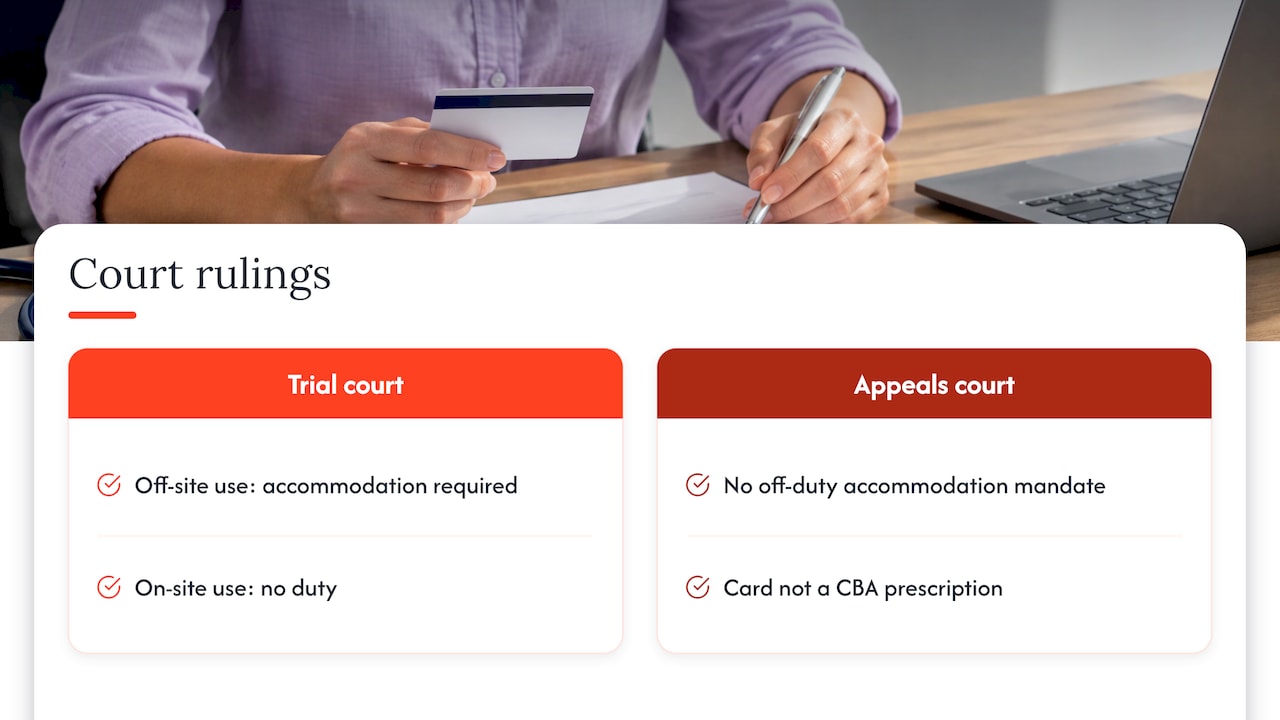
Courts have been working through off-duty use. Law firm Ogletree Deakins reported in 2025 that a trial court in the Giambrone matter concluded the Florida Constitution required a public employer to accommodate off-site medical marijuana use, while on-site use carried no such duty, according to the Ogletree blog.
The appellate court then went the other way. In Hillsborough County v. Giambrone (2026), the Second District Court of Appeal held that a medical marijuana card is not a “prescription” under the collective bargaining agreement, and that Florida law has no affirmative accommodation mandate for off-duty medical use, as reported by RumbergerKirk. The same report notes that the federal move of marijuana to Schedule III, effective April 28, 2026, did not change that outcome, because the events fell under 2019 law and the agreement’s wording controlled.
Another firm, Bryan Meek Davis, explained that the split between Giambrone and the Velez Ortiz case turned on whether the employer’s policies adequately protected its right to regulate off-duty marijuana use, per its 2025 analysis.
What this means for you: a card is not a safe harbor for a pre-employment or random screen. Read your employer’s policy, and read any union agreement that applies to you.
Public employers follow different rules
State agencies are governed by Section 112.0455, not 440.102. According to the 2026 Florida Statutes, state-agency employers may, but need not, conduct applicant, reasonable-suspicion, random, routine fitness-for-duty and followup testing. Key limits include:
- Random testing may occur once every 3 months.
- Random selection must be computer-generated by an independent third party.
- Random testing may not exceed 10 percent of the employee population.
- Followup testing may be quarterly, semiannual or annual for up to 2 years.
- An employer without a program must give 60 days’ notice before testing begins.
The statute also states that a positive test alone does not make an employee or applicant “handicapped” under the 1973 Rehabilitation Act. If you work for a state agency, ask your personnel office which of these testing types it actually uses.
New Florida laws for 2026
Readers often ask what is new in 2026. One bill stands out for workplace testing. A House of Representatives analysis dated February 11, 2026, describes CS/HB 689, which would amend Section 381.986 to limit an employer’s civil liability for specified adverse personnel actions involving medical marijuana, a refusal to test, or a positive marijuana test, provided the drug-free workplace or workers’ compensation requirements are met. The bill carried a July 1, 2026 effective date, per the bill analysis.
Bills change as they move through the legislature, so confirm the current status on the Florida Senate site before you rely on it. The practical direction is consistent with the rest of Florida law: employers have wide latitude to enforce testing policies.
For federally regulated jobs such as DOT-covered roles, federal rules apply on top of state law. Check with your employer’s designated representative about those requirements.
How to prepare for a Florida drug test
Preparation is mostly about information. Work through this list:
- Identify the test type. Urine, saliva and hair screens detect use over different windows. Ask the employer or the collection site which one you will take.
- Get the written policy. It tells you what triggers a test, what counts as a refusal and what happens after a positive.
- List every medication and supplement. Have prescriptions and prescriber details ready for the MRO.
- Know your timeline. If you have notice, use it. If the test is random or post-accident, you will not have any.
- Do not refuse. In a program covered by Section 440.102, a refusal can carry the same consequence as a confirmed positive.
- Keep records. Save every notice, date and lab report in case you need to contest a result within 5 working days.
If you need to know what you are facing, our guide to workplace drug testing policies in the U.S. lays out four common workplace tests and safe preparation options. Readers in other states can compare with our pieces on California drug testing laws and the Illinois marijuana testing law. For urine screens specifically, see our page on employee urine drug testing.
Our perspective
Florida’s framework is clear on one point: the employer sets the policy and the employee lives with it. A medical card does not change that at work, and the courts so far have not carved out an exception.
We built Passmydrugtest around that reality. People call us before a screen because they want to understand which test they face and what their options are. That is why we pair plain-language guides like this one with a curated selection of products for urine, saliva and hair screens, so you can match what you buy to your actual situation instead of guessing.
Our support team is available by phone during published business hours, and orders within the United States ship fast. If you have a test coming up, start by finding out its type, then choose products designed for that test.
MIchael
MIchael
Find products matched to your test
If you have a screen coming up, browse our selection of urine, saliva and hair drug testing products, including hair detox shampoo. Each category is built around a specific test type, and our team can help you pick by phone during business hours.
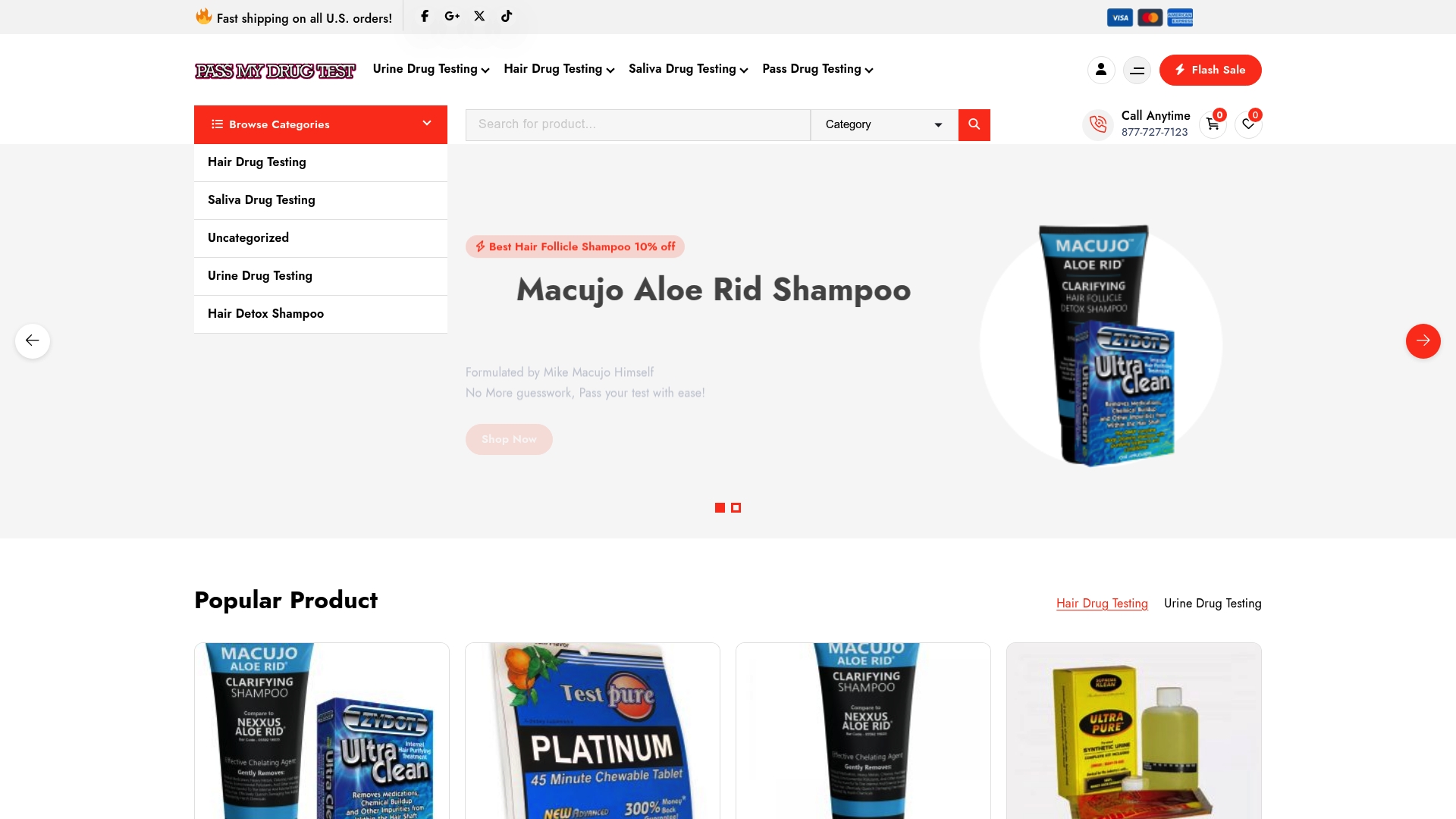
For a closer look at one category, see our hair follicle drug test page.
FAQ
Can a Florida employer fire me for a positive marijuana test if I have a medical card?
Generally yes. The medical marijuana statute does not limit an employer’s drug-free workplace policy, does not require accommodation at work and creates no wrongful discharge claim, according to Section 381.986. A 2026 appellate decision in Giambrone also found no affirmative accommodation mandate for off-duty use. An employment attorney can review your specific policy.
Can Florida employers test randomly?
Private employers are not precluded from random or other lawful testing, per the 2026 statute. State agencies may use random testing too, but only once every 3 months, selected by an independent third party and capped at 10 percent of employees.
Can I contest a positive drug test in Florida?
Yes. In a covered program, you have 5 working days after written notice to explain or contest a confirmed result. You may also request a retest at another licensed laboratory within 180 days at your own expense, as set out in Section 440.102.
Does a positive test affect workers’ compensation?
It can. If the employer runs a program under Section 440.102 and a drug is found at the level set by rule, you may be terminated and lose medical and indemnity benefits, per Section 440.101.
Sources
- Chapter 440 Section 102, 2026 Florida Statutes
- Chapter 440 Section 102, 2025 Florida Statutes
- Chapter 440 Section 101, 2025 Florida Statutes
- Online Sunshine: Florida Statutes, Section 440.102
- Chapter 112 Section 0455, 2026 Florida Statutes
- Chapter 381 Section 986, 2025 Florida Statutes
- An Employer’s Guide to a Drug-Free Workplace, Florida Department of Financial Services
- Fla. Admin. Code R. 59A-24.008, Legal Information Institute
- Florida House of Representatives bill analysis, CS/HB 689
- Medical Marijuana’s Effect on Employment Law, Florida Bar Journal
- RumbergerKirk: Florida appellate court upholds drug-free workplace policy
- Ogletree Deakins: Florida court rules on off-duty medical marijuana accommodation
- Bryan Meek Davis: Another Florida court weighs in on medical marijuana accommodation