
EtG Alcohol Test Detection Time: How Long It Lasts
An EtG urine test can detect alcohol for roughly 1 to 3 days after a few drinks, and in heavy drinking cases for up to about 80 hours or longer. The exact window depends on how much you drank, your body, and the cutoff the lab uses. The 80-hour figure is a ceiling, not a promise, and many people will test negative well before it.
This guide walks through the real numbers from laboratories and clinical studies, explains what a positive result means at different cutoffs, and covers the factors that stretch or shorten the window. If you have a workplace, court, probation, or treatment-program test coming up, you will know what the test can and cannot see.
TL;DR
- After one or two drinks, EtG is usually detectable for about 24 hours or a bit more. After heavier drinking, it can be detectable for 2 to 4 days.
- Labs cite up to 80 hours as the upper end for urine, and some reviews report longer windows after very heavy intake.
- A lower cutoff (100 or 250 ng/mL) catches more and lasts longer than a 500 ng/mL cutoff, which is the most common setting in monitoring programs.
- Kidney function, age, hydration, and the amount you drank all move the window. No calculator can give you an exact personal number.
- Hand sanitizer and other alcohol-containing products can sometimes produce low positives, so the cutoff and the tier of the result matter.
Table of Contents
- What an EtG test actually measures
- EtG detection window by amount of alcohol
- Where the 80-hour figure comes from
- Cutoffs: why the same sample can test positive or negative
- What a positive result means at each level
- What changes your personal detection window
- Hydration and dilution
- Incidental exposure: sanitizer, mouthwash, and food
- Perspective
- Planning ahead for a screening
- Prepare for your test with the right kit
- FAQ
- Sources
What an EtG test actually measures
EtG stands for ethyl glucuronide. It is a byproduct your body makes when it processes alcohol. Only a tiny share of the ethanol you drink ends up this way: one pharmacokinetic study found about 0.02% of the dose is excreted in urine as EtG. That small amount is still enough for a sensitive lab assay to find long after the alcohol itself is gone.
That is the key difference from a breath or blood alcohol test. In one study of four adults who drank 24 g of ethanol, ethanol itself was detectable for only 2 to 4 hours, while EtG showed up for 25 to 39 hours. An EtG test tells a program whether you drank recently, not whether you are impaired right now.
Many labs also test for EtS, ethyl sulfate, a second byproduct. Quest Diagnostics notes that EtG may be produced in the specimen when ethanol-producing bacteria are present in urine, while detecting EtS indicates alcohol was present in the body. That is why many confirmation tests look at both.
EtG detection window by amount of alcohol
The most honest answer to the detection time question is a range tied to dose. Here is how the published sources line up.
| Drinking level | Typical urine EtG window | Source |
|---|---|---|
| Small amount (about 0.1 g/kg body weight, less than one standard drink for many adults) | About 13 to 20 hours | Forensic Science International pharmacokinetic study |
| One or two drinks | 24 or more hours | Jatlow and O’Malley, 2010 |
| A few drinks | Up to 48 hours, sometimes 72 or longer if heavier | MUSC Clinical Neurobiology Lab |
| Heavier consumption | 2 to 4 days | Jatlow and O’Malley, 2010 |
| Large amounts | Up to about 3.5 days | Forensic Science International pharmacokinetic study |
| Excessive consumption | Up to 130 hours reported | Andresen-Streichert et al., 2018 |
A 2012 review of the evidence found that EtG can usually be detected in urine for 72 to 90 hours. The same review noted that studies using doses of 0.1 to 0.85 g/kg found windows of 24 to 48 hours, while a dose above 1 g/kg gave detection for 39 to 102 hours.
Put simply: a glass of wine with dinner and a night of heavy drinking leave very different trails.
Where the 80-hour figure comes from
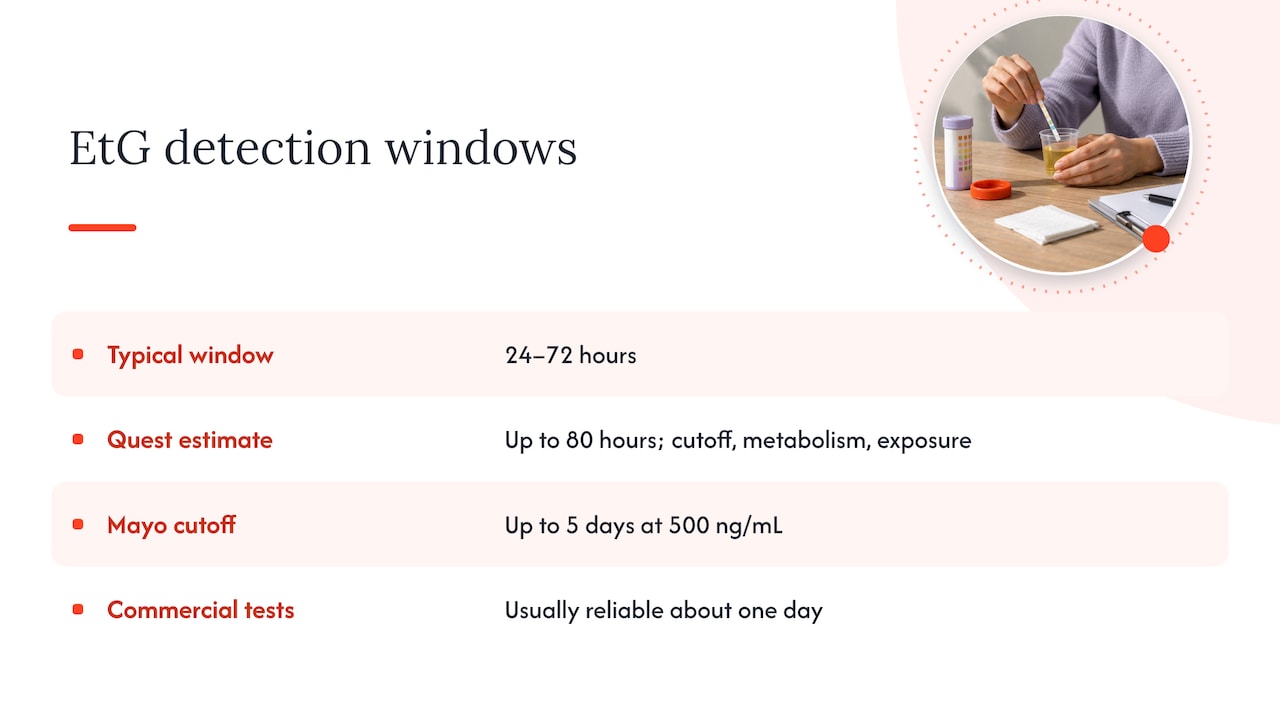
You will see 80 hours everywhere. Quest Diagnostics states that EtG may be present in urine for up to 80 hours after ethanol ingestion, depending on the cutoff, the person’s metabolic rate, and the timing and length of alcohol exposure. Mayo Clinic Laboratories says EtG and EtS can be detected for up to 5 days at a 500 ng/mL cutoff.
But a ceiling is not an average. The clinical literature pushes back on marketing built around the number. Jatlow and O’Malley warn that advertisements touting reliable detection three or more days after drinking, such as an 80 hour test, can be misleading. Healthline reports typical windows of 24 to 72 hours, and says commercially available urine EtG tests are usually reliable for about one day.
A dose-ranging alcohol challenge study shows the pattern well. EtG was always positive at 100 and 200 ng/mL cutoffs 12 hours after drinking, but sensitivity was poor at every cutoff 24 hours after a low dose, and poor after 48 hours regardless of dose.
Cutoffs: why the same sample can test positive or negative
The cutoff is the concentration at which a lab calls a result positive. It is measured in nanograms per milliliter (ng/mL), and it changes the window more than most people realize. The ADLM technical note explains that higher cutoffs shorten the window and may miss light or moderate drinking. It also reports that laboratories use many different settings, with proficiency testing data showing at least 8 immunoassay cutoffs between 50 and 1000 ng/mL.
Common cutoffs you may run into:
- 100 ng/mL: the most sensitive. Picks up very light exposure and drinking from further back.
- 250 ng/mL EtG and 100 ng/mL EtS: the settings in Mayo’s confirmation test, which reports positive if either cutoff is met.
- 500 ng/mL: the common monitoring cutoff. Quest considers EtG below 500 ng/mL negative, and treats 500 or higher as positive only if EtS is also 100 ng/mL or greater.
The Colorado Judicial Branch calls 500 ng/mL the Goldilocks cutoff for drug court, giving up to a 48-hour window while avoiding most incidental exposure. It adds that a positive at 500/100 is consistent with drinking one to two days before collection, and that a negative is not proof of abstinence.
One study looking at drinking more than 24 hours earlier recommended a 200 ng/mL cutoff for research and clinical outcomes. So if you are told you will be tested, ask which cutoff applies. It tells you more about your window than any chart.
What a positive result means at each level
SAMHSA’s 2012 advisory described three tiers, as summarized in the ADLM note: very low positive (100 to 500 ng/mL), low positive (500 to 1000), and high positive (above 1000). Mayo’s interpretation of these tiers is useful:
- High positive (above 1000 ng/mL): may indicate heavy drinking the same day or earlier, or light drinking the same day.
- Low positive (500 to 1000 ng/mL): may indicate previous heavy drinking, recent light drinking, or recent intense extraneous exposure.
- Very low positive (100 to 500 ng/mL): may indicate previous heavy or light drinking, or recent extraneous exposure.
Those tiers come from Mayo Clinic Laboratories. Notice how broad each description is. Researchers point out that the test’s sensitivity means levels cannot tell a binge several days ago from a small unintended intake a few hours before the sample.
What changes your personal detection window
Two people who drink the same amount can have different windows. The factors with the best evidence:
Amount and timing. More alcohol means a longer window, and the gap between your last drink and the sample matters most. The 2018 review states that sensitivity depends on quantity, time to collection, and the method’s cutoff.
Kidney function. The ADLM note reports that in one study of unsupervised drinking in patients with decreased renal function, concentrations were higher and detection windows nearly twice as long as in healthy volunteers.
Age, sex, and marijuana use. A WHO/ISBRA study found that age, gender, marijuana use, kidney disease, and grams of alcohol consumed last month significantly influenced urine EtG levels, while race, smoking, body mass index, cirrhosis, and total body water did not. If you are a cannabis user, that is worth knowing: it can nudge levels upward, though it does not change what the test is looking for.
Individual metabolism. Even after adjusting for urine dilution, researchers have reported wide differences between people in detection times. That is why a precise personal calculation is not reliable, and why labs describe windows as ranges.
Hydration and dilution
Urine concentration depends on how much fluid you are passing. The 2018 review notes that drinking large volumes of water produces a steep drop in EtG and EtS levels, which can cause false negatives. Labs counter this by checking creatinine and flagging samples below a minimum, usually above 20 mg/dL. Walsham and Sherwood add that expressing EtG as a ratio to creatinine overcomes the problem of urinary dilution.
The practical takeaway: a very dilute sample is likely to be flagged rather than treated as clean, and it can create a retest. Staying normally hydrated is the sensible approach.
Incidental exposure: sanitizer, mouthwash, and food
The SAMHSA advisory warns that the EtG test is inappropriate as the sole basis for a definitive, life-altering decision because highly sensitive tests cannot always separate drinking from exposure to common commercial and household products. It gives the example of a popular hand sanitizer that is about 64 percent ethanol, which can be absorbed through the skin and metabolized to EtG and EtS.
This is why programs use higher cutoffs. Mayo’s tiers list recent intense extraneous exposure as a possible explanation for low and very low positives, and Colorado’s drug court guidance chose 500 ng/mL partly to avoid incidental exposure.
If you get a low positive and you did not drink, say so, name any products you used heavily, and ask about a confirmation test using EtS. Our guides on false positive urine tests and false positive drug testing explain how confirmation testing works in general.
Perspective
Most people who search for an EtG window are not trying to learn chemistry. They have a date on the calendar, and they want to know where they stand.
Here is how we see it. The published ranges are wide, and anyone selling a single exact hour count is guessing. What helps is knowing your test type, your cutoff, how much you drank, and how much time you have. That is the information that lets you plan.
It is also why we pair education with products. On our site you can research the test you are facing, compare urine, saliva, and hair options, and order what fits your situation, with fast shipping in the United States and live phone support during business hours. We built the guides first because a good decision starts with the right information.
If your situation involves THC as well, our THC detox timeline covers the 50 and 15 ng/mL urine cutoffs in the same plain terms.
MIchael
Planning ahead for a screening
A few practical steps follow from the evidence above:
- Find out what is being tested. A standard workplace panel does not necessarily include alcohol. Court, probation, treatment, and some monitoring programs often do. Our employee drug testing guide covers what typical panels look for.
- Ask for the cutoff. A 500 ng/mL program and a 100 ng/mL program give very different windows.
- Count conservatively. If the program uses a sensitive cutoff, the safest planning assumption is the longer end of the range for your drinking level. Where abstinence is a condition of your program, avoid alcohol and alcohol-containing products altogether.
- Watch hidden sources. Hand sanitizer, some mouthwashes, and some foods and medicines contain alcohol. Read labels.
- Talk to the right professional. If you have kidney disease, tell the lab or your clinician, because it can lengthen your window. If you are struggling to cut back, a doctor or a treatment provider can help.
Prepare for your test with the right kit
If you want to know what a urine screen may show before you sit for the real one, we carry urine drug testing options alongside saliva and hair testing, plus detox products for different test types. Our team is available by phone during published business hours to help you match a product to your scenario, and orders ship fast within the United States.
You can browse the full range on our drug testing products page or start from the Pass My Drug Test homepage.
FAQ
How long does alcohol stay detectable on an EtG test?
For most people, EtG is detectable for roughly 1 to 3 days after drinking, depending on the amount. Laboratories cite up to 80 hours as the upper end, and some reviews report longer after very heavy intake. A single drink may be detectable for well under a day at a 500 ng/mL cutoff.
What is the EtG test window at a 500 ng/mL cutoff?
Colorado’s drug court guidance describes a window of up to 48 hours at 500 ng/mL, and says a positive is consistent with drinking one to two days before collection. Mayo notes that EtG and EtS can still be detected for up to 5 days at this cutoff after heavy drinking, so the amount you drank matters.
Can hand sanitizer cause a positive EtG result?
It can in some cases. SAMHSA’s advisory explains that alcohol absorbed through the skin from products like hand sanitizer can be metabolized to EtG and EtS. Higher cutoffs and EtS confirmation help separate this from drinking, and low positives in particular should be interpreted with care.
Does drinking water lower an EtG result?
Heavy water intake dilutes urine and can lower EtG concentrations, which is why labs check creatinine. Samples that are too dilute are often flagged and may lead to a retest rather than counting as a negative.
Is it safe to drink the night before a screening that includes alcohol?
It is risky. A drink the night before is well within the 24 to 48 hour window at most cutoffs. If your program tests for alcohol, plan on abstaining beforehand and check the specific rules with your program or employer.
Sources
- Quest Diagnostics: Alcohol Metabolites Quantitative Urine
- Mayo Clinic Laboratories: Ethyl Glucuronide Confirmation
- Ethylglucuronide and Ethyl Sulfate Assays in Clinical Trials (PMC)
- MUSC Clinical Neurobiology Lab: Urine Ethylglucuronide Testing
- Walsham and Sherwood: Ethyl glucuronide (2012)
- Alcohol Biomarkers in Clinical and Forensic Contexts (PMC)
- A pharmacokinetic study of ethyl glucuronide in blood and urine
- Ethyl glucuronide excretion in humans following oral administration (PubMed)
- Healthline: Urine Test for Alcohol
- ADLM technical note, September 2022
- WHO/ISBRA study on EtG sensitivity, specificity, and influences
- Colorado Judicial Branch: The Use of EtG and EtS Monitoring in Drug Court
- Determining Ethyl Glucuronide Cutoffs (PMC)
- SAMHSA News, November/December 2006
- Jatlow and O’Malley: Clinical Application of Ethyl Glucuronide (PMC)