
Drug Test Results Time: Why Detox Drinks Fail and What Helps
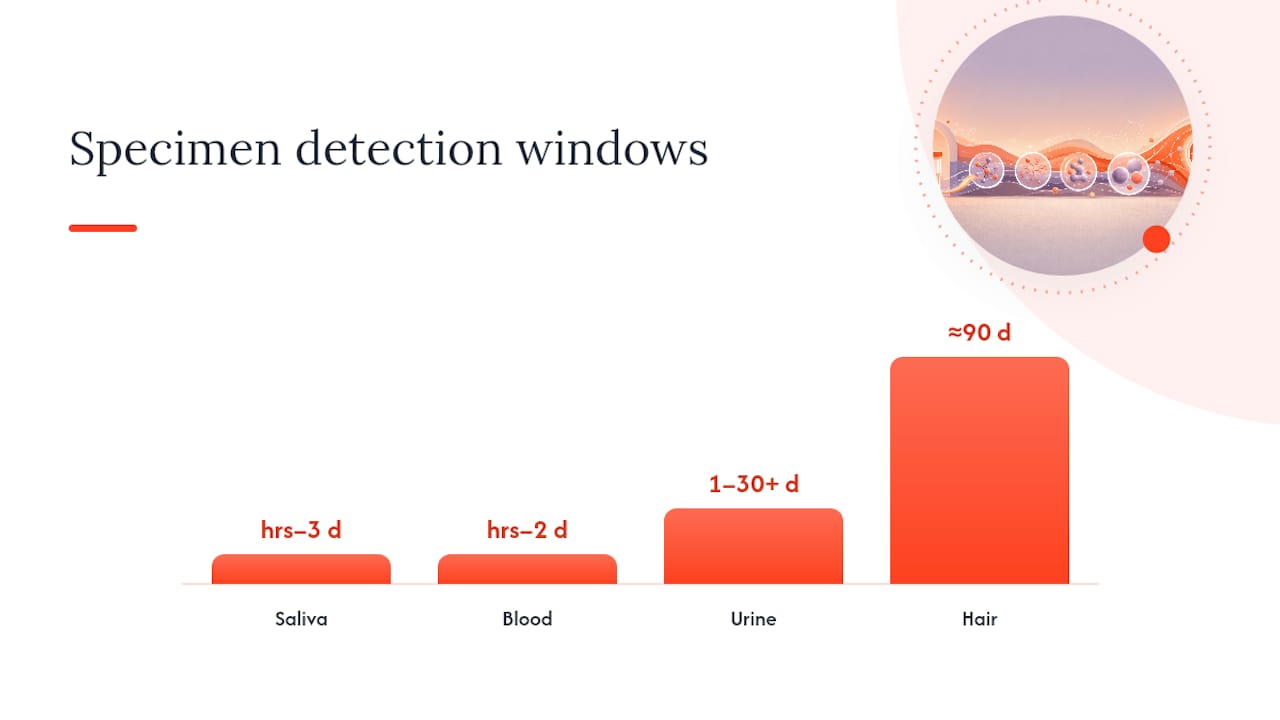
Drug test results time comes down to the specimen and the substance: urine typically shows metabolites for 1 to 30+ days, saliva and blood for hours up to a few days, and hair for roughly 90 days. Frequency and dose push those windows wider or narrower, according to NCBI’s clinical drug testing overview and lab-based detection-time charts. There’s no shortcut around that math. Time and abstinence are the only dependable path, and some providers build their product guidance around that reality rather than around wishful thinking.
TL;DR:
- Chronic heavy drug users may test positive in urine for over 30 days, significantly longer than occasional users, especially for THC.
- Hair testing generally detects drug use over the past 90 days, whereas blood and saliva tests reveal only recent use within a few days.
- Body fat percentage, liver, and kidney functions greatly influence detection windows, with higher fat storage prolonging THC detection.
- Detox drinks mainly dilute urine temporarily and cannot speed up the elimination of drug metabolites, which testing labs can typically detect.
- Preparing for testing by stopping drug use early and conducting home tests offers the best chance of passing, as no quick fix reliably shortens detection times.
Table of Contents
- How Long Different Specimen Tests Typically Detect Drugs
- Why Detection Times Vary Between People and Tests
- What Detox Drinks, Kits, and Supplements Can and Cannot Do
- Substance-Specific Detection Windows
- Getting Ready Before a Screening
- What Actually Matters When Time Is Short
- Where to Find Timing-Sensitive Products When You Need Them Fast
- Sources
- FAQ
How Long Different Specimen Tests Typically Detect Drugs
Each specimen type answers a different question. Urine tells a lab about the last several days to several weeks of use. Blood and saliva tell it about the last few hours to a couple of days. Hair tells a much longer story, one that stretches back roughly three months.
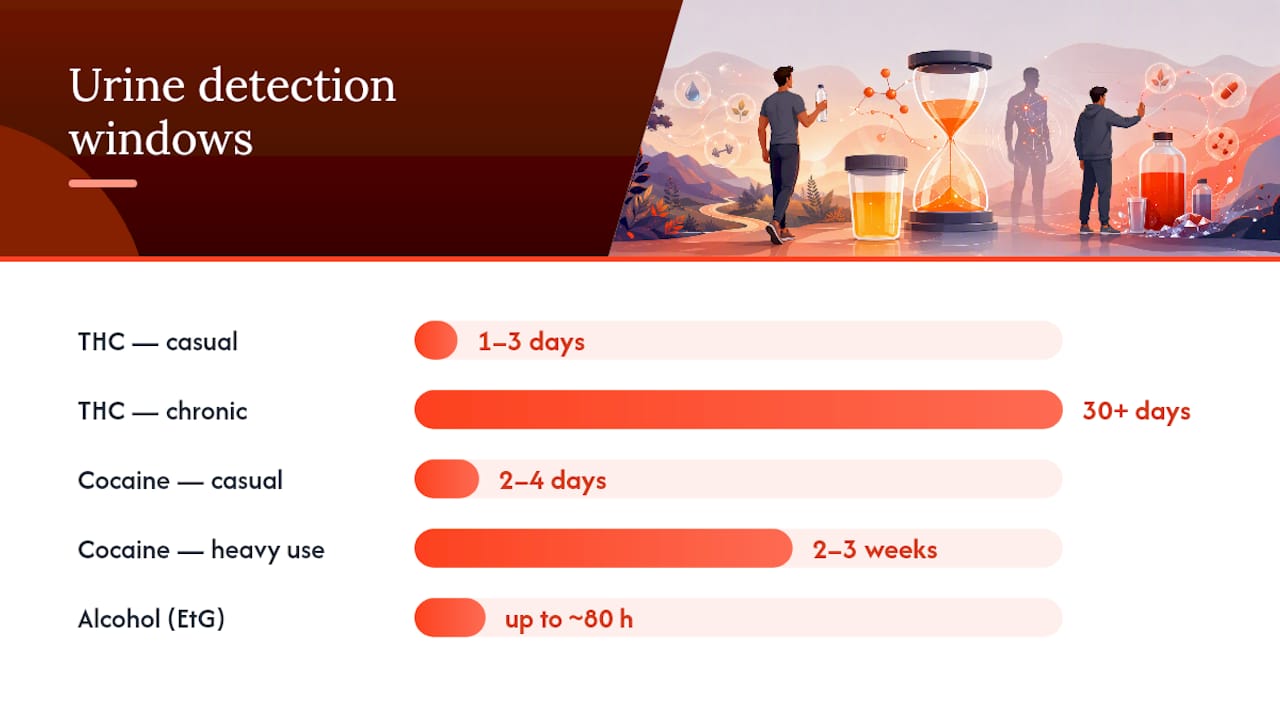
Urine is the most common workplace and legal specimen, and its window depends heavily on how often someone uses. A single dose of THC typically clears a casual user’s urine in 1 to 3 days. Daily, heavy cannabis use can push that out past 30 days, and some long-term heavy users test positive even longer, according to Cordant’s detection-time reference chart. Cocaine metabolites usually clear faster than THC, often within 2 to 4 days for occasional use.
Saliva tests catch recent use rather than a long history. Most substances show up for a few hours to 1 to 3 days, which is why oral fluid testing has become popular for post-accident or reasonable-suspicion screens where an employer wants to know what happened today, not last month. A closer breakdown lives on Passmydrugtest’s saliva detection page.
Blood windows run even tighter, typically hours to a couple of days, since blood testing exists mainly to confirm impairment at a specific moment rather than to build a use history.
Hair tests cover roughly 90 days of history for many drugs, based on how hair grows and traps metabolites in the follicle, per the StatPearls clinical overview. That makes hair testing useful for long-term pattern detection and nearly useless for catching last weekend’s use, since it takes about a week for hair to grow enough to sample. More specifics sit on Passmydrugtest’s hair detection guide.
- Urine: days for single use, up to 30+ days for chronic heavy use
- Saliva: hours to roughly 1 to 3 days
- Blood: hours to about 2 days
- Hair: approximately 90 days, reflecting a longer history rather than recent activity
Quick reference: Hair testing detects roughly a 90-day history, while blood testing typically covers only the last day or two. That gap explains why an employer might run one instead of the other depending on what they’re actually trying to find out.
Why Detection Times Vary Between People and Tests
Two people who use the same amount of the same drug on the same day can test differently a week later. That’s not random. It comes down to pharmacokinetics, the study of how a drug moves through absorption, distribution, metabolism, and elimination, and specifically to a concept called half-life, the time it takes the body to clear half of a given dose, as described in the MSD Manual’s pharmacokinetics overview.
Body composition matters more than most people expect. THC is lipophilic, meaning it binds to fat cells rather than passing through quickly, so someone with a higher body fat percentage often stores and releases it more slowly than a leaner person. Liver and kidney function also shape clearance, since both organs do the actual work of breaking down and excreting metabolites.
- Frequency and dose: occasional use clears far faster than chronic daily use
- Body fat percentage: higher fat storage extends THC’s window specifically
- Liver and kidney function: impaired function slows clearance across most substances
- Test method: immunoassay screening flags a possible positive; GC-MS confirmation nails down the specifics
Pro Tip: Don’t compare your timeline to a friend’s story from a forum. Their body fat, dose, and liver function aren’t yours, and the “I passed after 5 days” post you read says nothing reliable about your own window.
What Detox Drinks, Kits, and Supplements Can and Cannot Do
No clinically validated product speeds up how the body eliminates drug metabolites. What most detox drinks actually do is dilute urine temporarily, according to evidence reviews from Rehab. That’s a meaningful distinction: dilution isn’t detoxification, and labs are built specifically to catch it.
Specimen validity testing checks creatinine, specific gravity, pH, and oxidants like nitrites or glutaraldehyde, exactly the markers that spike or crash when someone over-hydrates or adds something to a sample. A diluted or invalid result often carries the same practical fallout as a positive one, since most workplace policies treat it as a failed test requiring retest or disciplinary review.
Flagged samples don’t disappear quietly. A diluted or adulterated specimen typically triggers a retest under closer supervision, and in many workplace policies, that outcome is treated exactly like a positive result.
- Dilution lowers concentration but leaves creatinine and specific gravity abnormal
- Masking agents can throw off pH or trigger oxidant flags
- A flagged sample commonly leads to a supervised retest, not a clean pass
- Home testing beforehand, like Passmydrugtest’s detox and testing guidance, helps borderline cases gauge where they actually stand
Substance-Specific Detection Windows
Detection windows shift a lot depending on which drug is in question, and lumping them together leads to bad planning. Here’s how the major categories typically break down across urine, the specimen most workplace and legal tests use.
THC clears fastest for occasional users, typically 1 to 3 days in urine. Chronic daily use is a different story entirely, sometimes extending past 30 days, and some heavy long-term users see even longer windows because of how thoroughly THC accumulates in fat tissue, per Cordant’s detection chart. Hair testing for THC still lands around the standard 90-day mark.
Cocaine metabolites generally clear within 2 to 4 days for casual, occasional use. Heavy or binge use can stretch that to 2 to 3 weeks, since repeated dosing builds up metabolite levels faster than the body clears them. Hair testing again reflects roughly 90 days.
Amphetamines and MDMA typically show up in urine for 1 to 3 days after use, with slightly longer windows for heavy or repeated dosing. Hair testing follows the same 90-day pattern as other substances.
Opioids mostly clear within 1 to 3 days in urine, though methadone is a notable exception that lingers considerably longer due to its extended half-life. Fentanyl detection depends heavily on whether the specific test panel screens for it, since many standard opioid panels miss synthetic opioids entirely.
Benzodiazepines split sharply by type. Short-acting versions clear in roughly 1 to 3 days, while long-acting ones like diazepam can remain detectable in urine for several weeks. Hair testing covers the usual 90-day window.
Alcohol biomarkers, specifically ethyl glucuronide (EtG), can sometimes be detected in urine for up to about 80 hours depending on the specific test used and how much was consumed, according to Numa Recovery’s compiled ranges.
- THC: 1 to 3 days casual, 30+ days chronic, ~90 days hair
- Cocaine: 2 to 4 days casual, up to 2 to 3 weeks heavy use
- Amphetamines/MDMA: 1 to 3 days, slightly longer with heavy use
- Opioids: 1 to 3 days typical, methadone notably longer
- Benzodiazepines: 1 to 3 days short-acting, weeks for long-acting like diazepam
- Alcohol (EtG): up to roughly 80 hours depending on test and amount
The range that surprises most people: chronic THC use can extend urine detection past 30 days, roughly ten times longer than a single casual use. That gap is exactly why generic “how long does it stay in your system” answers fail without knowing actual use patterns.
Getting Ready Before a Screening
Preparation only works within realistic limits, and the biggest mistake is starting too late.
- Stop using immediately and calculate an abstinence window specific to the substance involved, since a benzodiazepine timeline and a THC timeline aren’t remotely similar.
- Run a home test to check where you actually stand before the real one. A product like Passmydrugtest’s I Screen 1 Panel Drug Test mirrors standard lab screening sensitivity, though it isn’t confirmatory.
- Hydrate normally, not excessively, in the days before testing. A first-morning void is typically the most concentrated sample, and chugging water right before collection often backfires by triggering a dilution flag.
- Skip adulterants and substitution attempts. Labs test specifically for these, and getting caught usually leads straight to a confirmatory retest or disciplinary action, which is a far worse outcome than a straightforward positive.
Pro Tip: If you’re within a few days of a test and unsure where you stand, a home check is more useful than another detox drink. It gives you an actual data point instead of a guess.
What Actually Matters When Time Is Short
People searching for a fast fix usually already know the honest answer and are hoping for an exception. There isn’t one. Passmydrugtest exists to combine straightforward education with fast US shipping and phone support, because the products that make sense are the ones used to check status, not to fake a result. A home test before a real screening is reasonable. A detox drink bought an hour before collection, hoping it beats specimen validity checks, usually isn’t. Use the support line to talk through your specific timeline before you buy anything.
— MIchael
Where to Find Timing-Sensitive Products When You Need Them Fast
If you’re staring down a test date and need real answers instead of guesses, some services give you a direct path to check your status before it counts. For THC-specific concerns, the marijuana test kit page lets you self-check ahead of a screening rather than hoping abstinence math works out. If you’re facing an employer-mandated screen, the pre-employment drug testing resources walk through what most panels actually check for.
For the full range of home test kits and preparation products, browse Passmydrugtest’s drug testing products to compare options by specimen type and turnaround. Orders within the United States ship fast, which matters when a test date is days away, not weeks. If you’re not sure which kit fits your timeline, consider contacting customer support before you order. Getting the right product matched to your actual situation beats guessing every time.
This article is general information, not a substitute for advice from a qualified doctor. Consult a qualified healthcare professional about your own circumstances before acting on anything here.
Sources
- Clinical Drug Testing – StatPearls – NCBI Bookshelf
- Overview of pharmacokinetics – MSD Manual
- Drug detection times (chart) – Cordant referenced PDF
- Rehab
FAQ
How long do drugs stay detectable in urine?
Urine detection ranges from 1 to 3 days for a single use of most substances up to 30+ days for chronic heavy THC use, depending on frequency, dose, and body composition.
Do detox drinks actually shorten drug test results time?
No verified evidence shows detox drinks speed up how the body clears metabolites; they mainly dilute urine temporarily, which specimen validity testing at the lab is designed to catch.
What’s the difference between a screening test and a confirmatory test?
Immunoassay screening flags a possible positive quickly, while GC-MS confirmatory testing verifies that result with far greater specificity, which is why masking attempts rarely hold up.
Can a home test predict my official drug test results?
A home test like Passmydrugtest’s I Screen 1 Panel kit mirrors standard lab screening sensitivity closely enough to give a useful status check, though it isn’t a substitute for lab confirmation.
Why does hair testing cover 90 days when urine only covers weeks?
Hair grows slowly and traps metabolites as it forms, so a standard hair sample reflects roughly three months of history instead of the days-to-weeks window urine testing captures.