
1–5 Hour Detox Drink Duration: When Masking Helps and When to Abstain
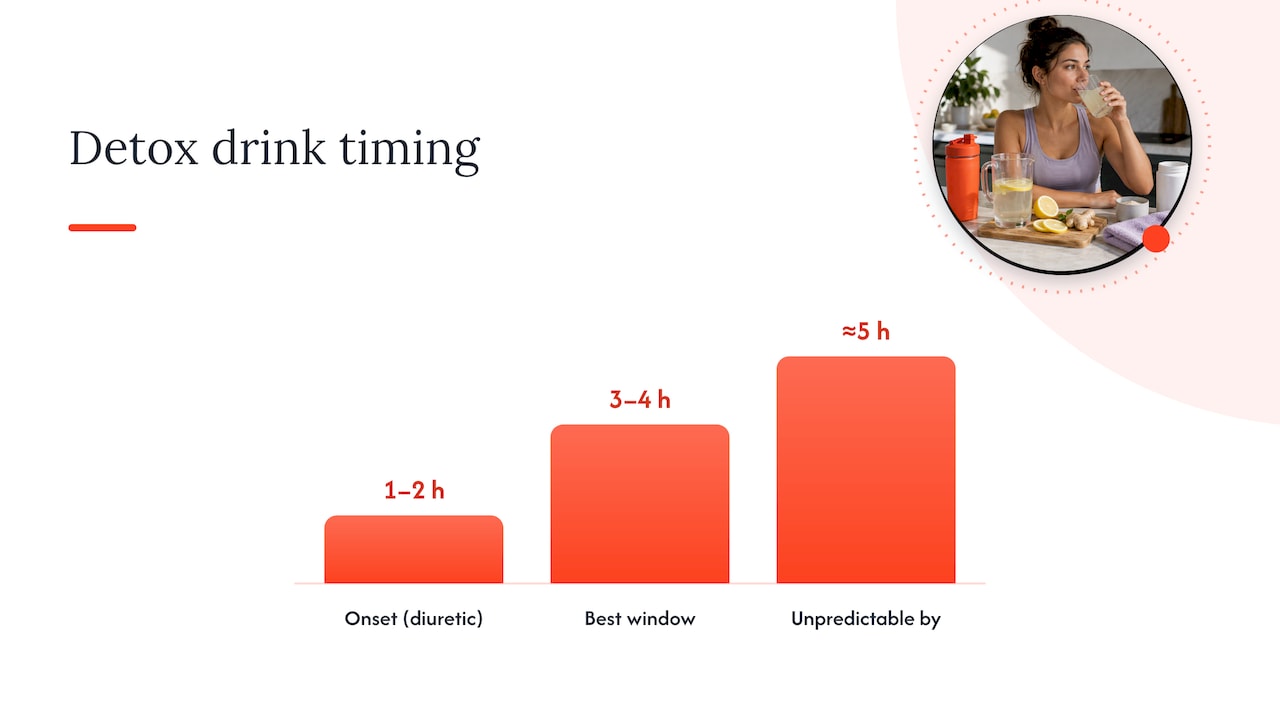
Most same-day detox drinks start working within 1 to 2 hours, hit their most useful window around 3 to 4 hours, and become unreliable by the 5-hour mark. They are temporary masking tools, not cleansers that remove anything from your system. How well they work depends on your body composition, how often you use the substance being tested, and whether the lab flags your sample as diluted. A short period of abstinence, when you have the time, beats same-day masking almost every time.
TL;DR:
- Same-day detox drinks typically work within 1 to 4 hours, with a peak effectiveness at 3 to 4 hours, but become unreliable afterward.
- Heavier or regular users usually require more than a few hours to clear metabolites, making multi-day abstinence the more dependable approach.
- Labs check specimen validity through markers like creatinine and specific gravity, which overhydration can inadvertently trigger flags rather than guarantee a clean result.
- Relying solely on detox drinks for detoxification is ineffective; combining limited-time use with prior abstinence and verification improves chances of passing.
- Medical and safety risks exist with detox products, especially for those with health conditions or on medications, emphasizing the importance of medical guidance and proper testing support.
Table of Contents
- Typical Timing for Same-Day Detox Drinks
- Multi-Day Timelines and Realistic Clearance Windows
- How Labs Check Specimen Validity and Why Dilution Backfires
- Safety, Medical Limits, and Ingredient Cautions
- Practical Timing Checklist Before Your Test
- Where Timing Advice Meets Responsible Use
- Getting Ready With the Right Products and Support
- Sources
- FAQ
Typical Timing for Same-Day Detox Drinks
Detox drink labels tend to follow a similar script: finish the bottle within 30 to 60 minutes, refill the container with water and drink that too, then urinate frequently over the next few hours. That instruction exists because the product is designed to work with your body’s own fluid turnover, not against it.
Onset usually starts around 1 to 2 hours after you finish the bottle, once the diuretic effect kicks in and you start urinating more. Most people find the best window falls between 3 and 4 hours after drinking. Past that point, effectiveness tends to fade, and by 5 hours the results become unpredictable for a lot of users. This lines up with how detox drinks fail to guarantee results even when timed correctly, since duration alone never accounts for individual variation.
Your usage pattern matters more than any product claim. Someone who uses infrequently and has a faster metabolism tends to see a cleaner, more predictable window. Someone who uses daily or has a higher body fat percentage is working against a much bigger internal load, and no drink timed for a few hours is going to catch up to months of accumulation.
A few practical patterns show up across most product instructions and user reports:
- Start the drink 1 to 2 hours before your appointment whenever your schedule allows it.
- Plan for 2 to 3 bathroom trips before you give your sample, spacing them out rather than rushing.
- Avoid drinking so much extra water that your urine turns completely clear, since that invites its own problems.
Pro Tip: Time your last bathroom trip so your sample falls as close to the 3 to 4 hour mark as your appointment allows, not right after you finish the bottle.
Light or occasional users get the most reliable results from this approach. Heavy or daily users are taking a bigger gamble no matter how precisely they follow the label, because the underlying metabolite load simply takes longer to clear than any beverage timeline can compress.
Multi-Day Timelines and Realistic Clearance Windows
Same-day products work against the clock. A multi-day approach works against your actual metabolite load, which is why it tends to be more dependable when you have any lead time before a test.
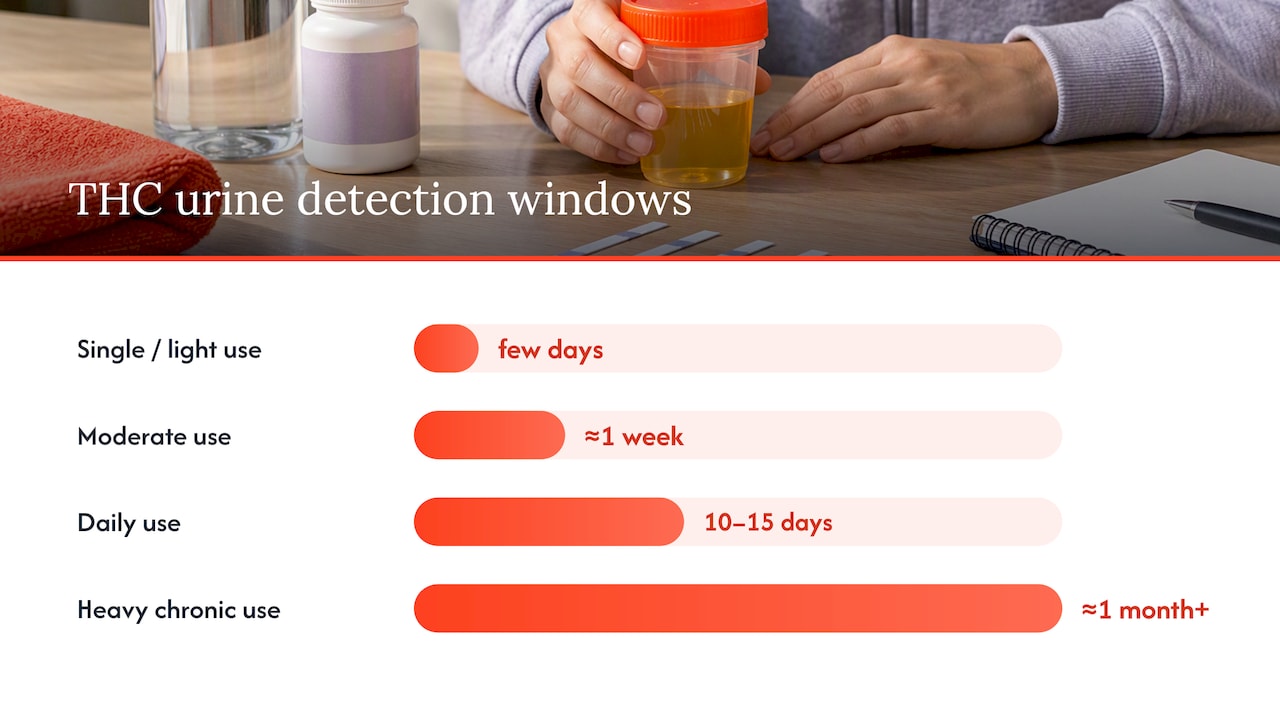
Detection windows vary by substance, dose, and how often you use it, so treat any range as a starting point rather than a guarantee. For THC specifically, commonly cited urine detection ranges run something like this depending on use pattern: a single or light use may clear within a few days, moderate use around a week, daily use often in the 10 to 15 day range, and heavy chronic use sometimes a month or longer. These are practical heuristics used by clinicians and testing guides, not fixed promises for any one person, since metabolism, body fat, hydration, and total dose all shift the number.
Even a short window of abstinence changes your odds. Going 48 hours or more without use lowers your metabolite concentration before you even factor in hydration or diet. For someone who used only once or occasionally, that alone might be enough. For a regular or heavy user, several days to a few weeks of abstinence does more good than any single-day product ever could, because the body needs that time to process and eliminate what accumulated.
A few situations point clearly toward choosing the multi-day route over a same-day drink:
- You have a week or more of lead time before the actual appointment.
- Your use has been frequent or heavy over the past month.
- You have already had a diluted or invalid result flagged once and cannot risk a second one.
When you have the time, stacking a brief abstinence period with normal hydration and a same-day product timed close to your appointment tends to beat relying on one tactic alone.
How Labs Check Specimen Validity and Why Dilution Backfires
Labs do not just look for drug metabolites. They also check whether the specimen itself is a normal, unadulterated human sample, and that second check is where a lot of detox strategies fall apart.
Federal collection procedures documented by SAMHSA’s urine collection handbook require the collector to read the specimen’s temperature within four minutes of collection, with an acceptable range of 90 to 100°F. The specimen also needs a minimum volume above 45 mL, along with creatinine and specific gravity readings that fall within normal human ranges. When any of these markers fall outside range, the collector can require an observed recollection or send the sample to a lab for additional validity testing.
| Validity marker | What labs check | What happens if it fails |
|---|---|---|
| Temperature | Read within 4 minutes, must be 90 to 100°F | Recollection often required, sometimes observed |
| Volume | Minimum of 45 mL | Insufficient specimen, recollection needed |
| Creatinine | Must fall within normal range | Low levels can flag a sample as dilute |
| Specific gravity | Must fall within normal range | Out-of-range readings support a dilute or substituted result |
A specimen with abnormally low creatinine and specific gravity is one of the clearest markers labs use to flag a dilute sample, according to SAMHSA’s biomarker validity testing research, which means overhydration rarely produces the clean negative people hope for.
This is the core problem with drinking excessive water to try to flush a system: it does not erase metabolites, it just lowers creatinine and specific gravity enough to get flagged. A reported “dilute” result usually triggers a retest rather than a pass, which can be worse than a slightly elevated but valid result in some testing contexts. Labs also use biomarker strategies and orthogonal evidence, meaning they cross-check multiple markers rather than relying on one number, which makes it harder to game a single measurement. Readers curious about the mechanics behind this can see more on how creatinine checks make detox drinks detectable and on whether detox drinks actually work against dilution testing.
Safety, Medical Limits, and Ingredient Cautions
Detox drinks and trend cleanses carry real risks that get glossed over in marketing copy, and some of them are serious enough to warrant a second look before you try anything.
Poison Control has stated plainly that there is no evidence popular “internal shower” or similar detox drinks actually flush toxins from the body, and the organization has documented specific harms tied to some of these products, including gastrointestinal obstruction from large chia seed intake and adverse events linked to alkaline-water products, according to Poison Control’s guidance on internal shower drinks. That is a meaningful distinction from a beverage simply not working: some of these products can actively cause harm.
Clinical sources are also clear that commercial detox kits are not a substitute for medically supervised withdrawal. According to American Addiction Centers’ review of detox kits, withdrawal from alcohol or benzodiazepines can be life-threatening, with seizures sometimes appearing anywhere from 2 hours to 2 days after the last drink. No beverage is equipped to manage that risk, and anyone in that situation needs medical care, not a product off a shelf.
A short list of warning signs worth taking seriously:
- Dizziness, confusion, or severe nausea after drinking a detox product.
- Any signs of withdrawal from alcohol or benzodiazepines, which require medical attention, not a drink.
- Symptoms that feel disproportionate to a mild diuretic beverage, which warrant stopping and seeking care.
Poison Control also recommends checking with a doctor before starting any detox or cleanse regimen, particularly for people with gastrointestinal conditions or those on regular medications, since some viral detox trends lack supporting evidence and have led to documented harm.
Practical Timing Checklist Before Your Test
Once you know your appointment date, the plan comes down to a handful of decisions made in order, not all at once.
- Decide your strategy first: if you have a week or more, lean toward multi-day abstinence and hydration; if your appointment is same-day or next-day, a timed detox drink is your only real option.
- If going same-day, start the drink 1 to 2 hours before your appointment, refill the bottle with water as instructed, and urinate 2 to 3 times before your sample, aiming to give the sample around the 3 to 4 hour mark.
- Verify your results with an at-home urine screen before your actual appointment whenever you can fit one in, so you are not walking in blind.
- If the at-home check still shows a risk, consider rescheduling the appointment if your circumstances allow it rather than showing up with a result you already suspect will fail.
- If you take legitimate prescribed medications, disclose them through the proper channel at your test, and talk to a doctor rather than a product label if you have any medical questions about interactions.
Pro Tip: An at-home screening kit the night before or morning of your appointment tells you far more than guessing based on how many hours have passed.
Guidance on producing a clean urine sample covers more of the practical mechanics if you want a deeper walkthrough of this same sequence.
Where Timing Advice Meets Responsible Use
The gap between what a detox drink promises and what it actually does comes down to one word: masking. A same-day drink dilutes and flushes fluid, it does not clinically remove anything from your system, and treating it like a cure is where most people go wrong. Multi-day abstinence works on a different mechanism entirely, giving your body actual time to process what is there, which is why it holds up better under scrutiny.
The most overlooked step in this whole process is verification. People spend more time researching which drink to buy than confirming, with an at-home screen, whether their plan is actually working. That single step catches problems while there is still time to adjust, whether that means rescheduling or shifting strategy.
Some providers combine educational guidance like this with curated detox products, shipping, and support to help people figure out which option fits their specific test scenario, rather than guessing from a shelf label alone.
— MIchael
Getting Ready With the Right Products and Support
Same-day timing only gets you so far if you are not sure your plan is actually working, and that is where having the right products and a way to check your results before the real appointment makes the difference. Various retailers carry a curated range of options built around different testing scenarios, offered with shipping and support to help customers pick the right fit.
- Urine drug testing supplies for readers who want to verify their own results before an appointment.
- Hair detox shampoo options for anyone facing a hair follicle test instead of a urine screen.
- Saliva drug testing products for shorter-notice oral fluid tests.
Whichever path fits your situation, verify with a home test before you rely on any timing plan, and follow label and medical guidance closely. Start by browsing the full range at PassMyDrugTest to find the product that matches your test type and timeline.
Sources
- SAMHSA – Urine specimen collection handbook (2024)
- Poison Control – Is the ‘internal shower’ drink safe?
- American Addiction Centers – Drug detox kits
FAQ
How long does a drink detox last?
Most same-day detox drinks work best in a narrow window, typically starting 1 to 2 hours after you finish the bottle and peaking around 3 to 4 hours, with effectiveness dropping off by around 5 hours. How well it works still depends heavily on your usage pattern and hydration level going into it.
How long does detox take to clean the system?
A drink does not clean your system in the clinical sense, it primarily increases urination and dilutes your sample temporarily. Full clearance depends on the substance and your use pattern, ranging from a few days for light or single use to a month or longer for heavy, chronic use, according to commonly cited detection-range heuristics.
How long does it take for your body to flush out toxins?
There is no fixed number of hours that applies to everyone, since clearance depends on the substance, dose, frequency of use, and individual metabolism. Poison Control has noted that there is no proven evidence that popular detox drinks accelerate this process beyond what normal hydration and time already do.
What drink is best to flush your system?
No beverage has been shown to reliably flush a specific substance from your system on a guaranteed timeline, and some trend products carry documented risks rather than benefits. Plain water taken at normal levels, paired with time and abstinence when possible, remains the safer and more realistic approach than relying on a specialty drink alone.
Can drinking extra water help me pass a drug test?
Drinking excessive water can lower your creatinine and specific gravity enough that a lab flags your sample as dilute rather than giving you a clean negative. Under SAMHSA’s validity criteria, a dilute result often triggers a recollection instead of a pass, so moderate hydration works better than overloading on fluids.