
THCA and Workplace Drug Tests: Why 47% of Vaporized Sessions Flag Urine
Yes, THCA can absolutely cause a positive drug test, but not because labs are looking for THCA itself. Heat converts THCA into Δ9‑THC, which your body metabolizes into THC‑COOH (also written THCCOOH), the exact compound standard urine, blood, and hair tests screen for. If you’ve smoked, vaped, dabbed, or cooked with THCA flower and have a test coming up, stop use now and find out exactly what specimen type your test uses before you do anything else.
TL;DR:
- Vaping or smoking THCA flower converts it into psychoactive THC, which then metabolizes into THC‑COOH detectable in urine tests.
- Drinking or holding raw THCA in tinctures poses a lower but unpredictable risk of decarboxylation, meaning some THC‑COOH might still form.
- Urine tests typically detect THC‑COOH several days to weeks after use, with detection windows heavily influenced by dose, frequency, and individual metabolism.
- Standard screening cutoffs are 50 ng/mL for initial tests and 15 ng/mL for confirmation; results near these thresholds vary based on assay sensitivity and personal factors.
- Using detox drinks or diluting urine to pass tests is ineffective and may trigger invalid results, making abstinence the most reliable strategy.
Table of Contents
- What Actually Happens: THCA, Decarboxylation, and the Metabolite Labs Detect
- How Long Does THCA Stay Detectable? Windows by Specimen Type
- What Changes Your Personal Detection Window
- The Screening and Confirmation Process, Explained
- Detox Drinks, Flushing, and Dilution: Why the Shortcuts Fail
- Your Pre-Test Action Plan
- How Passmydrugtest Products Fit Into This Process
- A Pragmatic, Compliance-First Take on THCA Testing
- Get Ready Before Test Day, Not After
- Sources
- FAQ
What Actually Happens: THCA, Decarboxylation, and the Metabolite Labs Detect
Plant THCA and the thing showing up on your lab report are not the same molecule, and mixing them up is where most of the confusion starts. THCA, short for tetrahydrocannabinolic acid, is the non-intoxicating acidic compound that raw cannabis plants actually produce. It has no meaningful psychoactive effect on its own. What gets you high, and what eventually shows up on a drug screen, is Δ9‑THC, and that only forms after THCA loses a carboxyl group under heat, a process chemists call decarboxylation.
Here’s where it gets genuinely confusing for consumers: some regulatory and laboratory documents use the abbreviation “THCA” to refer to the urinary metabolite 11-nor-9-carboxy-THC, which is a completely different compound from the plant precursor. This naming overlap has caused real anxiety among people who assume “THCA” appearing on a lab report means something about their unheated flower purchase, when it usually means the opposite. Throughout this article, and ideally in your own research, it’s worth using “THCA (precursor)” for the plant compound and “THC‑COOH” or “THCCOOH” for the metabolite labs actually target.
The conversion pathway looks like this:
- Heat applied (smoking, vaping, dabbing, or cooking) converts THCA into Δ9‑THC almost immediately.
- Δ9‑THC enters the bloodstream through the lungs (inhalation) or digestive tract (edibles).
- The liver metabolizes Δ9‑THC into THC‑COOH, the stable metabolite that urine tests detect.
- THC‑COOH accumulates in urine and can remain detectable long after the high fades.
Research backs up how quickly and reliably this happens. A study tracking urinary excretion profiles after smoked and vaporized cannabis found that THCCOOH concentrations peaked roughly 4 to 6 hours after inhalation, and that vaporizing sometimes produced higher urinary metabolite levels than smoking the same dose. That finding alone should put to rest the idea that vaping is a “cleaner” or safer route for avoiding a positive result.
Fast fact: Under federal testing criteria, that same study found 47% of vaporized sessions and 21% of smoked sessions produced a positive result at active THC doses, using the standard 50 ng/mL screening cutoff and the 15 ng/mL confirmatory cutoff.
What about raw, unheated THCA products, tinctures held sublingually without heat, or cold-pressed juices? They’re less predictable, since minimal decarboxylation means less Δ9‑THC formation, but “less predictable” is not the same as “safe.” Digestive acids, storage heat, and even how a tincture is processed can trigger partial conversion. Nobody should treat raw THCA as a guaranteed pass.
How Long Does THCA Stay Detectable? Windows by Specimen Type
Detection windows swing wildly depending on what fluid or tissue gets tested, and pretending there’s one universal number is where a lot of bad advice comes from. Here’s what the specimen matrix actually determines:
| Specimen type | Typical detection window | What it reflects |
|---|---|---|
| Oral fluid (saliva) | Hours to a few days | Recent use, close to the testing moment |
| Blood | Hours to about a couple of days | Very recent, active impairment window |
| Urine | Several days to a few weeks | Cumulative metabolite buildup, most common workplace test |
| Hair | Weeks to months or longer | Long-term use history, not recent impairment |
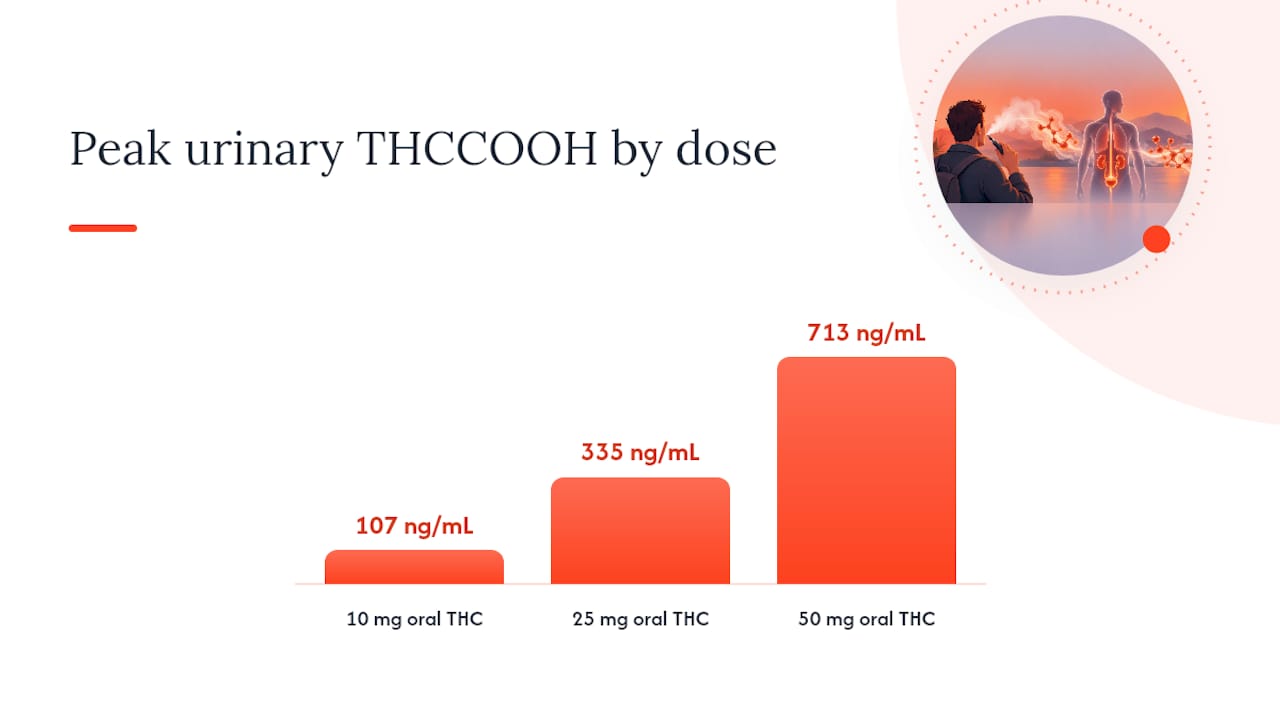
Urine testing dominates workplace and legal screening because it’s cheap, non-invasive, and captures a wider window than blood or saliva. But “days to weeks” hides enormous variability. A pharmacokinetic study on THCCOOH excretion gave oral THC at three doses and tracked average peak urinary concentrations: 107 ng/mL at 10 mg, 335 ng/mL at 25 mg, and 713 ng/mL at 50 mg, with peaks arriving around 6 to 9 hours post-dose. Triple the dose, and peak metabolite concentration jumps more than sixfold. Dose matters that much.
Here’s the part almost nobody explains clearly: a screen and a confirmation are two different tests with two different cutoffs.
- Step one, the immunoassay screen, flags anything at or above 50 ng/mL as presumptively positive.
- Step two, confirmatory testing using GC/MS or LC/MS/MS, requires the metabolite to register at or above 15 ng/mL to report a confirmed positive, per DOT Rule 49 CFR Part 40.
- Anything below 50 ng/mL on the initial screen gets reported negative and typically never reaches confirmatory testing at all.
That gap between the screening and confirmatory cutoffs exists on purpose. It reduces false positives while still catching genuine recent use. If you want a deeper breakdown of how these windows shift with frequency of use, the urine detection timeline guide walks through daily versus occasional use patterns in more detail, and the hair follicle detection timeline covers the much longer lookback window that hair testing creates.
One more warning worth repeating here: drugstore or online home kits often use different cutoff concentrations than federally regulated labs, and they’re immunoassay screens only, with no confirmatory step. A negative home result is a reassuring data point, not proof you’d pass an actual DOT or employer-mandated lab test.
What Changes Your Personal Detection Window
No two people clear THC‑COOH at the same rate, and the factors driving that variation fall into four rough categories.
Dose and frequency of use matter more than almost anything else. Someone who used THCA flower once at a party clears metabolites far faster than someone smoking daily for months, because chronic use lets THC accumulate in fat tissue and leach back into the bloodstream over weeks.
Route of administration changes both timing and, somewhat counterintuitively, magnitude. Inhalation produces a fast spike and relatively fast metabolite clearance for occasional users; oral ingestion (edibles, tinctures) produces a slower, more delayed THCCOOH curve because it has to pass through the liver first. Neither route is inherently “safer” for testing purposes.
Physiology does a lot of the heavy lifting behind why identical doses produce different results in different people:
- Body fat percentage, since THC metabolites are lipophilic and store in fat tissue
- Metabolic rate and liver function, which control how fast Δ9‑THC converts to THC‑COOH
- Kidney function and hydration level, which affect urinary concentration
- Biological sex, tied partly to average differences in body composition
Assay variables on the lab’s end also swing results. The screening cutoff a specific program uses (some non-federal programs use lower cutoffs than the standard 50 ng/mL), assay sensitivity, and whether a specimen is diluted all affect whether a borderline case reports positive or negative.
Pro Tip: If you’re worried about a borderline result, don’t rely on gut feeling about “how long weed stays in your system.” Use a home urine check calibrated close to actual lab cutoffs a few days before your test date, and treat the result as informational, not a guarantee.
The Screening and Confirmation Process, Explained
Every federally regulated drug test follows the same two-step sequence, and understanding it removes a lot of the mystery around what a “positive” actually means.
The initial immunoassay screen is fast, automated, and cheap, but it’s not highly specific. It flags any specimen at or above 50 ng/mL for the marijuana metabolite. That threshold was chosen deliberately as a policy tradeoff between catching genuine recent use and minimizing false positives from trace exposure.
Fast fact: Anything that screens positive moves to confirmatory testing using GC/MS or LC/MS/MS, methods precise enough to identify and quantify THC‑COOH down to and below the 15 ng/mL confirmatory cutoff. These methods require hydrolyzing conjugated metabolites before extraction, which is part of why confirmation takes longer and costs more than the initial screen, and why lab reference protocols treat sample prep as critical to accuracy.
This is also where the terminology confusion resurfaces. Some lab report templates and regulatory tables label the confirmed analyte “THCA,” meaning the metabolite, not the plant compound, which is exactly why so many people panic seeing that abbreviation on paperwork.
If a confirmed positive comes back, a Medical Review Officer (MRO) reviews the result before it reaches your employer. The MRO will ask about prescriptions, medical cannabis authorization where applicable, and any explanation you want to offer. Passive exposure claims are rarely accepted at federal cutoffs without corroborating evidence, so “I was just in the room” typically doesn’t hold up on its own.
Detox Drinks, Flushing, and Dilution: Why the Shortcuts Fail
There’s no scientifically supported way to instantly flush THC‑COOH out of your system. Metabolite clearance follows biological timelines tied to fat storage and liver processing, and no drink, tea, or supplement speeds that up on demand.
Here’s what commonly marketed shortcuts actually do, and why they backfire:
- Excessive water loading dilutes urine enough to lower creatinine and specific gravity outside normal ranges, which labs flag as a “dilute” specimen rather than a clean negative.
- Detox drinks and cleanses rely mostly on the same dilution mechanism dressed up with vitamins, and offer no evidence of accelerating actual metabolite clearance.
- Adulterants (bleach, niacin megadoses, various additives) risk producing an “invalid” result, which most testing policies treat the same as a missed or refused test, sometimes triggering an automatic retest under direct observation.
The practical risk here isn’t just failing. It’s turning a manageable situation into a documented refusal-to-test, which under many workplace policies carries harsher consequences than an honest positive.
Your Pre-Test Action Plan
If a test is on the calendar, work through these steps in order rather than scrambling at the last minute.
- Stop all cannabinoid products immediately, including raw THCA, edibles, and vape products. Every day of abstinence works in your favor.
- Identify the exact specimen type your test uses (urine, hair, oral fluid, or blood) and whether it’s a federally regulated DOT test or a private employer panel, since cutoffs and consequences differ.
- Run a home pre-check a few days out to get a rough read, understanding it’s a screening estimate, not a lab-grade confirmation.
- Keep product packaging, receipts, or a doctor’s note if you used a legal hemp-derived or medically authorized product, in case an MRO conversation becomes necessary.
- If you get a positive screen, ask about the confirmatory testing and appeal process, and be straightforward with the MRO about any legitimate product use rather than guessing at explanations.
Pro Tip: Treat a home urine test as a smoke detector, not a fire extinguisher. It tells you there’s a problem in time to act. It does not put the problem out.
How Passmydrugtest Products Fit Into This Process
The site offers home urine and saliva test kits, hair detox shampoo, and detailed guides covering similar scenarios, aimed at helping people understand their situation before a real lab test. A home urine kit can help you check your status a few days before testing. Hair detox shampoo is promoted as a preparatory step ahead of a hair follicle collection, not a substitute for time and abstinence. None of these products override biology or guarantee a lab result. They’re tools for reducing uncertainty and making an informed decision, which is a meaningfully different promise than a guaranteed pass, and one this article has tried to keep straight throughout.
A Pragmatic, Compliance-First Take on THCA Testing
The instinct to search for a workaround is understandable, but the evidence consistently points the same direction: abstinence and accurate timing beat every shortcut on the market. What matters more than any product is honesty with yourself about your usage pattern, honesty with an MRO if a result comes back positive, and realistic expectations about what a home test can and can’t tell you. Compliance isn’t the exciting answer, but it’s the one that actually holds up under a confirmatory GC/MS run.
— MIchael
Get Ready Before Test Day, Not After
The site provides a place to check your status before a lab sees your sample, rather than relying on forum advice or outdated flush myths. The main product catalog covers home urine, saliva, and hair testing options plus detox shampoo, all with fast US shipping and phone support if you need help picking the right fit for your specific test scenario.
If a hair follicle test is what you’re facing, hair detox shampoo is built specifically for that pre-collection window. If it’s a standard urine screen, a home urine test kit gives you a real read days before the actual test instead of relying on guesswork about your personal timeline. Either way, the smartest move is checking your status early enough to actually do something about it. Browse the catalog, pick the kit that matches your test type, and give yourself the lead time a confirmatory lab result doesn’t offer.
Sources
- Urinary excretion profile of THCCOOH following smoked and vaporized cannabis (PMC)
- DOT Rule 49 CFR Part 40 Section 40.85
FAQ
How to Flush THCA Out of Your System?
There’s no scientifically proven way to instantly flush THC metabolites from your body. Water loading only dilutes urine, which labs can flag as a dilute specimen rather than a clean negative, and time combined with abstinence remains the only reliable path to clearing THC‑COOH.
Why Shouldn’t You Smoke THCA?
Smoking THCA decarboxylates it into Δ9‑THC almost instantly, which your liver then converts into THC‑COOH, the exact metabolite standard drug tests detect. Unlike raw THCA, smoked or vaped THCA carries a real, measurable risk of a positive result, with one controlled study finding positive rates as high as 47% in vaporized sessions under federal testing cutoffs.
Is THCA Considered a Drug?
THCA itself is non-intoxicating and legally treated differently from Δ9‑THC in various jurisdictions, but its legal status gets complicated because heating it produces active THC. Employers and testing programs generally care about the metabolite THC‑COOH showing up in your system, not whether the product you used was labeled “THCA” or “THC” on the package.
Does THCA Show Up on a Standard Drug Test?
Standard drug tests don’t screen for plant THCA directly. They screen for THC‑COOH, the metabolite your body produces after THCA converts to Δ9‑THC through heat and metabolism, which is why heated THCA products carry real testing risk despite THCA’s non-intoxicating reputation.
Can THCA Flower Pass a Drug Test?
Raw, unheated THCA flower carries lower conversion risk than smoked or vaped flower, but nothing guarantees a pass. Storage conditions, digestive processing, and even minor combustion during handling can trigger partial decarboxylation, and a home urine check is the only way to get a real read on where you personally stand before a lab test.