
PCP Detection Time: How Long It Shows on Drug Tests
PCP (phencyclidine) is usually detectable in urine for about 2 to 8 days after last use, according to Mayo Clinic Laboratories. Other lab references give somewhat different ranges, and heavy or chronic use can stretch the window. Blood and saliva cover hours to a few days, and hair can reach back about 90 days. Below, each test type is laid out with the sources behind the numbers, so you can see where your own situation falls before a screening.
If you came here from the THC side of drug testing, the logic is the same: every substance has a window, and the test type and your own body decide how long it stays open. We cover that window for PCP here, and our guides cover marijuana urinalysis detection times in the same way.
TL;DR
- Urine: the most common test. Lab references put the PCP window at roughly 1 to 10 days, with Mayo Clinic Laboratories citing 2 to 8 days. Chronic use can push it toward 30 days.
- Blood and saliva: short windows. Blood is hours, saliva is about one to two days, sometimes up to 3 or more.
- Hair: the longest window, up to about 90 days for a standard scalp sample.
- Your window is not a fixed number: dose, how often you use, metabolism, body mass, age, health and urine pH all move it.
- False positives exist: some common medications can trigger a PCP screen, which is why a positive should be confirmed by a second, more specific test.
Table of Contents
- What a PCP drug test actually looks for
- PCP detection time in urine
- Blood, saliva, hair and sweat
- What changes your personal window
- Is two days enough?
- Why a positive is not always PCP
- If you are preparing for a test
- Find the right product for your test
- FAQ
- Sources
What a PCP drug test actually looks for
PCP is part of the standard 5-panel test, often called the SAMHSA-5. SAMHSA is the federal agency that sets the panel used in federal and many private workplace programs. The five drug classes on it are marijuana (THC), cocaine, opiates, amphetamines and PCP. So if an employer orders a standard 5-panel urine test because of THC, PCP is on the same cup whether or not anyone expects it.
Urine screening typically works in two steps, as described in a 2016 review in the National Library of Medicine’s PMC archive. First comes an immunoassay, a quick chemical test that reacts to the drug or its by-products. A positive is then confirmed with gas chromatography-mass spectrometry (GC-MS), a lab method that identifies the exact molecule. Newer liquid chromatography methods can skip the first step.
The screening cutoff matters. A Lab Blue provider policy describes PCP immunoassays as typically set at 25 ng/mL. A cutoff is the concentration below which the lab reports a negative, even if a trace is present. Our explainer on federal drug test cutoff levels shows how cutoffs work across the panel.
PCP detection time in urine
Urine is the test most people face, so this is the number most readers want. The published figures vary, and the spread is itself useful information:
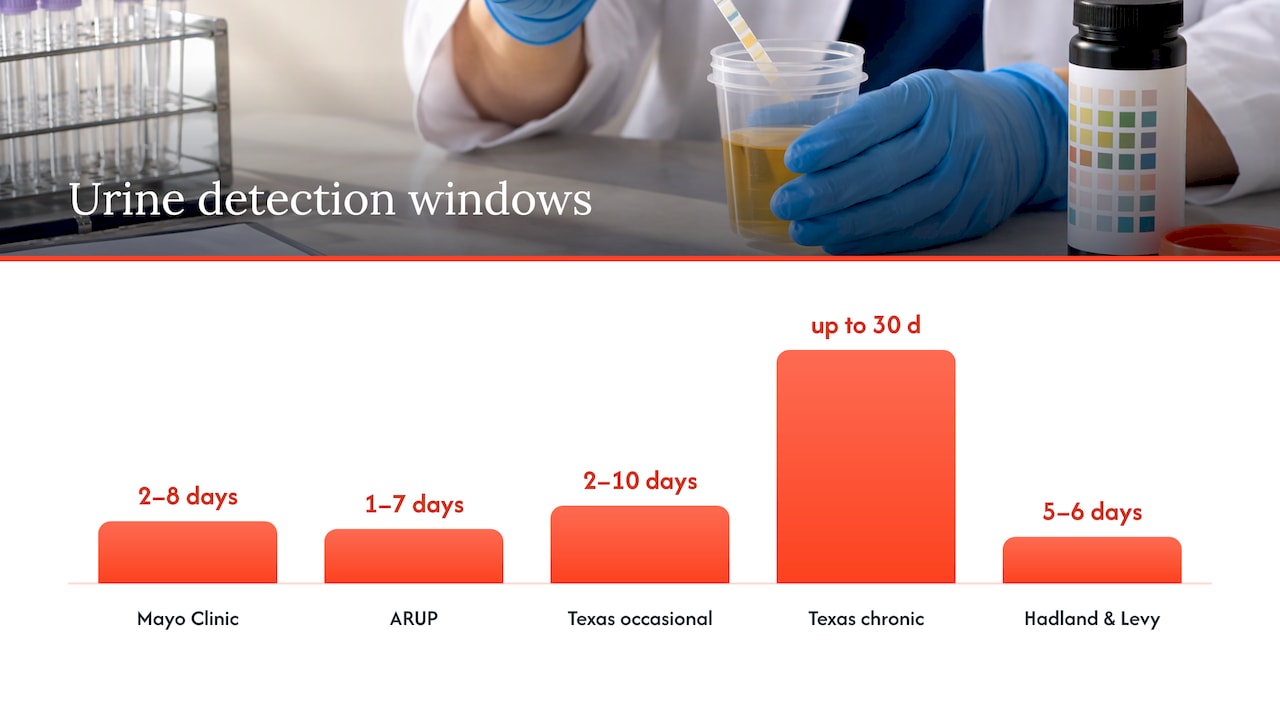
- Mayo Clinic Laboratories: a result above the 25 ng/mL limit of quantitation indicates exposure within about 2 to 8 days before collection. Its page gives an average clearance half-life of 15 hours.
- ARUP Laboratories (October 2023 reference table): a plasma half-life of 7 to 46 hours and a urine detection window of 1 to 7 days, described as estimates affected by many factors. Its table is here.
- Texas DFPS handbook appendix (June 2010): 2 to 10 days in urine, and up to 30 days in chronic users, drawing on a national testing lab’s table, in the state agency’s detection periods chart.
- Hadland and Levy (2016): about 5 to 6 days in urine, in the same PMC review.
Put together, a single occasional use most often falls somewhere in the first week. Repeated or heavy use is the situation where the longer end of the range, up to a month in the Texas table, comes into play.
A half-life is the time it takes your body to clear half of the drug in your blood. With a 15-hour half-life, the amount falls by half roughly every 15 hours. That is why the window depends so heavily on how much you started with. A larger dose has more halvings to go before it drops under the cutoff.
A worked example
Suppose two people take the same test. One used PCP a single time. The other used it several times a week for months. Both have the same 15-hour half-life. The first person starts with a modest amount to clear, so the level can drop under 25 ng/mL within days. The second person’s body has stored the drug over time, so the same halving takes much longer to reach the same cutoff. This is why one published number can never promise a result for you. The labs themselves say so: the Mayo Clinic page ties the actual detection time to dose, frequency and individual metabolism.
Blood, saliva, hair and sweat
Urine is not the only option. Employers, courts and treatment programs choose the test to fit the question they are asking.
| Test | Typical PCP window | What it tells the tester |
|---|---|---|
| Urine | About 1 to 10 days (up to 30 days in chronic use) | Recent use, within roughly the last week or so |
| Blood | Hours, commonly 1 to 12 hours | Use very close to the test; also used in emergencies |
| Saliva | About 1 to 48 hours, some references up to 3 days | Use within the last day or two |
| Hair | Up to about 90 days | A pattern of use over roughly three months |
| Sweat | About 7 to 14 days (one review) | Use over the wear period of a patch |
The blood and saliva figures come from the PMC review, which says blood testing generally detects use within 2 to 12 hours and oral fluid contains the drug or its metabolite for about 24 to 48 hours. The Texas DFPS table lists 1 to 48 hours for saliva and up to 90 days in hair, with a year for body hair. Hadland and Levy report up to 90 days in hair and 7 to 14 days in sweat. Different labs list slightly different saliva figures, and one review lists oral fluid as not applicable for PCP, which is a reminder that these tables are estimates rather than guarantees.
Hair tests in more detail
A hair test reads a strip of hair near the scalp. A standard 1.5-inch sample covers roughly three months of use, according to the PMC review. Drug use does not show up right away: the same review says metabolites can appear in hair as early as about a week after use, and the Texas appendix says hair takes about two weeks. That means a hair test does not catch use from the past few days, but it does cover a long stretch before that.
Hair results also depend on the hair itself. The PMC review notes that sweat can move metabolites along the shaft, second-hand smoke can get drugs into hair, dark hair with more melanin can hold higher concentrations, and bleaching or coloring can change the measured levels. If a hair test is coming up, our guides on hair drug test detection times and the hair follicle drug test walk through how the process works.
What changes your personal window
No table can tell you your exact number. SAMHSA’s Clinical Drug Testing in Primary Care guide lists the factors that matter:
- the chemical properties of the substance and how it is taken (route of administration)
- how often and how much you use
- your metabolism and how your body excretes the drug
- your health, diet, weight, gender and fluid intake
- your genetics, which affect how quickly you break drugs down
- the test’s sensitivity and the cutoff concentration the lab uses
The Texas DFPS appendix adds age and urine pH. It also notes that urine takes about 6 to 8 hours after use before a drug is metabolized and excreted, which is why a urine test taken within hours of use is not the same as one taken a day later.
Two of these deserve emphasis for readers who also use THC. First, frequency: the longer-use ranges apply to regular users, just as they do for marijuana. Second, the cutoff: a lab that uses a lower cutoff can see a trace for longer than a lab with a higher one. Neither of these is something you can see from the outside, which is why a published average is a starting point and not a promise.
Is two days enough?
For PCP, two days is not a safe assumption. Mayo Clinic Laboratories says a result above the cutoff indicates exposure within 2 to 8 days before collection. ARUP’s range runs to 7 days and the Texas table to 10 days, with chronic use stretching longer. Two days sits at the very bottom of what any of these sources describe, and it is only the realistic lower end for a single, small exposure.
The same reasoning applies to the 19 or 20 days of abstinence some readers mention in forums: that is beyond most single-use urine windows, but chronic use and the hair test are different stories. A hair test looks back about 90 days, so a few weeks of abstinence does not clear the lookback period.
Why a positive is not always PCP
The PCP immunoassay is known for reacting to other compounds. The PMC review notes that dextromethorphan, an ingredient in many cough medicines, can cause a false positive. The Lab Blue provider policy adds tramadol, alprazolam, clonazepam and carvedilol to the list of compounds that can interfere, and says positives should be confirmed by GC-MS.
This is a safety point as well as a testing point. If you take any prescription or over-the-counter medication, tell the lab or the medical review officer (the physician who reviews positive workplace results) before the screening. Bring the prescription or the product label. A confirmed GC-MS result is specific to the molecule, so a screening positive caused by a cough syrup does not carry through to the confirmation. Your doctor or pharmacist is the right person to ask about any particular medication you take.
If you are preparing for a test
The most useful preparation is knowing which test you face and how long you have. A urine cup, a saliva swab and a hair sample each have different windows, so the first question is which one your employer, probation officer or program uses. The order of steps below is simple.
- Find out the test type. Urine, saliva, hair and blood have very different lookback periods, as shown in the table above.
- Count back from the collection date, not from today. Use the longer end of the range if you use regularly.
- List every medication and supplement you take, and bring that list to the collection site so a screening result can be interpreted correctly.
- Match the product to the test. A kit designed for hair is not designed for urine or saliva.
We stock urine, saliva and hair testing categories, along with a hair detox shampoo, so the product you look at lines up with the test on your paperwork. If you are not sure which fits, our phone team can help you sort it out during published business hours.
We are asked about PCP less often than THC, but the questions behind them are the same: how long, which test, and what should I do now?
Our approach is to give people the specific numbers from lab sources and then be honest that a published average is a range and not a prediction. That is why we publish educational guides alongside our products. Someone facing a workplace, legal or pre-employment screening makes better choices when they understand the test first.
The second half of the job is matching a person to the right product for their situation. A person with a hair test needs a different path than a person with a urine test, and a person using several substances needs to think about the whole panel, not just one drug. Our curated selection and live phone support are designed for exactly that decision, and fast shipping within the United States helps when the date is close.
MIchael
Find the right product for your test
Our site brings the testing categories together in one place: urine, saliva and hair drug testing, plus a hair detox shampoo. Browse the urine drug testing and saliva drug testing categories, or the hair drug testing and hair detox shampoo pages, depending on the sample you will give. We ship quickly within the United States, and you can call us during our published business hours if you want help choosing.
If you want to see how a similar window works for THC, read our guide to the weekend smoker and a 50 ng/mL urine test. It uses the same cutoff logic described above.
FAQ
How long does PCP stay in your system?
It depends on the test. Urine references run from about 1 to 10 days, with up to 30 days after chronic use in one state agency table. Blood is measured in hours, saliva in one to a few days, and hair up to about 90 days. Dose, frequency and metabolism change where you land in those ranges.
Does a 5-panel drug test include PCP?
Yes. The SAMHSA-5 panel covers marijuana, cocaine, opiates, amphetamines and PCP. A standard urine screen uses an immunoassay first and confirms any positive with GC-MS.
Can cough medicine cause a false positive for PCP?
It can. Dextromethorphan, found in many cough and cold products, is documented as a cause of false-positive PCP screens, and several prescription drugs can interfere too. Tell the lab or medical review officer what you take, and expect a positive screen to be confirmed by GC-MS.
Is two days enough to clear PCP from urine?
Not reliably. Mayo Clinic Laboratories puts a result above the cutoff at exposure within 2 to 8 days before collection, and other labs list up to 7 to 10 days. Regular or heavy use can take longer.
Sources
- Phencyclidine (PCP), Mayo Clinic Laboratories
- Drug plasma half-life and urine detection window, ARUP Laboratories, October 2023
- Appendix 1922.1: Detection Periods for Abused Substances, Texas DFPS
- Objective Testing: Urine and Other Drug Tests, PMC, 2016
- Clinical Drug Testing in Primary Care, SAMHSA
- Prescription Medication and Illicit Drug Testing in the Outpatient Setting, Lab Blue, 2023