
Oxidant Test in a Urine Drug Screen: What It Flags
An oxidant test is a check on your urine sample, not on your THC level. It looks for oxidizing chemicals such as nitrite, bleach, iodine or chromium compounds that do not belong in normal urine. If you are preparing for a urine screen, the useful question is not “how do I get past this check?” but “what is this lab checking, and which preparation choices keep my sample looking like ordinary human urine?” At Pass My Drug Test we sell urine, saliva and hair test products and kits, and our phone team can help you match a product to your specific test, so you are not guessing about what a lab will look at.
TL;DR
- The oxidant test is part of specimen validity testing: it checks whether something was added to urine after collection. It does not measure THC.
- Normal human urine contains almost no oxidants. Labs treat roughly 200 µg/mL of oxidant as abnormal and 500 µg/mL of nitrite as adulteration.
- An oxidant flag is not the same as a drug result, and it is not automatic proof of tampering. A medical review officer (MRO) reviews it before anything is reported to an employer.
- Oxidant additives sold as “cleansers” are exactly what this test was built to catch. Choose preparation products for your actual test type and talk to us before you order.
Table of Contents
- What an oxidant test actually checks
- The numbers behind the cutoffs
- What happens after a flag
- Can anything innocent trip an oxidant test?
- Why oxidant “cleansers” are the wrong direction
- A practical plan before a urine screen
- Where Pass My Drug Test fits
- Our perspective
- FAQ
- Sources
What an oxidant test actually checks
When a lab receives a urine sample, it does two jobs. First it looks for drugs. Then it asks whether the sample is a real, unaltered specimen. That second job is called specimen validity testing, which means detecting adulteration (something added), dilution (too much water) or substitution (someone else’s urine or a synthetic product). According to the RTI National Laboratory Certification Program, initial urine validity testing includes pH, creatinine and oxidants.
The general oxidant test is a colorimetric assay run on an automated analyzer. It does not name the chemical. It just signals that an oxidizer is present, and results are reported as nitrite equivalents in µg/mL. The same RTI article lists the oxidizing adulterants it can flag: nitrites, chromium (VI) compounds, halogens such as bleach and iodine, and glutaraldehyde. These substances interfere with the immunoassay (the first-pass screening chemistry) or chemically alter drugs and metabolites so they are harder to detect.
The federal rulebook makes the check routine. The HHS Urine Mandatory Guidelines, summarized in SAMHSA’s 2025 guidance for medical review officers, require creatinine and pH on every federal urine specimen, specific gravity when creatinine is below 20.0 mg/dL, and at least one test for oxidizing adulterants. Many private-sector labs run the same panel, so you should assume it is part of your screen even if your employer is not federally regulated.
Why THC users hear about oxidants so often
The oxidant check exists largely because of marijuana. A university interpretive summary on specimen validity and cross-reactivity explains that oxidants and pyridinium chlorochromate are added to a specimen after collection and are aimed mainly at altering the structure of THC-COOH, the metabolite urine tests look for. It also states that normal human urine should not contain oxidants at all.
That is the key point for you. A urine THC screen is looking for a metabolite your body made. The oxidant test is looking for a chemical someone put in the cup. They are separate questions, and the lab answers both.
The numbers behind the cutoffs
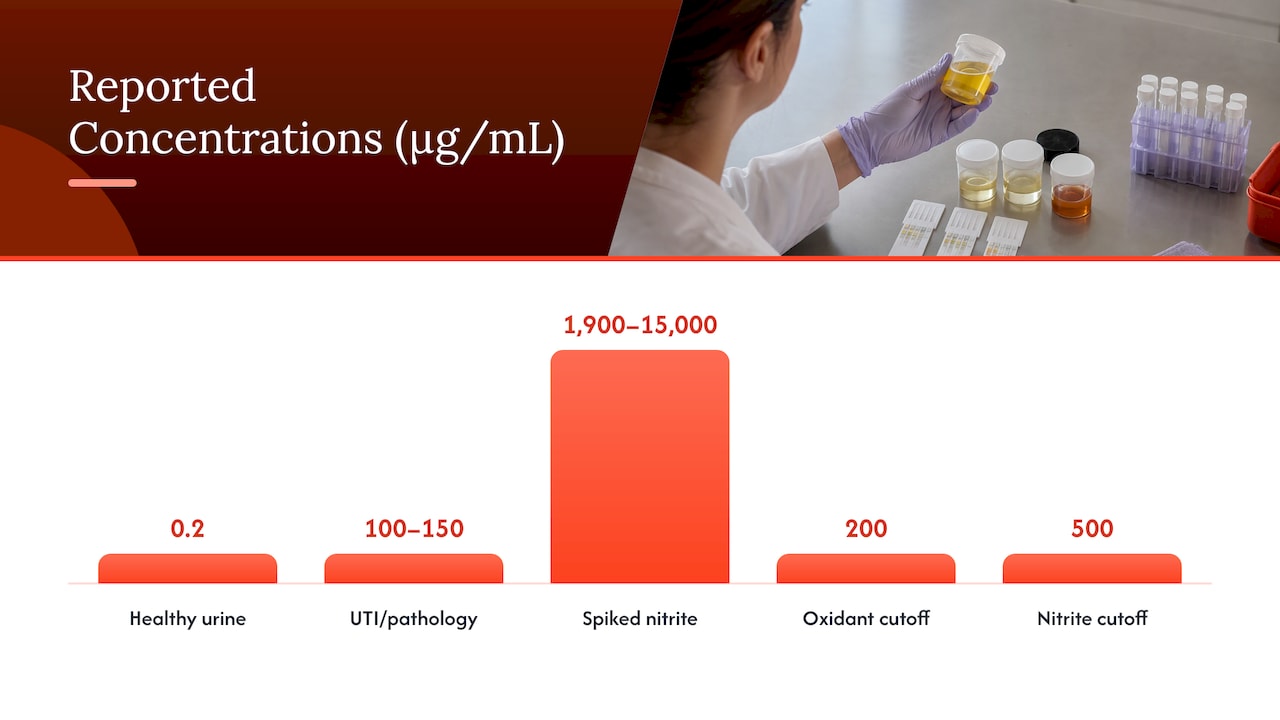
The thresholds are not arbitrary. The manufacturer’s insert for the DRI General Oxidant-Detect test cites a study of healthy volunteers whose urine averaged 0.2 µg/mL nitrite. People with urinary tract infections or other pathology can reach 100 to 150 µg/mL. Urine spiked with a nitrite product contained 1,900 to 15,000 µg/mL. That gap is why a line at 200 µg/mL is considered defensible: it sits above anything the body normally produces and far below what an additive delivers.
Here is how the main figures line up:
| Measure | Figure | What it means |
|---|---|---|
| Typical healthy urine nitrite | about 0.2 µg/mL | Essentially none |
| Oxidant at or above 200 µg/mL | Reported as invalid by one major lab | Higher than normal physiology explains |
| Nitrite at or above 500 µg/mL | Reported as adulterated, per the same lab FAQ | Treated as an added substance |
| Oxidant cutoff in a reference lab’s adulterant panel | 200 mg/L oxidant, 500 mg/L nitrite | Same thresholds, different units (mg/L equals µg/mL) |
The federal rule for nuclear-industry testing, 10 CFR 26.161, adds that an adulterated, substituted, dilute or invalid result must rest on an initial test of one aliquot (a portion of the sample) and a confirmatory test on a second. The RTI article notes that few labs keep specialized confirmation methods and usually repeat the general oxidant test on a fresh aliquot. Consistent results on the second portion allow the lab to report the specimen as invalid.
Note what the test does not catch. The DRI insert says oxidants added to urine cause no meaningful change in appearance, pH, specific gravity or creatinine. So a sample can look completely ordinary and still be flagged, because the oxidant assay is the check designed for exactly that case.
What happens after a flag
A flag does not go straight to your employer as a verdict. Only HHS-certified laboratories may report specimens as positive, adulterated, substituted, invalid or dilute, and a medical review officer reviews every one of those results. SAMHSA’s 2025 MRO guidance describes the MRO’s job: review the result, interview the donor when required, make a determination and report the verified result to the agency.
Two details matter for you:
- Invalid is not the same as adulterated. SAMHSA’s 2025 case studies include a specimen cancelled as invalid because of oxidant activity, with the oxidant reported as chromium (VI) equivalents. The reporting criteria differ by substance and level.
- A lab result is not automatically a finding of tampering. The SAMHSA manual states that an invalid, adulterated or substituted result does not by itself identify a person as having tampered, and that the MRO must consider legitimate medical explanations.
The RTI article adds that invalid results can come from unusual circumstances, such as abnormal pH from how a specimen was stored. It also says the lab usually does not need to work out which strategy produced an adulterated oxidant result, since adulteration and substitution both count as subversion.
The stakes depend on your test. For a DOT-regulated job, our explainer on why 49 CFR 40.3 treats an adulterated result as a refusal covers the consequence. If you hold a safety-sensitive commercial role, speak with your employer’s designated employer representative or a qualified attorney about your rights, rather than relying on a general article.
Can anything innocent trip an oxidant test?
Sometimes, yes, which is one reason the MRO step exists. The Siemens oxidant test insert states that urine from people taking concentrated cranberry-extract supplements may read positive, and that some oxidizing agents diminish over time in a sample. It also notes that high levels of antioxidants such as ascorbic acid (vitamin C) can interfere, and the OHSU summary says they may produce false negative oxidant results.
If you take cranberry concentrates or large doses of vitamin C, write them down before your test and tell the MRO if you are asked. Disclose all medications and supplements during the MRO interview; that conversation is where legitimate explanations are weighed.
A separate topic is false positives on the drug screen itself, where common medications and foods can cross-react with the immunoassay. We cover that in our guide to false positive drug testing. An oxidant flag and a false positive are different events: one concerns the integrity of the sample, the other concerns what the drug assay reacted to.
Why oxidant “cleansers” are the wrong direction
The DRI insert names the oxidants most commonly sold to clear a THC result: nitrite, chromate, iodine, bleach and horseradish peroxidase with hydrogen peroxide. It also says oxidant-adulterated marijuana samples can screen positive on the immunoassay yet fail to confirm by GC/MS (gas chromatography-mass spectrometry, the confirmation method). In other words, the lab sees the additive and the mismatch.
If you are preparing for a urine screen, that tells you where the line sits. Anything that puts a chemical into the sample after it leaves your body is the thing this test exists to find. Your preparation is better spent on things that happen before collection and on the specific test you will face: a urine screen, a saliva swab or a hair follicle test each work differently, and a product made for one does nothing for another.
Two related checks are worth understanding at the same time. Creatinine and specific gravity tell the lab whether urine is overly diluted, and our piece on what the 20 mg/dL creatinine cutoff can miss walks through that side of validity testing. Together with pH and the oxidant assay, these make up the usual validity panel.
A practical plan before a urine screen
- Find out what test you are facing. Ask the employer, probation office or clinic whether it is urine, oral fluid or hair, and whether it is a federal (HHS) or private panel. Federal programs follow the guidelines above. Oral fluid collections are observed, so the RTI article notes no validity testing is currently required for them.
- Match your preparation to that sample type. Urine, saliva and hair each have their own products. Our urine drug testing, saliva and hair categories are organized that way.
- Keep your sample free of anything added to it. Because the oxidant assay reacts to added chemicals, avoid any product whose method involves putting an oxidizer into urine.
- List your medications and supplements. Include cranberry concentrates and high-dose vitamin C. You will want them ready for a possible MRO interview.
- Call before you order. Our phone line operates during published business hours, and we ship fast within the United States, so you can sort out the right product without losing time.
- Know the rule changes. A Federal Register proposed rule published October 29, 2026 would raise the invalid-specimen pH cutoff from 9.0 to 9.5. It is a proposal, so check the official page for its status.
Where Pass My Drug Test fits
Our site is built for people who have a test coming and need to choose carefully. We carry urine, saliva and hair testing products, hair detox shampoo, and at-home test kits, alongside detailed guides written for workplace, legal and personal testing in the United States. For urine specifically, start with our clean urine drug test guide and our urine drug test blog archive, then browse the Pass My Drug Test shop for the product that fits your situation.
If you are unsure which category applies to you, call us. Our positioning is simple: in-depth education, a curated selection and live phone support, so you can pick the right product for your particular test.
Our perspective
Most people who write to us about oxidant tests have the same worry: they have heard a lab can see what they did to their sample. The honest answer is that the oxidant assay is a narrow, well-understood chemistry check, and it is aimed at additives.
That shapes how we think about preparation. The first step is always identifying the test: urine, saliva or hair, federal or private. A product is only useful when it is made for the sample type in front of you, which is why we organize our shop that way and publish guides for each scenario.
We built Pass My Drug Test around education first, then a curated selection of products, fast shipping in the United States and live phone support during published hours. If you tell us what test you expect, we can point you to the right category and explain what the lab will look at.
Our aim is for you to walk into your test understanding the process, not guessing at it.
MIchael
FAQ
Does the oxidant test detect THC?
No. It detects oxidizing chemicals such as nitrite, bleach, iodine and chromium compounds, which normal urine should not contain. THC metabolite is measured by the separate drug immunoassay and confirmation tests. The oxidant result is about the integrity of the sample, not your drug use.
What level of oxidant counts as a problem?
One major lab’s validity FAQ reports oxidants or nitrites at 200 µg/mL or higher as invalid and nitrite at 500 µg/mL or higher as adulterated. A reference lab uses the same 200 and 500 mg/L cutoffs. Healthy urine averages around 0.2 µg/mL nitrite, so these lines sit far above normal.
Is an oxidant flag proof that I tampered with my sample?
Not by itself. SAMHSA’s guidance says invalid, adulterated or substituted results do not automatically identify tampering, and an MRO reviews the result and interviews you when required. Tell the MRO about any medications or supplements, including cranberry concentrates and high-dose vitamin C.
Do all drug tests include an oxidant check?
Not all. Federal urine programs must include at least one oxidant test. Per the RTI program, oral fluid collections are observed, so validity testing is not currently required for them. Private employers set their own panels, so ask which test and panel applies to you.
Sources
- RTI NLCP: An Introduction to Specimen Validity Testing
- SAMHSA Medical Review Officer Guidance Manual 2025
- OHSU interpretive summary of cross-reactivity and specimen validity
- DRI General Oxidant-Detect Test package insert
- Labcorp specimen validity testing FAQ
- Mayo Clinic Laboratories ADULT adulterants survey
- eCFR 10 CFR 26.161 validity testing cutoffs
- SAMHSA 2025 MRO Case Studies, Urine
- Federal Register proposed rule, October 29, 2026