
Colorado Marijuana Testing Laws: What Employers Can Test For
Colorado voters legalized adult cannabis use, but that did not stop employers from testing for THC. Since January 1, 2023, a Colorado employer also cannot fire you or refuse to hire you solely for lawful off-duty, off-premises cannabis use. Those two facts sit side by side, and the gap between them is where most test-takers get caught. If a test is coming, you need to know which rules cover your job and which kind of test you will face. Our guides and product selection at Pass My Drug Test are built around that decision.
TL;DR
- Colorado does not prohibit private employers from drug testing, and the state’s cannabis agency says employers may test for THC and make employment decisions based on results.
- Under HB22-1317, effective January 1, 2023, employers may not fire or refuse to hire someone solely for off-duty, off-premises cannabis use.
- Federal DOT rules override state law for covered safety-sensitive jobs, and marijuana remains prohibited there. A Colorado medical card does not change that.
- A urine test shows past use, not impairment, so the test type you face matters as much as the law.
Table of Contents
- Is marijuana legal in Colorado, and does that stop workplace testing?
- When Colorado employers can test
- What changed in 2023: HB22-1317
- Why the type of test matters
- Medical marijuana cards and federal jobs
- A practical plan if you have a test coming
- Preparing for your test with Pass My Drug Test
- Our perspective
- FAQ
- Sources
Is marijuana legal in Colorado, and does that stop workplace testing?
Colorado legalized recreational cannabis for adults 21 and older in November 2012 through Amendment 64. The state’s cannabis agency summarizes the rules on possession and public use: adults can buy and possess limited amounts, and using it in public is illegal.
Legal for adults does not mean protected at work. When voters passed Amendment 64, they left employers free to decide whether to allow cannabis use and whether to test. The state agency’s guidance for businesses says employers do not have to allow employees to use cannabis products. The constitutional text itself says Amendment 64 does not require an employer to permit or accommodate marijuana use in the workplace.
There is also no statewide statute that bans private employers from running drug tests. Baker Donelson’s Colorado guide states that Colorado has no law prohibiting drug and alcohol testing by private employers. So the practical answer to “can they test me?” is generally yes.
When Colorado employers can test
Because the state sets no testing triggers for private employers, the policy your employer wrote decides when you get tested. Common situations include:
- Pre-employment, after a conditional job offer
- Random testing, where the employer has an established policy
- After an accident
- On reasonable suspicion of impairment
- Return-to-duty or follow-up testing after a prior violation
Baker Donelson’s guide notes that an employer with an established drug policy can terminate an employee over a positive test, and that privacy rights do not stop termination for refusing a test conducted under a previously established policy. That is why reading your employee handbook matters. The policy is the rulebook.
A few limits still apply. According to the same guide, testing must comply with the Colorado Anti-Discrimination Act and the Americans with Disabilities Act, and a test with a disparate impact must be job-related and consistent with business necessity. The test must be run by a licensed or certified laboratory, and the employer must cover the cost of required testing under C.R.S. § 8-2-118(1).
Local rules can differ. The SMACNA guidelines’ state table notes that the city of Boulder limits testing to cases of reasonable suspicion of on-the-job drug influence. If you work in Boulder, check with the city or an employment attorney how that applies to your job.
What changed in 2023: HB22-1317
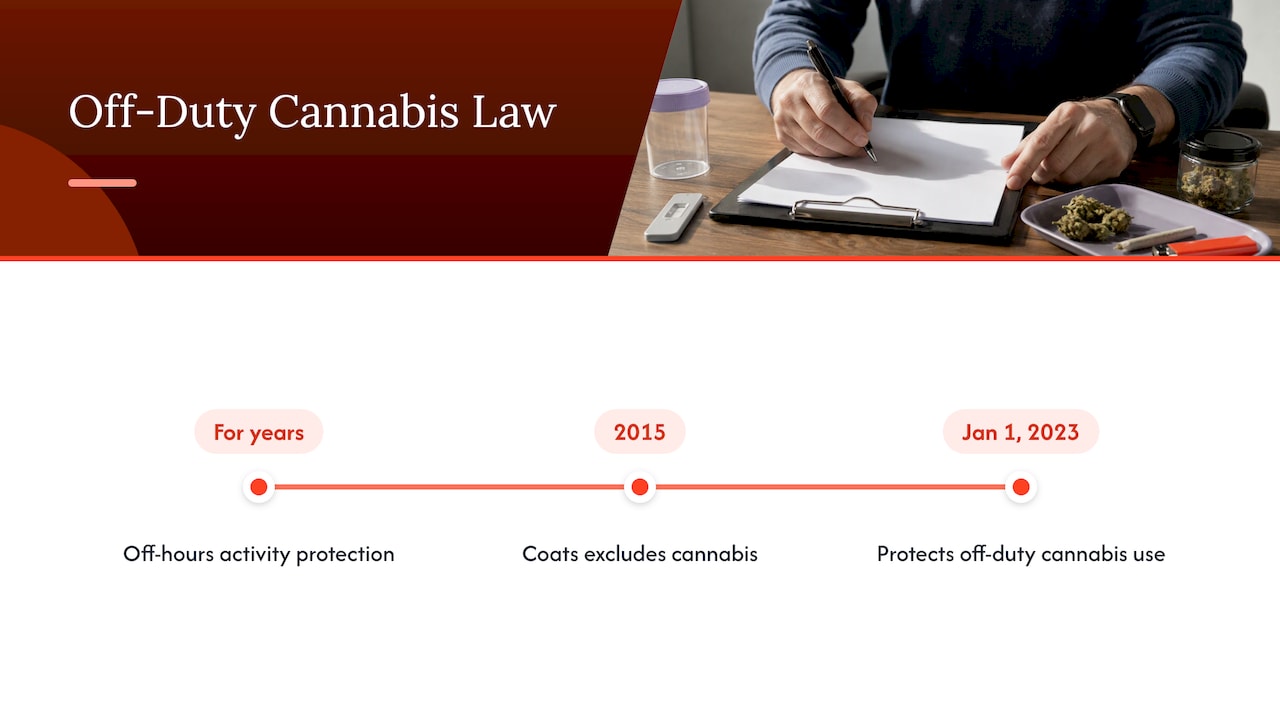
For years, Colorado’s “lawful activities” statute, C.R.S. § 24-34-402.5, made it an unfair employment practice to fire someone for lawful off-premises, nonworking-hour activities. The statute has exceptions. The statute’s text allows a restriction that relates to a bona fide occupational requirement, is reasonably related to the employee’s duties, or is necessary to avoid a conflict of interest. An employee fired in violation can bring a civil action for lost wages and benefits.
The catch was cannabis. In Coats v. Dish Network (2015), the Colorado Supreme Court held that “lawful” in that statute is not limited to state law. Because marijuana remains illegal under the federal Controlled Substances Act, even state-licensed medical use was not a protected lawful activity. The worker in that case, who held a medical marijuana card, lost.
HB22-1317 changed the picture for off-duty use. According to Nolo’s Colorado guide, updated March 2026, the law took effect January 1, 2023, and amended the lawful activities statute to explicitly include recreational cannabis. Employers may no longer terminate or refuse to hire an employee or applicant solely because of off-duty, off-premises cannabis use.
What the law still lets your employer do
The same source says employers may still:
- Prohibit use during work hours or on work premises
- Discipline or terminate employees who are impaired on the job
- Comply with federal requirements for federally regulated or safety-sensitive positions
Nolo also explains the practical consequence for testing. Cannabis can stay detectable long after impairment ends, so a positive test alone does not show on-the-job impairment. An employer that acts solely on a positive result, with no evidence of impairment at work, may face liability under the lawful activities statute.
This is the part many readers miss. The law protects you from being punished for the habit, not from being tested, and it does not remove the exceptions. Disputes tend to turn on facts: what the policy says, what the job requires, and what the employer can show about impairment. If you believe an employer acted against you solely because of lawful off-duty use, talk to a Colorado employment attorney or the Colorado Civil Rights Division before you decide how to respond. This article is general information, not legal advice.
Why the type of test matters
Even with the 2023 protection, a positive result can start a conversation you would rather not have. It helps to know what each test actually detects.
Urine tests, the most common pre-employment screen, look for THC-COOH, an inactive metabolite. A peer-reviewed occupational health guide states that this metabolite can remain detectable for weeks and does not correlate with acute impairment. FindLaw’s state overview adds that no specific test for marijuana impairment exists, and that one-time use can show up in a urine test up to 72 hours later. Regular use can stay detectable much longer.
The same occupational health authors recommend that employers define expected signs of impairment in advance, train supervisors, and use clinical evaluation plus blood cannabinoid testing when impairment is suspected, rather than relying on a urine screen. That reasoning supports the legal point above: a positive urine result is evidence of past use, not of being high at work.
Here is how the main test types compare for a THC user:
| Test | What it looks for | What it tells an employer |
|---|---|---|
| Urine | Inactive THC metabolite | Past use, not impairment |
| Saliva | Recent use of THC | More recent exposure |
| Hair | Metabolites deposited over time | A longer history of use |
| Blood | Active THC levels | Closest to impairment, rarely used for screening |
We sell urine, saliva and hair test products and a hair detox shampoo because these are the formats people ask us about most. Knowing which one your employer uses is the first step in choosing how to prepare.
Medical marijuana cards and federal jobs
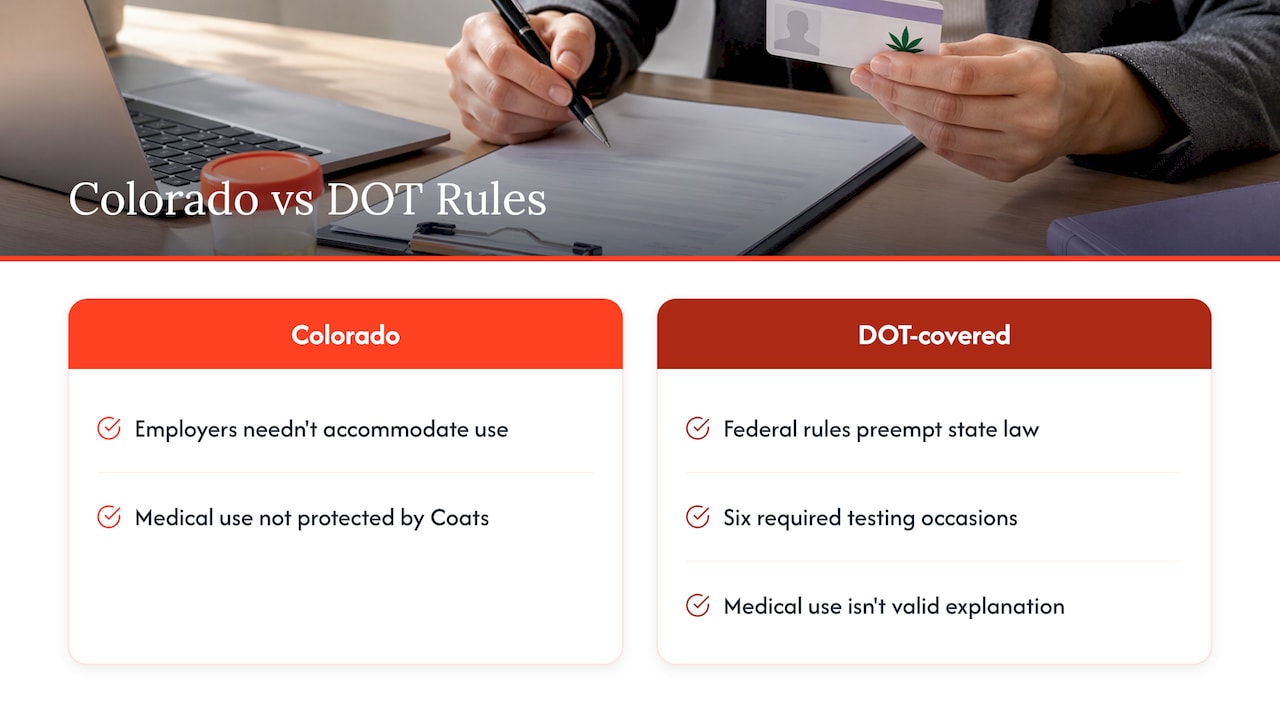
A Colorado medical card does not work as a workplace shield. The Colorado Constitution, in the medical marijuana section, says nothing in it requires an employer to accommodate medical use in any workplace, and Coats held that state-licensed medical use is not a protected lawful activity because it is prohibited federally.
Federal rules go further for covered safety-sensitive work. The SMACNA guidelines explain that DOT regulations expressly preempt state and local law (49 C.F.R. § 382.109). They require pre-employment, post-accident, random, reasonable suspicion, return-to-duty and follow-up testing. Under 49 CFR § 40.151(e), medical marijuana is not a valid medical explanation for a covered employee’s positive result.
If you drive a commercial vehicle, work in aviation, transit, rail, pipelines or another DOT-regulated role, Colorado’s legalization and HB22-1317 do not apply to your test. Our guide to DOT drug test rules, cutoffs and consequences covers what is tested and what follows a positive result. Workers in these jobs should also read about CBD products and drug tests, since safety-sensitive employers apply the rules strictly.
Outside DOT, employers in federally regulated industries and those with contracts that require a drug-free workplace may have their own policy language. Ask HR for the written policy before a test, not after.
A practical plan if you have a test coming
These steps fit a Colorado worker or applicant who uses THC and wants to be ready.
- Find out whether you are DOT-covered. If the job involves a commercial driver’s license or another federally regulated safety-sensitive role, state protections do not apply.
- Read the written drug policy. It should say when testing happens, which substances are screened and what the consequences are.
- Identify the test type. Urine, saliva and hair have very different detection patterns. Ask the employer or the testing site which one you will take.
- Work out your timeline. Detection depends on how often and how heavily you use, and your own body. A single use and daily use are very different situations.
- Choose preparation that matches the test. A product built for a hair test is not the right tool for a saliva test, and the reverse. Our team helps people match products to their scenario.
- Keep records. If an adverse action happens after a positive result, notes about the policy, the date, who you spoke with and any evidence of your performance help an attorney assess whether HB22-1317 applies.
Other states handle this differently. If you travel or relocate for work, compare Colorado with our guides to Washington, Nevada and California.
Preparing for your test with Pass My Drug Test
Our site is one place to research test methods, compare products and order what suits your situation, whether that is a urine, saliva or hair screening. We offer detox products including a hair detox shampoo, along with at-home test kits, and our educational articles explain each format. Orders ship fast within the United States, and you can reach us by phone during our published business hours if you want help matching a product to your test.
Start on our drug testing tips page for guidance by test type, or go to the urine drug testing, saliva drug testing or hair drug testing pages for the format you expect.
Our perspective
Colorado is the clearest example of why “legal” and “safe to test” are different questions. Voters legalized cannabis, the legislature later protected off-duty use, and yet employers keep their testing programs, their policies and their federal obligations. Most of the people who contact us are not confused about the law. They are trying to work out what their particular test will look at.
That is why we pair education with products. A person facing a hair test needs different information than a person facing a saliva screen, and a DOT driver faces rules that no state law can change. We built our guides and our curated selection so you can match your situation to a test type before you spend money, and we keep live phone support during business hours for the questions that do not fit neatly into an article.
Our advice is simple: read your policy, learn your test, and prepare for the format you will actually take.
MIchael
FAQ
Can my Colorado employer fire me for a positive marijuana test?
It depends. Since January 1, 2023, an employer cannot terminate or refuse to hire you solely for lawful off-duty, off-premises cannabis use. The employer can still act if you were impaired at work, used on the premises or during work hours, or hold a federally regulated safety-sensitive job. If you think you were fired only for off-duty use, consult a Colorado employment attorney.
Does a Colorado medical marijuana card protect me at work?
No. Colorado law does not require employers to accommodate medical marijuana use, and in Coats v. Dish Network the state supreme court held that medical use is not a protected lawful activity because marijuana remains illegal under federal law. For DOT-covered jobs, medical marijuana is not an accepted explanation for a positive result.
Do employers have to pay for my drug test in Colorado?
Baker Donelson’s Colorado guide cites C.R.S. § 8-2-118(1) for the rule that the employer must pay the cost of required drug testing. The test must also be done by a licensed or certified laboratory.
How long does THC show up on a urine test?
FindLaw notes that one-time use can appear in a urine test up to 72 hours later, and regular use can be detected for longer. Detection varies by person, frequency of use and test sensitivity, which is why identifying your test type matters.
Sources
- Business and property owners, Colorado Cannabis
- Laws about cannabis use, Colorado Cannabis
- Colorado, Baker Donelson employment guide
- SMACNA substance abuse testing guidelines
- Colo. Rev. Stat. § 24-34-402.5
- Coats v. Dish Network, Colorado Supreme Court opinion
- Colorado Drug Testing Laws in 2026, Nolo
- State Pre-Employment Drug Testing Laws, FindLaw
- Marijuana in the Workplace: Guidance for Occupational Health Professionals