
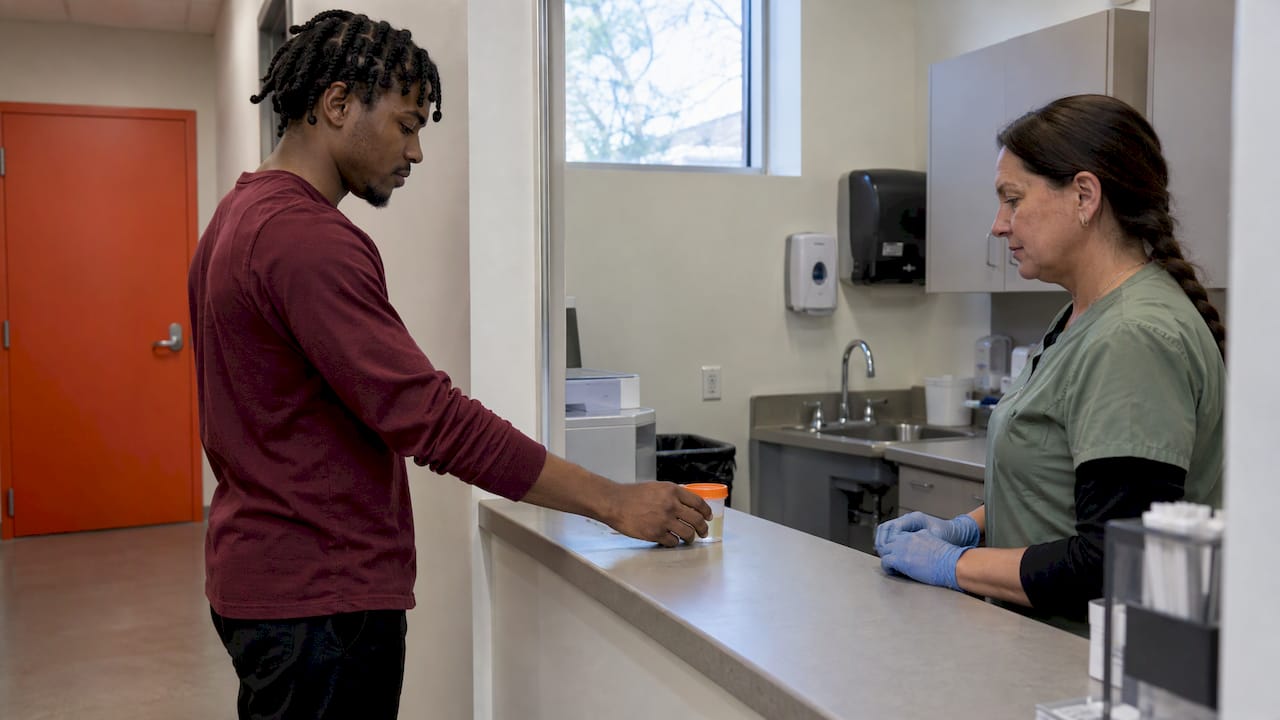
Massachusetts Marijuana Testing Laws: What They Mean for Your Drug Test
Massachusetts has legal cannabis, but it has no comprehensive state law that stops a private employer from drug testing you. The rules come from court decisions, so a pre-employment screen, a reasonable-suspicion test or a post-accident test can still put a THC result in front of your boss. If you use cannabis and a test is coming, the useful question is not whether cannabis is legal. It is which test you will face, who is giving it, and how much time you have to prepare.
This guide separates the two things people mean by “testing laws” in Massachusetts: the rules for testing cannabis products before they are sold, and the rules for testing people. It then shows where THC users stand, and how to choose a preparation plan that fits your test. We sell test kits and hair detox shampoo for exactly this situation, and we point to them where they fit.
TL;DR
- Massachusetts has no comprehensive drug-testing statute for private employers. Rules come from case law, so most employers can still screen applicants and test employees in set situations.
- Recreational use has no workplace protection. Medical marijuana patients may be entitled to reasonable accommodation, but not to on-the-job use or impairment.
- Product testing rules (labs, potency, contaminants) govern what dispensaries sell. They do not change how your own drug test works.
- Match your preparation to the test type: urine, saliva or hair each work differently, and the timeline matters more than anything else.
- Federal rules, such as those covering transportation jobs, override state cannabis protections.
Table of Contents
- Two kinds of “marijuana testing” in Massachusetts
- What Massachusetts employers can test for
- Federal rules override state cannabis protections
- Bills that could change the rules
- What the product testing rules mean for a consumer
- Choosing your preparation plan by test type
- Where our products fit
- Our perspective
- FAQ
- Sources
Two kinds of “marijuana testing” in Massachusetts
Search results for this topic mix two different bodies of law, and it helps to know which one affects you.
Product testing regulates cannabis before it reaches a shelf. Under Massachusetts General Laws chapter 94G, section 15, the Cannabis Control Commission (CCC, the state regulator) sets testing protocols, and no marijuana product may be sold unless an independent testing laboratory has tested it and found it meets them. This is about contaminants and potency, not about you.
Workplace and personal testing regulates what happens when someone asks you for a urine, saliva or hair sample. That is where a THC user’s job, license or custody situation can be affected, and it is the part most readers searching this phrase actually need. We cover it first.
What Massachusetts employers can test for
Massachusetts has no comprehensive drug-testing statute for private employment. According to Nolo’s Massachusetts workplace drug testing guide, the rules come from case law, notably Webster v. Motorola (1994), which held that random testing must be balanced case by case against an employee’s privacy rights.
In practice, that guide describes the following:
- Pre-employment tests: employers may generally require them, as long as they apply the test consistently to applicants in similar roles.
- Reasonable suspicion: employers may test a current employee when there is a reasonable basis to suspect drug use.
- Post-accident tests: testing after a workplace accident is permitted.
- Random tests: usually allowed only for safety-sensitive positions. A blanket random-testing policy that does not distinguish those jobs from every other job is not allowed.
The practical reading for you: if you are applying for an office role, the pre-offer or post-offer screen is the one you are most likely to meet. If you work around machinery, driving or public safety, random testing becomes more likely.
Recreational use gets no workplace protection
Legal cannabis for adults does not mean a protected right to a clean-looking test. Per the same Nolo guide, recreational users have no workplace protections: an employer may discipline or fire an employee who tests positive, even after off-duty use. The guide also notes that a cannabis test can stay positive after impairment has worn off. That is the core issue for a THC user. A test measures what is in your system, not whether you were impaired at work.
Medical marijuana patients have more room, but not unlimited
If you hold a medical marijuana certification and use cannabis to treat a disability, the picture is different. Mass.gov’s medical marijuana law page states that employers are not required to accommodate on-site use. It also says an employee who uses medical marijuana to treat a disability is entitled to reasonable accommodation under state disability discrimination law. Employers with 6 or more employees must accommodate off-site, off-duty use unless an equally effective alternative treatment exists or it would cause undue hardship.
The Supreme Judicial Court addressed this in a 2017 decision. As summarized by the National Law Review, the court found medical marijuana can be a permissible accommodation when it is the most effective medication for the employee’s debilitating condition and any alternative the employer’s policy allows would be less effective. The employer can still try to prove undue hardship on performance or safety.
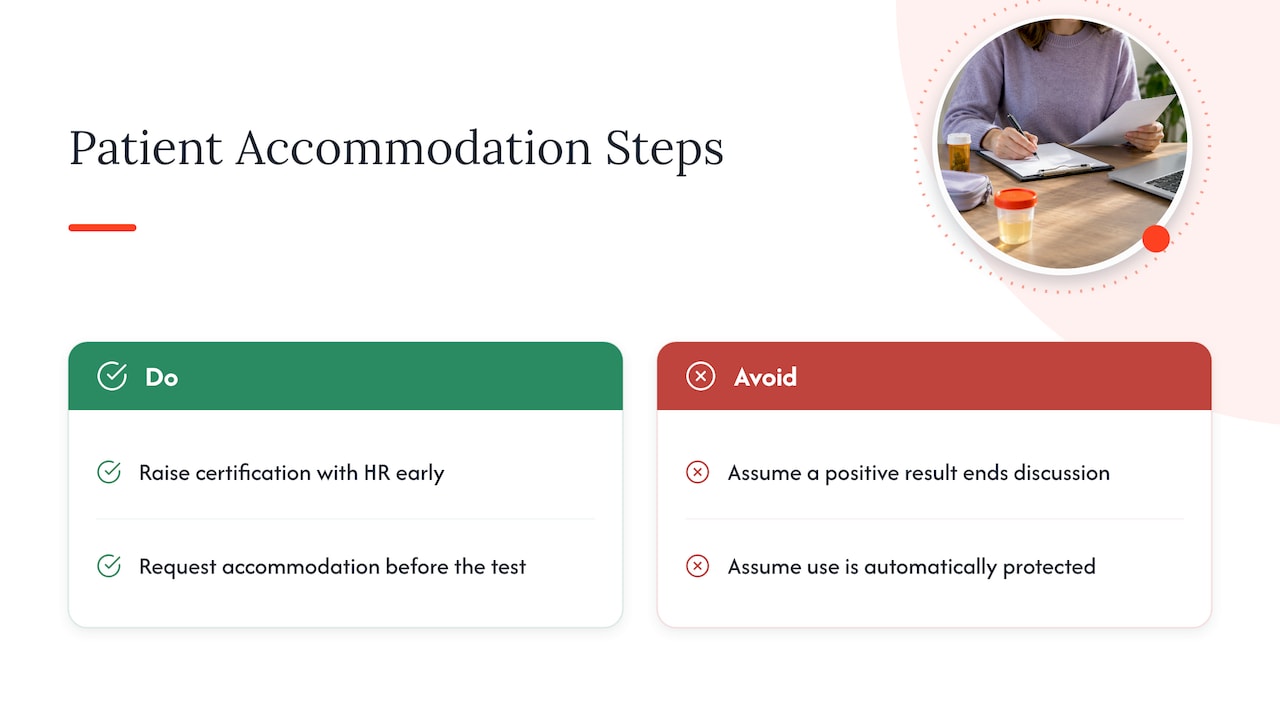
What this means if you are a patient with a positive test coming: do not assume the result ends the conversation, and do not assume it is protected either. Raise your certification and your accommodation request with the employer’s HR department early, ideally before the test rather than after. For a legal question about your own case, an employment attorney licensed in Massachusetts is the right person to see.
Federal rules override state cannabis protections
State cannabis law does not reach every job. Federal contracts and Department of Transportation (DOT) regulations apply regardless of what Massachusetts allows, a point made in LegalClarity’s analysis of the state’s testing landscape. If you drive commercially, work under a federal contract or hold a safety-sensitive federal role, treat any cannabis use as a direct risk to the job, whatever your state card says.
Bills that could change the rules
The same LegalClarity piece describes House Bill 2179, a proposal to protect qualifying medical marijuana patients from being refused hire or punished absent reasonable suspicion of on-the-job impairment. As of early 2026 it had passed its first reading and was awaiting a second reading in the House, so it had not become law. Bills like this move slowly and change, so check the status on the Massachusetts Legislature’s website before you rely on one. Until a bill is signed, plan under the case-law rules above.
What the product testing rules mean for a consumer
The state’s lab rules do not tell you what a test will find in your body, but they do explain what is on the label of what you buy.
Under the CCC’s product catalog guidance, regulated marijuana must pass a state-required panel before sale: heavy metals, pesticides and plant growth regulators, microbiological contaminants and mycotoxins, residual solvents, vitamin E acetate for final vaporizer products, and a full cannabinoid profile including THC. Licensed independent labs issue certificates of analysis, and results are valid for one year.
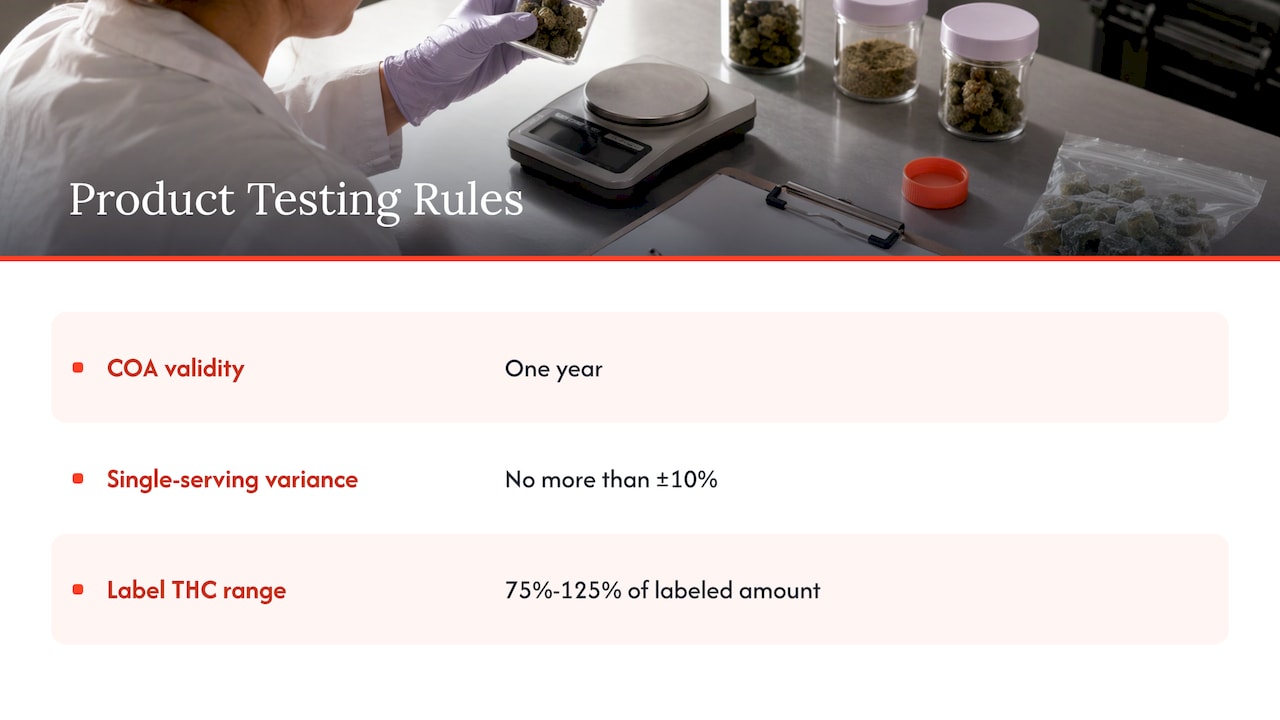
On potency, 935 CMR 500.160 allows a variance of no more than plus or minus 10% for single-servings of tested marijuana products. The CCC announced on May 22, 2026 that it would begin auditing THC potency on labels. A product whose THC falls outside 75% to 125% of the labeled amount is out of compliance and gets removed from the market until the issue is resolved.
Why this matters for a drug test: label potency tells you roughly how much THC you are taking in, and that influences how long it stays detectable. A label is a guide, not a guarantee of what your own system will show.
Rules that are still changing
The CCC released draft testing regulations at its October 22, 2026 meeting. According to its November 12, 2026 announcement, commissioners decided to require compliance testing before any business-to-business or business-to-consumer sale, require labs to automatically retest failures before issuing a certificate of analysis, and require labels to identify sanitized or remediated products. The effective date is set six months after promulgation, tentatively April 2027.
When a product fails today, 935 CMR 500.160 lets the licensee reanalyze, remediate or dispose of it. A product may be remediated at most twice, and if it fails after the second attempt it cannot be sold. None of this changes your own testing situation, but it is the reason Massachusetts cannabis labels are more standardized than many states’.
Choosing your preparation plan by test type
The law tells you whether you can be tested. It does not tell you how. Your plan depends on the specimen, and most readers get this part wrong by treating every test as one test.
| Test type | What it is | What matters most |
|---|---|---|
| Urine | The most common screen for pre-employment and post-accident testing | How recently and how often you have used |
| Saliva | A cheek or mouth swab, often used for reasonable-suspicion or on-site testing | How recently you used |
| Hair | A small sample cut close to the scalp | Your use history over a longer span, and what is on your hair itself |
For a plain explanation of how long THC can be detected by each method, our guide to marijuana detection in drug testing is the place to start. Our marijuana drug testing facts page covers the basics a first-time test-taker should know.
Step 1: Find out which test you will take
Ask the employer, staffing agency or testing site what kind of specimen they collect. A pre-employment offer letter often names it. Knowing whether it is urine, saliva or hair changes everything that follows.
Step 2: Count your days
Write down the date of your test and your last use. The time between them is the one variable you fully control. The more days you have, the more options you have. If your window is short, say so up front when you contact us by phone during our published business hours, and we can help you narrow down the product that fits your test.
Step 3: Match the product to the specimen
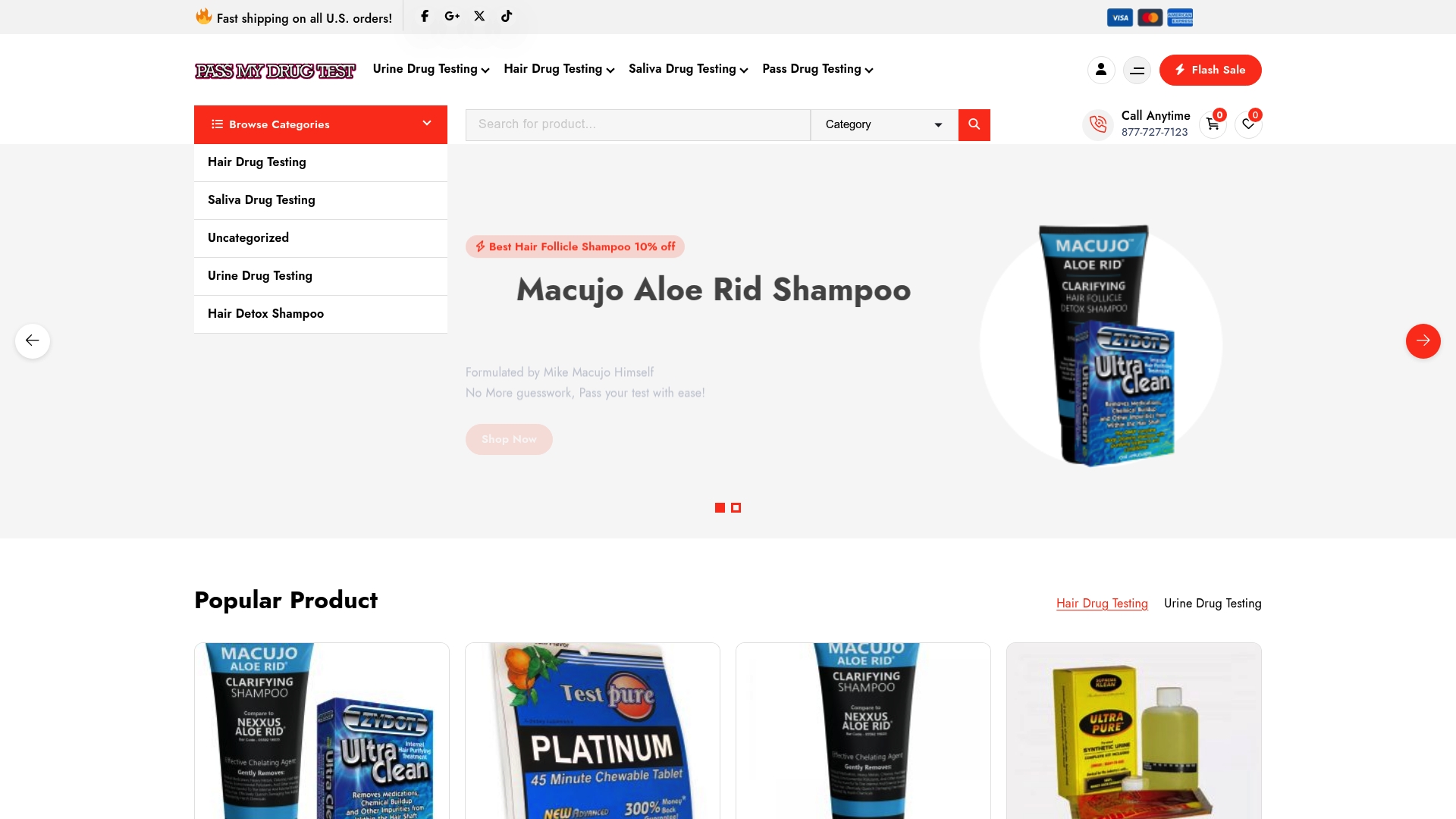
A product made for one kind of test is not made for another. We sell urine, saliva and hair drug test kits, plus a hair detox shampoo. Taking the right kit helps you know where you stand before the real screening: our urine drug testing, saliva drug testing and hair drug testing categories are organized by specimen so you can go straight to yours. For hair, we carry the Zydot Ultra Clean Shampoo and a wider hair detox shampoo range.
Step 4: Read the instructions before test day
Every product has directions on timing and use. Read them in full several days ahead, not the morning of the test, so you can ask questions while there is still time.
Step 5: Know your rights at the collection site
Bring photo ID. If you take prescription medication or hold a medical marijuana certification, bring the documentation and tell the collector before the test, not after. Medical patients with a disability-related need should also raise accommodation with HR in writing.
Where our products fit
If you are preparing for a workplace, legal or pre-employment screening, we built the site so you can research and order in one place. We sell at-home test kits for urine, saliva and hair, along with detox products including shampoos, drinks and chewable tablets. Orders ship fast within the United States, and you can call us during our published business hours to talk through which product suits your test.
The Pass My Drug Test store is the starting point, and our marijuana category groups the relevant guides and products.
For more guidance on how other states handle the same question, see our guides to California drug testing laws, Washington cannabis testing, Illinois marijuana testing law and Nevada marijuana testing law. If you are moving or interviewing out of state, those rules differ from Massachusetts.
Our perspective
Most people who write to us about a Massachusetts test are not confused about whether cannabis is legal. They are confused about why legal does not mean safe on a drug screen. The law protects your right to use cannabis. It does not promise you a negative result.
We built Pass My Drug Test around that gap. Our position is simple: once you know which test you face and how many days you have, you can make a plan. That is why we pair educational guides with a curated selection of products for urine, saliva and hair, and why we answer the phone during published business hours. Choosing among products is easier when someone helps you match the product to your specific scenario.
Massachusetts rules will keep moving. The state regulator is rewriting its product testing protocols, and legislators have proposed workplace protections. Until those change, the practical move is to prepare for the test you are actually going to take, with the right product for it and enough lead time.
MIchael
FAQ
Is it legal for a Massachusetts employer to test me for marijuana?
Generally yes. Nolo’s guide to the state’s workplace rules says employers may require consistent pre-employment testing and may test employees for reasonable suspicion or after accidents. Random testing is usually limited to safety-sensitive positions.
Can I be fired for a positive test if I use marijuana legally?
For recreational use, yes: an employer can discipline or fire an employee who tests positive, even for off-duty use. Medical marijuana patients may be entitled to reasonable accommodation under state disability law, but employers need not allow impairment on the job. A Massachusetts employment attorney can advise on your specific facts.
Do Massachusetts cannabis product testing rules affect my drug test?
No. Those rules govern contaminants and potency on products sold by licensed businesses. They do not change how a urine, saliva or hair test works, though accurate labels help you understand how much THC you are consuming.
Does a medical marijuana card protect me from pre-employment testing?
It does not stop the test itself. It may give you a right to reasonable accommodation if you use cannabis to treat a disability and your employer has 6 or more employees, according to Mass.gov. Raise your certification with HR before the test, not after.
Which test should I prepare for?
Ask the employer or collection site which specimen they use: urine, saliva or hair. Then match your plan to it. Our store organizes kits and products by test type, and our phone team can help you choose.
Sources
- Massachusetts General Laws, Chapter 94G, Section 15
- Cannabis Control Commission: Product Catalog
- 935 CMR 500.160, Testing of Marijuana and Marijuana Products
- CCC: Auditing THC potency on labels (May 22, 2026)
- CCC: Advances new testing regulations (November 12, 2026)
- Nolo: Massachusetts Workplace Drug Testing Laws Explained
- Mass.gov: Massachusetts law about medical marijuana
- National Law Review: Massachusetts employers may need to accommodate medical marijuana users
- LegalClarity: Massachusetts Drug Test Bill