

Kratom Drug Test: What Actually Shows Up and When
Standard 5-, 10-, and 12-panel workplace and DOT drug screens do not test for kratom. Mitragynine and 7-hydroxymitragynine (7-OH), the primary active alkaloids in kratom, are chemically distinct from the opiates and other substances those panels target. Kratom only shows up when a kratom-specific assay is deliberately ordered, typically a urine immunoassay screen followed by LC-MS/MS confirmation at a clinical lab.
Quick takeaways:
- Standard workplace and DOT panels won’t detect kratom — it requires a targeted mitragynine/7-OH assay
- Specialized lab tests (urine LC-MS/MS) will detect it, with screening thresholds as low as 5.0 ng/mL
- At-home dip cards give presumptive results only; they are not confirmation-grade and carry real limitations
Table of Contents
- Does kratom show up on a drug test, and which tests can detect it?
- What commercial and at-home kratom test kits actually do
- How long does kratom stay in your system?
- How to interpret your results: screens, confirmations, and false positives
- Why detection times vary so much from person to person
- How clinical labs test for mitragynine and why it’s complicated
- What to do if you expect a kratom drug test
- Key Takeaways
- The part most guides get wrong about kratom testing
- Passmydrugtest has the tools to help you prepare
- Useful sources and further reading
Does kratom show up on a drug test, and which tests can detect it?
The short answer: routine toxicology screens do not detect kratom. A standard urine panel screens for substances like THC, cocaine, amphetamines, opiates, and PCP. Kratom’s alkaloids don’t cross-react with those immunoassay antibodies in any meaningful way, so they pass through undetected.
Detection only happens when someone specifically orders a kratom panel. That decision belongs to the ordering party: an employer, a court, a probation officer, or a clinician. Because kratom is not part of any federally mandated workplace panel, your drug testing facts situation depends entirely on what that party chose to order.
Sample types and detection methods compared
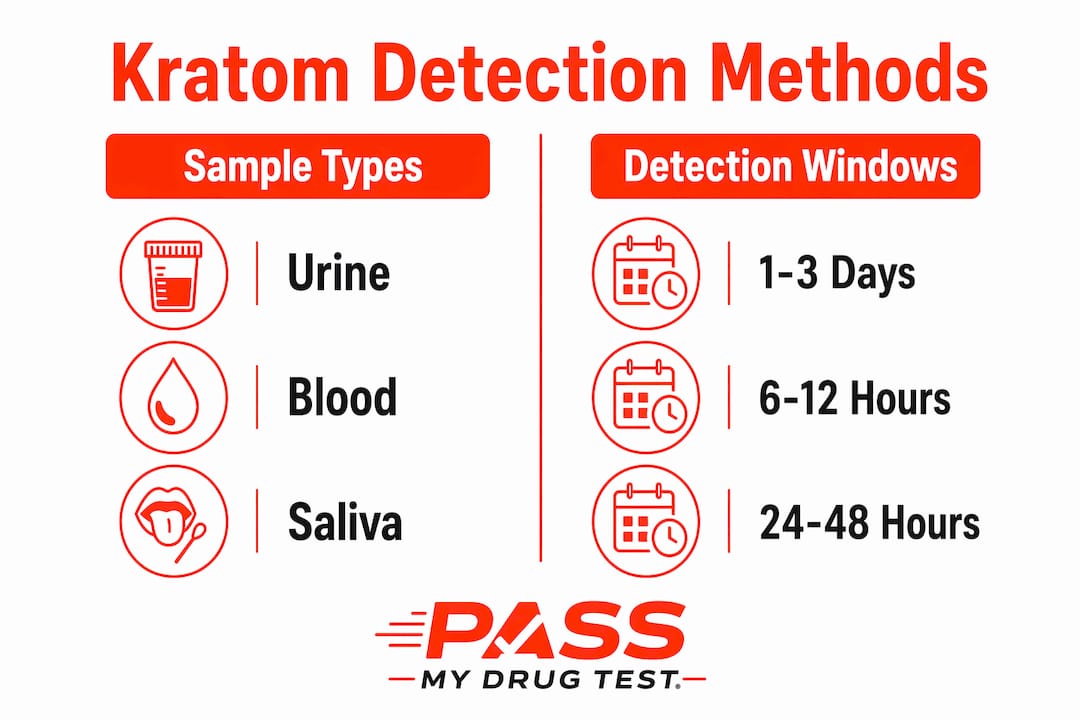
Each sample type has a different detection window and a different analytical method behind it. Urine is by far the most common matrix for kratom testing because it offers a practical window and works well with both immunoassay screens and LC-MS/MS confirmation. Blood and saliva windows are short and used mainly in clinical or acute-care settings. Hair testing can theoretically capture months of use history but is rarely ordered specifically for kratom.
| Sample Type | Typical Detection Window | Test Method | Sensitivity / Cutoff Example | Turnaround | Intended Use |
|---|---|---|---|---|---|
| Urine | 1–3 days for single use; up to 14+ days for chronic daily users | Immunoassay screen → LC-MS/MS confirmation | Example: 5.0 ng/mL screening, 1.0 ng/mL confirmation (Labcorp) | Hours to 3 days (lab) | Workplace, clinical, legal screening |
| Blood | Less than a day | LC-MS/MS | Low ng/mL range | Same-day to within one day | Acute clinical, forensic |
| Saliva | Within one day | LC-MS/MS | Low ng/mL range | Same-day | Roadside, clinical |
| Hair | Months (theoretical) | LC-MS/MS or LC-HRMS | Low pg/mg range | 5–10 business days | Forensic, long-term monitoring |
Note on cutoffs: The 5.0 ng/mL screening and 1.0 ng/mL confirmation thresholds are examples from Labcorp’s published test specifications, not universal industry standards. Individual labs set their own cutoffs.
Standard workplace panels are not designed to detect kratom, and kratom usually does not trigger an opioid-positive result on those screens either. Mitragynine and 7-OH are structurally different enough from morphine-class opiates that routine opioid immunoassays typically won’t flag them.
What commercial and at-home kratom test kits actually do
Rapid immunoassay dip cards and test strips for kratom work by detecting mitragynine above a set cutoff concentration in urine. Most read in 5 minutes or less. Two products you’ll find in the market are the SAFE LIFE Kratom Dip Card Test Kit (available on Amazon) and the Rapid Response Kratom Drug Test Strip from LochNess Medical. Both are lateral-flow immunoassay devices that give a presumptive positive or negative result.
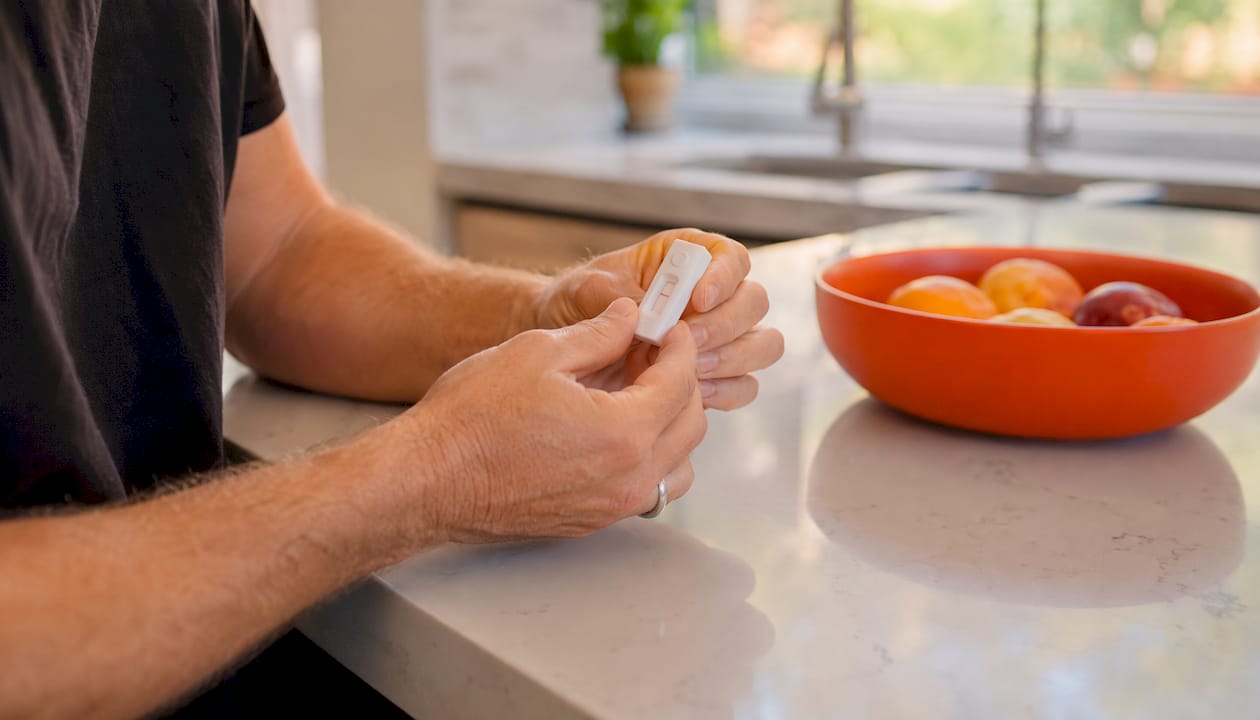
The word “presumptive” carries real weight here. These kits are screening tools, not confirmation tests.
Key limitations of at-home dip cards:
- They target mitragynine specifically; other kratom alkaloids like speciociliatine or speciogynine won’t necessarily trigger a positive even if present in significant amounts
- Cutoffs vary by manufacturer; some consumer dip cards use a 300 ng/mL cutoff, which is far higher than the 5.0 ng/mL lab screening threshold, meaning a card can read negative while a lab test would read positive
- No chain-of-custody documentation, so results carry zero weight in employment or legal proceedings
- Cross-reactivity with other substances can occasionally produce a false positive, though this is uncommon with mitragynine-specific antibodies
- A negative result on a home kit does not guarantee a negative on a lab-ordered test
Pro Tip: Use an at-home dip card only as a pre-check to gauge where you stand before a real test. For any employment, legal, or court-ordered situation, request laboratory confirmation with LC-MS/MS. A home kit result is a data point, not a verdict.
The gap between a 300 ng/mL home-kit cutoff and a 5.0 ng/mL lab screen is not trivial. Someone who tests negative at home could still test positive at a clinical lab. If the stakes are high, a home kit alone is not enough information.
How long does kratom stay in your system?
Detection windows for kratom vary and depend on use pattern and individual factors.
| Sample Type | Single Use | Chronic / Heavy Use | Notes |
|---|---|---|---|
| Urine | 1–3 days | Up to 14+ days | Most common testing matrix; window extends with repeated dosing |
| Blood | Within one day | Up to 1 to 2 days | Short window; used mainly in acute or clinical settings |
| Saliva | Within one day | Within one day | Very short; rarely ordered for kratom specifically |
| Hair | Months | Months | Theoretical; kratom-specific hair testing is uncommon in practice |
Pharmacokinetic research on mitragynine shows that single-dose clearance estimates don’t hold for chronic users. Repeated dosing promotes tissue accumulation and extends the terminal half-life, meaning someone who uses kratom daily may need 14 days or more for levels to fall near baseline. A one-time user at a moderate dose will likely clear urine detection within 3 days. A daily heavy user is in a different situation entirely.
Urine remains the most practical matrix for kratom testing. The window is long enough to catch recent use, the collection process is non-invasive, and the sample works with both immunoassay screens and LC-MS/MS confirmation. Hair testing can theoretically capture months of use history, but hair testing for kratom is rarely ordered outside forensic contexts because validated methods are still limited.
Individual variability is wide. Any window listed here is an estimate based on population-level data, not a guarantee for any specific person.
How to interpret your results: screens, confirmations, and false positives
A positive result on an immunoassay screen, whether from a home dip card or a lab’s initial screen, is not a confirmed positive. It’s a signal that warrants a second look.
The standard two-step workflow:
- Presumptive screen: An immunoassay (dip card or automated lab analyzer) detects mitragynine above the cutoff. This is fast and inexpensive but not definitive.
- Reflex confirmation: The lab runs the same sample on an LC-MS/MS instrument, which identifies and quantifies specific compounds by molecular weight and fragmentation pattern. This step is definitive.
- Medical Review Officer (MRO) review: For employment or legal tests, an MRO reviews confirmed positives, contacts the donor to ask about legitimate explanations, and makes the final call on the result.
If a kratom screen comes back presumptive positive, the confirmation step is what matters. False positives on urine immunoassays happen across many drug classes; kratom-specific assays are generally more targeted, but cross-reactivity is still possible. LC-MS/MS confirmation resolves those cases because it identifies the actual compound, not just an antibody reaction.
Kratom rarely causes a false positive on a standard opioid panel. The alkaloids don’t bind strongly enough to morphine-class antibodies to trigger a positive at typical cutoffs. When kratom does show up as an unexpected opioid result, it appears as mitragynine and 7-OH on confirmation, not as morphine or codeine. Disclosing kratom use to the MRO when a presumptive opioid positive occurs is the right move; it speeds up the resolution process.
Cutoff thresholds matter here. A lab using a 5.0 ng/mL screening cutoff will catch far more exposures than a home dip card set at 300 ng/mL. That gap is why a negative home result before a lab-ordered test can still be misleading.
Why detection times vary so much from person to person
Two people who take the same kratom dose on the same day can clear it at very different rates. The variables fall into two categories: biological and product-related.
Biological factors:
- Metabolic rate: faster metabolism clears mitragynine more quickly
- Body fat percentage: mitragynine is lipophilic, so higher body fat can extend retention
- Age: metabolic efficiency generally declines with age, slowing clearance
- Liver and kidney function: both organs are involved in mitragynine metabolism and excretion; impairment extends the window
- Hydration status: heavy dilution can lower urine concentrations temporarily, but it doesn’t eliminate the compound
- Interacting medications: CYP3A4 inhibitors (common in some antifungals and antibiotics) can slow mitragynine metabolism significantly
Product factors:
- Dose: higher doses take longer to clear
- Frequency: daily use causes accumulation that single-dose pharmacokinetics don’t predict
- Potency: 7-OH concentrates and high-alkaloid extracts produce higher peak plasma levels than raw leaf powder
- Product type: capsules, teas, and extracts have different absorption rates and alkaloid profiles
- Alkaloid variability: kratom products vary widely in alkaloid content even within the same strain label
Pro Tip: If you’ve been using kratom daily for weeks, don’t rely on single-dose clearance estimates. Chronic use timelines are genuinely different. Give yourself at least 14 days of abstinence before a high-stakes test, and use an at-home pre-check in the final days to gauge where you stand. “Flush” remedies and detox teas don’t change what LC-MS/MS finds in your sample.
The interaction between frequency and potency is where most people underestimate their window. Someone switching from leaf powder to a 7-OH concentrate will have a much longer clearance curve than they expect based on past experience with the same product category.
How clinical labs test for mitragynine and why it’s complicated
LC-MS/MS (liquid chromatography-tandem mass spectrometry) and LC-HRMS (high-resolution mass spectrometry) are the gold-standard methods for confirming kratom exposure in urine. Both technologies separate compounds by chromatographic retention time and then identify them by molecular mass and fragmentation pattern, which is why they can distinguish mitragynine from structurally similar alkaloids that an immunoassay might lump together or miss entirely.
The analytical challenge with kratom is that it’s not a single-compound drug. Peer-reviewed analyses document at least four major alkaloids and multiple diastereomers in kratom samples: mitragynine, speciociliatine, speciogynine, and mitraciliatine. Speciociliatine in particular can be more abundant than mitragynine in some products, which means an assay that only targets mitragynine may undercount actual exposure. A user of a speciociliatine-dominant product could test negative on a mitragynine-only screen while having substantial kratom alkaloid levels in their system.
“Assays that target only mitragynine can miss other abundant alkaloids. Speciociliatine may exceed mitragynine in some kratom products, creating a real risk of under-detection with single-target immunoassays.” — Drug Testing and Analysis, PMC10098727
Labcorp’s published test uses a two-tier approach: an initial immunoassay screen at 5.0 ng/mL, confirmed by LC-MS/MS at 1.0 ng/mL. That confirmation threshold is sensitive enough to catch low-level residual exposure that a home dip card at 300 ng/mL would completely miss. The difference between those two cutoffs is roughly 300-fold, which tells you a lot about the gap between home screening and clinical confirmation.
The two-tier model also reduces false positives. An immunoassay that cross-reacts with a structurally similar compound will produce a presumptive positive; LC-MS/MS confirmation then either confirms the specific compound or clears it. That’s the workflow that makes lab results defensible in legal and employment contexts.
What to do if you expect a kratom drug test
Whether the test is for a new job, a court requirement, or a clinical program, the steps are the same: get information first, then act on it.
- Ask which panel is being ordered. Not all tests include kratom. Request the specific panel name or test code. If the tester can’t tell you, ask whether mitragynine or 7-hydroxymitragynine is included.
- Run an at-home pre-check. A consumer dip card won’t give you a lab-grade answer, but it tells you whether you’re clearly above a detectable threshold. Use it 2–3 days before the actual test.
- Plan your abstinence timeline. For single or occasional use, 3–5 days is usually sufficient for urine clearance. For daily or heavy use, budget at least 14 days and verify with a home test.
- For legal or court-ordered tests, request chain-of-custody documentation. This protects you if a result is disputed. A test without chain of custody is not defensible in court.
- Disclose kratom use to the MRO if a presumptive positive occurs. Especially if the positive appears on an opioid panel rather than a kratom-specific assay. The MRO can order confirmation testing and document your disclosure.
- Seek medical advice if you’re using kratom to manage opioid withdrawal. Abrupt cessation before a test can trigger withdrawal symptoms. A clinician can help you manage the timeline safely.
- For employment tests, know your rights. Kratom is legal at the federal level and in most states as of 2026, though some states have restrictions. An employer can still test for it and act on a positive result under their own policy.
Pro Tip: For any high-stakes test, combine an at-home pre-check with a strategy for requesting lab confirmation if the screen comes back positive. A presumptive positive is not the end of the process; it’s the beginning of the confirmation step.
Growing regulatory attention on concentrated 7-OH products means kratom-specific testing is becoming more common in probation, treatment, and some employment contexts. If you’re in any of those programs, assume the possibility of a targeted test rather than relying on the fact that standard panels don’t cover kratom.
Key Takeaways
Standard workplace panels don’t detect kratom; only a targeted mitragynine/7-OH assay ordered by an employer, a court, or a clinician will show kratom use, with urine LC-MS/MS confirmation as the definitive method.
| Point | Details |
|---|---|
| Standard panels miss kratom | DOT and workplace 5-, 10-, and 12-panel screens don’t include mitragynine or 7-OH. |
| Lab tests are definitive | Urine LC-MS/MS with a 1.0 ng/mL confirmation threshold is the gold standard for detection. |
| Detection windows vary widely | Urine: 1–3 days for single use, up to 14+ days for chronic daily users. |
| Home kits have real limits | Consumer dip cards often use a 300 ng/mL cutoff vs. a lab’s 5.0 ng/mL screen — a 300-fold gap. |
| Passmydrugtest for prep | Passmydrugtest offers at-home test kits and detox products to help you pre-check and prepare before a real test. |
The part most guides get wrong about kratom testing
There’s a persistent assumption in online kratom communities that because standard panels don’t test for kratom, you’re essentially invisible to drug testing. That framing is outdated and getting more dangerous by the month.
The real picture is more nuanced. Detection risk is situational, not universal. An employer running a standard 10-panel has no idea you use kratom. A probation officer who specifically orders a mitragynine panel knows exactly what they’re looking for. The difference between those two scenarios isn’t about kratom’s chemistry; it’s about who ordered the test and why.
What most people also underestimate is the sensitivity gap between home kits and lab assays. A 300 ng/mL cutoff on a consumer dip card versus a 5.0 ng/mL lab screen isn’t a minor technical detail. It means someone can test themselves at home, see a negative, feel confident, and then fail a lab-ordered test the next day. That’s not a hypothetical; it’s a predictable outcome of using the wrong tool for the situation.
The other thing worth saying plainly: “flush” strategies and same-day detox drinks don’t change what LC-MS/MS finds. They can temporarily dilute urine concentration, which might push you below a home kit’s 300 ng/mL cutoff, but a lab running at 5.0 ng/mL with creatinine and specific gravity checks will flag a dilute sample and may require a retest. The only reliable strategy for a lab-confirmed test is time and abstinence, with a home pre-check to verify progress.
At-home kits are genuinely useful for one thing: knowing where you stand before the real test. Use them for that, and don’t ask them to do more than they’re designed to do.
Passmydrugtest has the tools to help you prepare
If you’re facing a kratom drug test and want to know where you actually stand, Passmydrugtest gives you two things most people need: a way to pre-check at home and a range of preparation products to support your timeline.
The site carries at-home test kits, detox products including drinks, cleanses, and capsules, plus detailed educational guides on how different test formats work. Fast shipping is available on U.S. orders, and phone support is available during business hours if you have questions about which product fits your situation.
One honest note: at-home kits from any source are presumptive only. They’re useful pre-checks, not substitutes for lab confirmation. For employment or legal tests, a confirmed lab result is what counts. Passmydrugtest’s resources help you prepare and pre-screen; the confirmation step belongs to a certified lab.
Ready to pre-check before your test? Browse detox and preparation products at Passmydrugtest and get fast U.S. shipping on your order.
This article is general information, not medical or legal advice. Confirm current testing policies and your specific situation with a qualified professional or the relevant testing authority.
Useful sources and further reading
- Kratom (Mitragynine), Screen and Confirmation, Urine — Labcorp: Published test specifications including screening and confirmation cutoffs
- Drug testing for mitragynine and kratom: Analytical challenges and medico-legal considerations — PMC: Peer-reviewed analysis of multi-alkaloid detection challenges and LC-HRMS methodology
- Kratom (Mitragyna speciosa) — StatPearls / NCBI Bookshelf: Clinical summary of kratom pharmacology and toxicology screening limitations
- Pharmacokinetic study on mitragynine half-life and accumulation — MDPI Molecules: Pharmacokinetic modeling data on single-dose vs. repeat-dose clearance
- PubMed search: Drug Test Anal journal: Peer-reviewed research on analytical drug testing methods including kratom assays