
Hair Test Cutoff Levels for THC: What the Numbers Mean
A hair test cutoff is the concentration of a drug marker, measured in picograms per milligram of hair (pg/mg), above which a lab reports “positive.” For THC, that number is tiny: a screening cutoff of 1 pg/mg and a confirmation cutoff somewhere between 0.05 and 0.1 pg/mg of the marijuana metabolite, depending on the lab and the proposal. If you are preparing for a hair test, these numbers tell you what the lab is looking for, how far back it can see and why hair-specific preparation matters. Our hair drug testing selection and the guides below are built around that problem.
TL;DR
- Hair labs run two steps: a screen (about 1 pg/mg for the marijuana metabolite THC-COOH) and a confirmation (0.05 to 0.1 pg/mg THC-COOH, sometimes with a THC minimum as well).
- Hair cutoffs are not comparable to urine cutoffs. Urine uses ng/mL, hair uses pg/mg, and the two windows are very different.
- No final federal hair-testing rule exists. The 2020 HHS/SAMHSA proposal is the reference point, so private labs and employers set their own numbers.
- A standard hair test looks back roughly 90 days, with a 5 to 7 day lag before use shows up in hair.
- In a 2022 laboratory study, everyday hair products cut measured THC by 52 to 65% on average, which is why shampoo-based preparation is worth understanding.
Table of Contents
- What a cutoff actually is
- Screening vs. confirmation: the two-step process
- THC hair cutoff levels at a glance
- Cutoffs for other drugs on the same panel
- Why hair cutoffs and urine cutoffs are not comparable
- What the cutoff does and does not tell you about timing
- How treatment connects to the cutoff
- Hair is the long-lookback test
- Where we can help
- Our perspective
- FAQ
- Sources
What a cutoff actually is
A hair test is not a yes-or-no detector. The lab measures how much of a substance is in a hair sample and compares it with a threshold. Above the threshold, the result is positive. Below it, the result is negative, even if a trace is present.
The 2021 consensus of the Society of Hair Testing defines the cutoff as the value that identifies drug users. It applies to head hair segments no longer than 3 cm. For single-exposure cases the cutoff is not used, and the lab’s lower limit of quantification applies instead.
Two units matter here:
- pg/mg means picograms of the drug per milligram of hair. A picogram is a trillionth of a gram.
- ng/mg is 1,000 times bigger. A cocaine cutoff of 0.5 ng/mg is the same as 500 pg/mg.
Screening vs. confirmation: the two-step process
Most workplace hair programs use two steps.
- Screen. An immunoassay (a fast antibody-based test) checks the whole sample against a low threshold.
- Confirmation. If the screen is presumptive positive, a second, more precise method (GC-MS/MS, gas chromatography with tandem mass spectrometry) measures the exact marker. Only a confirmed result is reported as positive.
The FDA’s 510(k) decision summary for an ELISA-based hair THC assay shows how this works in practice: a screen at 1.0 pg/mg THC-COOH, then confirmation requiring at least 0.1 pg/mg THC-COOH and at least 5.0 pg/mg THC. A negative screen is reported negative, and a presumptive positive is not reported until confirmed.
That double requirement matters. THC-COOH is a metabolite, a compound the body makes after THC is processed. It is not found in smoke itself. The 2020 federal proposal chose it as the target for exactly that reason, since smoke or residue on hair cannot create it.
THC hair cutoff levels at a glance
There is no single U.S. number. These are the main reference points.
| Source | Screen | Confirmation |
|---|---|---|
| HHS/SAMHSA proposed rule (2020) | 1 pg/mg THCA | 0.05 pg/mg THCA |
| FDA-reviewed hair THC assay | 1.0 pg/mg THC-COOH | 0.1 pg/mg THC-COOH and 5.0 pg/mg THC |
| Society of Hair Testing (2021) | n/a | 50 pg/mg THC, with THC-COOH at a minimum 0.2 pg/mg limit |
The Journal of Applied Laboratory Medicine’s 2025 review confirms the same split: European consensus bodies use 50 pg/mg for THC and 0.2 pg/mg for THC-COOH, while SAMHSA’s proposed value is 0.05 pg/mg for THC-COOH with no THC cutoff.
What this means for you: a U.S. employer’s lab most likely screens at 1 pg/mg and confirms on THC-COOH at a level between 0.05 and 0.1 pg/mg. Which lab and which panel the employer uses is the detail to find out, because it sets the exact threshold.
Cutoffs for other drugs on the same panel
If your hair test is a standard five-panel, THC is not the only line. The 2020 federal proposal lists:
- Cocaine: 500 pg/mg screen, with 500 pg/mg cocaine and 50 pg/mg benzoylecgonine confirmation.
- Opiates: 200 pg/mg.
- PCP: 300 pg/mg.
- Amphetamines: 500 pg/mg screen, 300 pg/mg confirmation.
THC is the outlier. Its cutoff is hundreds of times lower than cocaine’s, because very little THC-COOH ends up in hair. That is why a marijuana result depends so heavily on sample handling. If cocaine is also a concern, see our page on the hair drug test for cocaine.
Why hair cutoffs and urine cutoffs are not comparable
People often see “50 ng/mL” for THC and assume hair uses something similar. It does not.
- Different matrix. Urine is a liquid measured in nanograms per milliliter. Hair is a solid measured in picograms per milligram.
- Different window. Urine shows recent use, from days to weeks depending on how often you use. Hair is a longer record. Our guide to THC cutoff levels explains the 50 and 15 ng/mL urine numbers, and the federal cutoff overview covers the other drug classes.
- Different logic. A urine cutoff reflects what is in your system now. A hair cutoff reflects what has been incorporated into the strand over weeks.
So you cannot convert one into the other. A person can pass a urine test and fail a hair test on the same day, or the reverse.
What the cutoff does and does not tell you about timing
The cutoff sets the threshold. The detection window sets the time frame. They are separate things.
The 2020 SAMHSA proposal would allow head hair specimens of about 0.5 to 1.0 inch, representing a detection window of roughly 30 to 60 days. It also notes that drug markers do not appear in hair for 5 to 7 days after use. That is why hair is a poor tool for catching very recent use, and why a test taken a few days after a single use can come back negative.
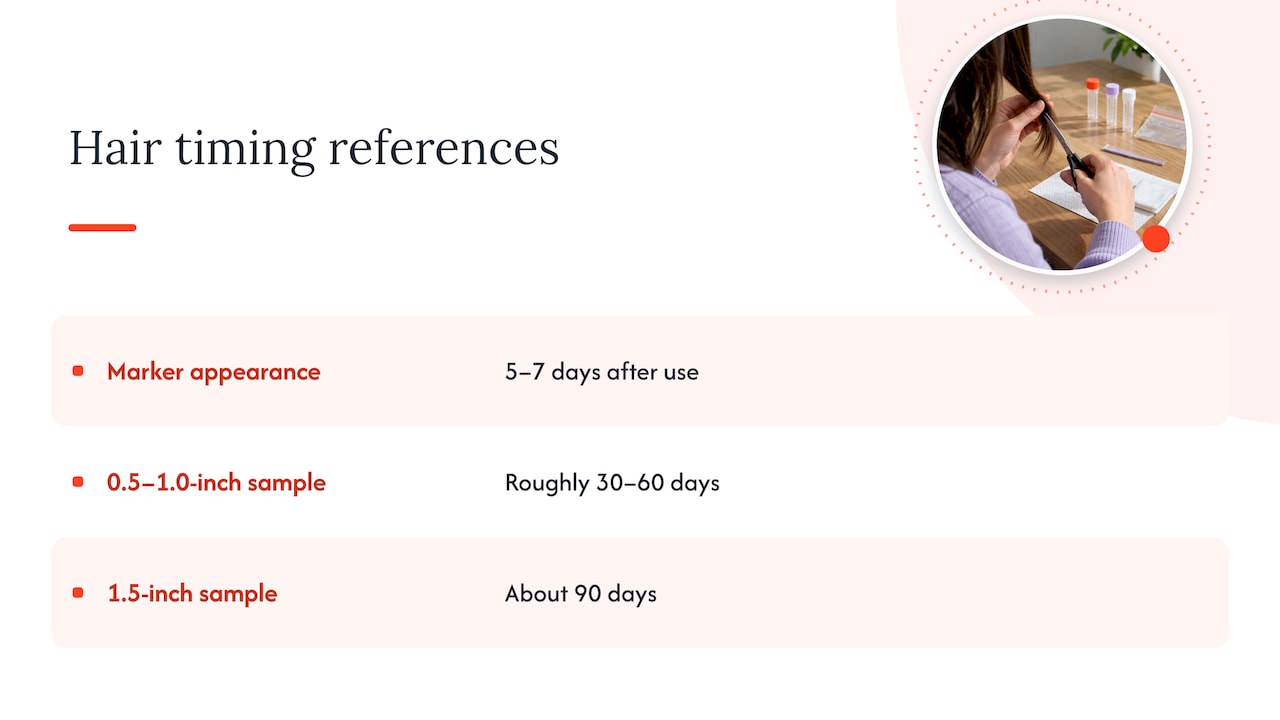
Many commercial labs test a longer 1.5-inch sample, which is why you will often see 90 days quoted. We cover the numbers in hair drug test detection times and in what the hair test window looks like.
Frequency changes what lands above the line
A 2007 study of 53 head hair specimens from 38 documented cannabis users found detection in 85% of daily users and 52% of non-daily users. THC concentrations ranged from 3.4 to over 100 pg/mg, and THC-COOH from 0.10 to 7.3 pg/mg. The 2025 JALM review adds that there is no strong correlation between dose and hair concentration, and that hair color can influence how much a strand holds. In other words, the cutoff is fixed, but where you land against it depends on your pattern of use and your own hair.
SAMHSA’s 2023 urine guidelines noted that no federal agencies were testing hair at that point, and as of late 2026, the 2020 hair proposal has not been finalized. The result is that your test is governed by the employer’s or court’s own policy and lab, not a federal hair rule.
How treatment connects to the cutoff
Because THC-COOH cutoffs are so low, even a partial reduction in what is measured can matter. Researchers have looked at this directly.
In a 2022 laboratory study by Bertges and colleagues, 54 THC-positive hair samples were treated with common products: vodka, a hair tonic, Zydot shampoo, a disinfectant and an everyday dandruff shampoo. Average THC reductions were 58% for vodka, 63% for the tonic, 52% for Zydot, 65% for the disinfectant and 52% for the dandruff shampoo. In 14 of the 54 samples, THC fell below 0.02 ng/mg, and the treatments were not visible to the eye.
A 2023 study by Mestria and colleagues tested internet-described cleansing routines and found concentration drops of up to 60% for THC with bleaching and dyeing, with the hair showing no visible damage.
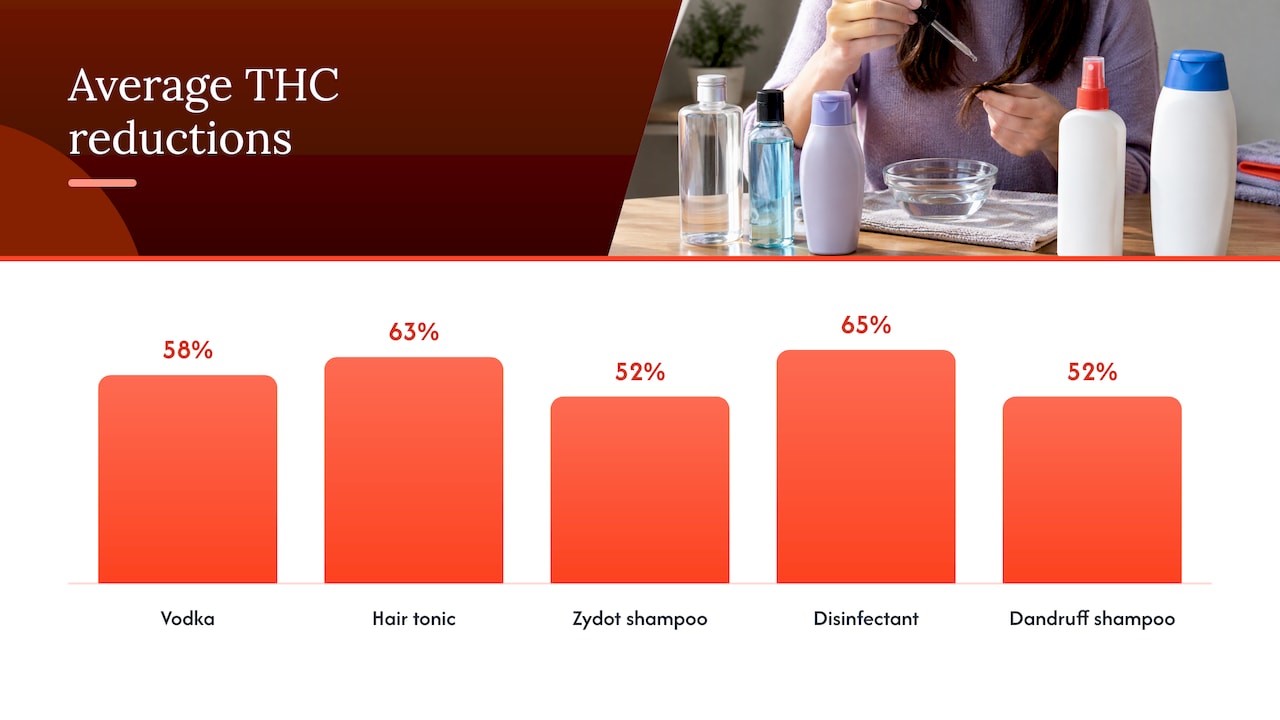
The takeaway for a reader facing a hair test: because the line is drawn at fractions of a picogram, how the hair is washed and handled before collection can move the result. This is lab work on hair samples, not a promise about any individual outcome, and results depend on your hair, your history of use and the lab’s method. A shampoo designed for this purpose, such as our Zydot Ultra Clean Shampoo, is part of a routine, not the whole of it.
A sensible preparation routine
- Find out the test type and window. Ask HR or the court which panel, which lab and how long a sample they take.
- Count back. Allow for the 5 to 7 day lag and the 30 to 90 day window.
- Reduce exposure first. Stopping use is what lowers what new hair grows in with.
- Use hair-specific products. Look through our hair detox shampoo range and follow the directions on the label.
- Plan for the collection date. Washing consistently in the days leading up to the test matters more than a single wash.
For a fuller walk-through, read how to prepare for a hair drug test for marijuana.
Hair is the long-lookback test
Of all the screening methods, hair is the one with the longest memory. Our breakdown of the hardest drug test explains why: it looks back months but carries a 7 to 10 day lag. If your employer requires a hair test, plan on the longer horizon rather than the days-to-weeks timing you would use for urine.
Where we can help
Our site covers hair, saliva and urine testing and hair detox shampoo in one place, with guides written for people in the United States who have a test coming up. Orders ship fast within the U.S., and our phone support is available during published business hours if you want help matching a product to your test type.
Start with the hair follicle drug test page to see the options, or browse the full store from our home page.
Our perspective
Hair testing looks intimidating because the numbers are so small. A cutoff of 1 pg/mg or 0.05 pg/mg sounds like a wall. In practice, it is a measuring rule, and a rule can be understood and planned around.
What we try to do at Passmydrugtest is put the facts and the products in one place. You should know your test type, the lab’s cutoff, the window and the lag before you buy anything. Then you can match the product to the situation instead of guessing.
For hair, that means a routine built around hair-specific products, started early and followed consistently. We curate detox shampoos and hair test kits for exactly that scenario, and our team is on the phone during business hours to help you choose.
Know the number, know the window, and prepare for the test you are actually taking.
MIchael
FAQ
What is the cutoff level for THC in a hair test?
There is no single U.S. figure. A common screening cutoff is 1 pg/mg of the marijuana metabolite THC-COOH, with confirmation at 0.05 pg/mg in the 2020 federal proposal or 0.1 pg/mg in an FDA-reviewed assay. Some labs also require a minimum THC level in the confirmation step.
Do hair test levels differ from urine test levels?
Yes. Urine is measured in ng/mL and reflects recent use, while hair is measured in pg/mg and reflects a longer window. The two numbers cannot be converted into each other, so a person can get different outcomes on each.
How far back does a hair test go?
A proposed federal hair sample would represent about 30 to 60 days, and many commercial tests quote around 90 days. Drug markers take 5 to 7 days after use to appear in hair, so very recent use may not register yet. See our detection times guide for the detail.
Is there a federal hair testing standard?
Not a final one. HHS/SAMHSA published proposed hair cutoffs in the Federal Register in September 2020, but they have not been finalized as of November 2026. Employers and labs therefore apply their own policies.
Can a hair detox shampoo lower the measured result?
Laboratory research found that common hair products lowered measured THC by 52 to 65% on average in treated samples. Results vary by person and by lab, so use a product designed for hair testing and follow its directions closely.
Sources
- 2021 Society of Hair Testing consensus on drugs of abuse testing in hair
- FDA 510(k) decision summary, hair THC assay
- Federal Register: Mandatory Guidelines for Federal Workplace Drug Testing Programs (2020)
- HHS/SAMHSA hair testing proposal text (2020)
- Review on Toxicology Testing in Hair, Journal of Applied Laboratory Medicine (2025)
- Cannabinoid Concentrations in Hair from Documented Cannabis Users (2007)
- Manipulation of THC Hair Concentrations by Commercially Available Products (2022)
- Hair analysis: Assessment of homemade hair treatments, Drug Testing and Analysis (2023)
- Hair Follicle Testing for Cannabis: What It Detects