

Georgia Drug Testing Laws: What THC Users Need to Know
Georgia does not require private employers to drug test anyone, but it lets them choose to, and that includes testing for marijuana and THC. Whether you are tested depends on your employer’s policy, your job and whether the employer joins the state’s voluntary Drug-Free Workplace Program. If you use THC and a screening is coming, the useful question is not “is this legal?” but “what will my employer’s policy and test cover, and how do I prepare?”
TL;DR
- Georgia has no general mandate for private-sector drug testing. Employers set their own policies, and many test after a job offer.
- Employers in the state-certified Drug-Free Workplace Program test at specific moments: after an offer, on reasonable suspicion, after a workplace injury and on a routine fitness-for-duty schedule.
- Georgia gives no workplace protection for medical cannabis. A positive THC result can end a job offer or a job, even if the use happened off duty.
- Federal rules for DOT-regulated and other safety-sensitive jobs treat marijuana as a banned drug, with no medical exception.
- Know which specimen you will give (urine, hair or saliva), because each one looks back over a different window of time.
Table of Contents
- Does Georgia require drug testing?
- The Georgia Drug-Free Workplace Program
- Can Georgia employers test for marijuana?
- Your rights if you test positive
- What the test will actually look at
- How to prepare when a test is coming
- Where our products fit
- What changed recently in Georgia
- FAQ
- Sources
Does Georgia require drug testing?
No. According to GeorgiaLegalAid.org, private employers in Georgia are not required to conduct drug testing and are generally free to set their own policies. That means one company may screen every new hire, another may never test, and a third may test only after an accident.
There are two exceptions worth knowing about. The first is the voluntary state program described below. The second is federal: some jobs, such as commercial driving, fall under federal testing rules no matter what Georgia law says.
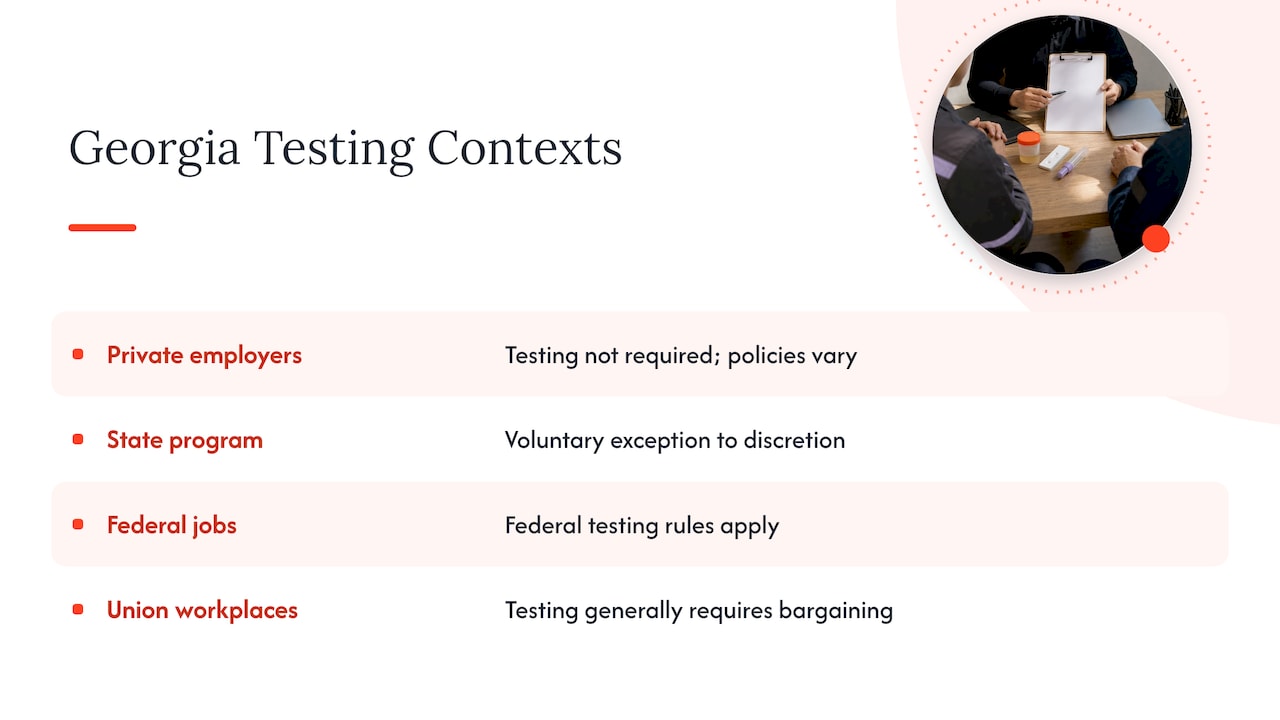
If you work in a unionized workplace, a drug-testing program generally has to be negotiated through collective bargaining under the National Labor Relations Act, according to SAMHSA’s summary of federal laws. Check your collective bargaining agreement if that applies to you.
The Georgia Drug-Free Workplace Program
The reason so many Georgia employers do test is a financial one. Employers can adopt a Drug-Free Workplace Program certified by the Georgia State Board of Workers’ Compensation and, in return, receive a 7.5% reduction on workers’ compensation premiums.
To qualify, the employer has to give written policies, educate employees and train supervisors. It also has to run specific kinds of tests, laid out in O.C.G.A. § 34-9-415:
| When you may be tested | What it means for you |
|---|---|
| After a job offer | Applicants are tested once an offer is made, so a test is often the last step before a start date. |
| Reasonable suspicion | A supervisor has a specific, documented reason to think you may be impaired or using. |
| Routine fitness-for-duty | Scheduled checks tied to your role, announced in the written policy. |
| After rehabilitation | Follow-up testing after certain treatment programs. |
| After a workplace injury | Testing of an employee who caused or contributed to an injury that resulted in lost work time. |
The same statute sets the guardrails. Specimen collection has to respect your privacy. Confirmation tests have to be performed by qualifying laboratories. And an employer must notify you in writing of a confirmed positive result within five working days.
If your employer participates, the policy should be in writing and available to you. Read it before the test: it names the drugs screened, the situations that trigger a test and what happens after a positive.
Can Georgia employers test for marijuana?
Yes. Georgia law lets employers keep zero-tolerance policies for marijuana, and the policy can cover off-duty use. A positive THC test can be the basis for refusing to hire you or for taking action against you. Georgia does not give employees a legal right to use marijuana away from work without consequences.
This matters because THC is the substance most people on this page are thinking about. Unlike alcohol, THC metabolites can remain detectable long after any effect has worn off. A test does not measure impairment. It measures whether the substance or its byproducts are present at or above a set cutoff. Your employer’s policy decides what that result means.
Medical cannabis does not change the workplace picture
Georgia has a low-THC medical cannabis registry, and that surprises many people. Registration does not protect your job. The state’s own Department of Administrative Services FAQ says state agencies may terminate an employee who tests positive for marijuana even when that employee holds a valid registration card. Private employers have the same freedom, since Georgia sets no accommodation duty for medical cannabis use.
So if you hold a card, treat a pre-employment or random test the same way a recreational user would. Raise it with the employer only after reading the policy, and speak with an employment attorney if you think a disability-related accommodation applies to you.
Federal rules: DOT and safety-sensitive jobs
If you drive a commercial vehicle, work in aviation, rail, transit or pipelines, or hold another federally regulated safety-sensitive job, federal rules apply on top of Georgia law. The federal government treats marijuana as a Schedule I drug in these roles and does not recognize medical marijuana as a valid medication, as the state’s own FAQ notes. Under 49 CFR Part 40, section 40.137, the employee carries the burden of proving a legitimate medical explanation for a positive result, and marijuana cannot be the basis for one.
Our guide to DOT drug test rules covers what is tested, the cutoffs and the consequences in more detail.
Your rights if you test positive
A positive result does not always mean the end of the road, but it does mean a short clock starts.
- Written notice. Under § 34-9-415, a program employer must notify you in writing of a confirmed positive result within five working days.
- A chance to explain. Employees who test positive have five days to dispute or explain the result. An explanation might be a prescription or a collection error.
- Confirmation testing. The statute requires confirmation by qualifying laboratories, so a quick on-site screen is not the last word.
- Non-discrimination. Testing must be done in a non-discriminatory way. It is illegal to single out individuals for testing because of race, sex, religion or nationality, according to the same legal aid page.
The Americans with Disabilities Act also matters here. Per SAMHSA, employers cannot discriminate based on past drug use or enrollment in a rehabilitation program, but the law does not protect people who are currently using illegal drugs when an employer takes action. Because marijuana remains illegal under federal law, that second part applies to THC.
If you believe your employer broke the notice, privacy or discrimination rules, an employment lawyer is the right person to talk to. A lawyer, not a product, is the answer to a legal dispute.
What the test will actually look at
Georgia law tells you when you can be tested. It does not tell you how. That comes from your employer’s policy and the lab. For a THC user, the specimen type changes everything:
- Urine is the most common for pre-employment screening. It is a snapshot of recent use, and the window depends on how often and how heavily you use.
- Hair looks back much further, so it is used by employers who want a longer history. It is a harder test for regular users to plan around.
- Saliva is observed and quick, and it is often used for reasonable-suspicion or post-accident situations because it points to more recent use.
There is no honest one-size answer for “how long until I am clear.” Frequency of use, body composition, metabolism and the lab’s cutoff all play a part. What you can do is learn which specimen you are facing, work out your timeline from the date of the test and prepare for that specific method.
How to prepare when a test is coming
Preparation starts with information, and the order matters.
- Find out the test type. Ask HR or read the offer letter. Is it urine, hair or saliva? Is it a lab collection or an instant on-site cup?
- Find out the timing. A post-offer test usually comes within a few days of the offer. A random or reasonable-suspicion test comes with little or no warning, which is why it pays to know your options before you need them.
- Read the written policy. Note which substances are tested and what a positive means for your job.
- Stop use as early as you can. More time between your last use and the test is always on your side.
- Choose preparation products that match the specimen. A product built for a urine test is not the same as one for hair.
- Handle what you cannot control. Prescription medications, collection errors and disputes should be raised in writing within the notice window.
Our pre-employment drug testing guide walks through what a post-offer screen looks like, and the pages on employee drug testing and drug testing on the job cover random, suspicion-based and post-accident testing.
A note on honesty with yourself: if you are in a federally regulated job or an employer’s program has a strict collection protocol, read the rules for your situation first and make decisions around them. We do not offer legal advice, and an employment attorney can speak to your specific case.
Where our products fit
Once you know which test you face, you can choose what to buy to get ready for it. At Pass My Drug Test we sell products by test type: urine drug testing items, hair drug testing items, saliva drug testing items and hair detox shampoo. Our selection also includes detox drinks, chewable tablets and at-home test kits.
We ship fast within the United States, and our team answers questions by phone during published business hours, so you can describe your test scenario and get help choosing the right product for it.
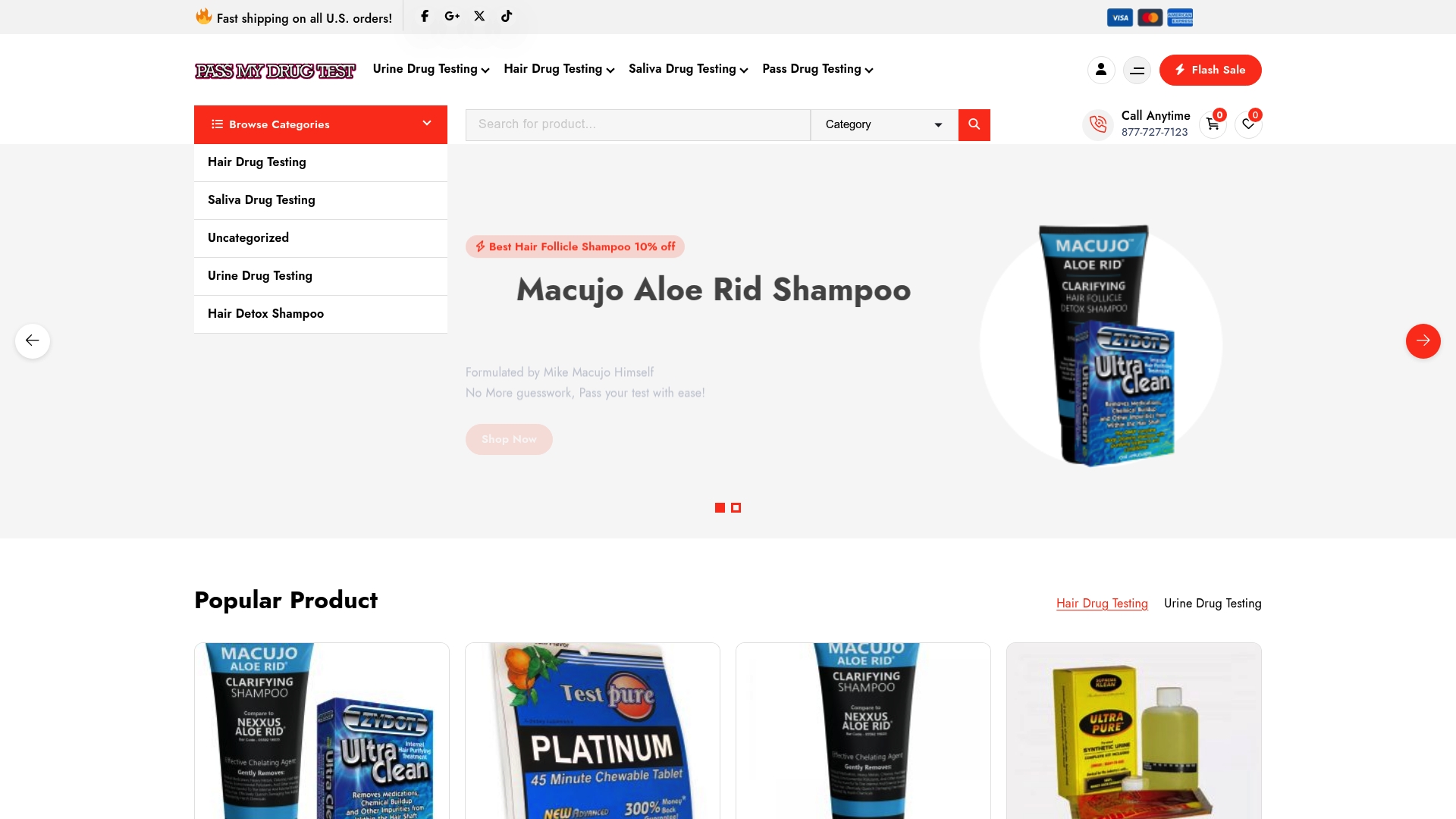
If you already know your test type, start from the Pass My Drug Test home page and pick the category that matches it.
Our view: know the test before you spend a dollar
Most people who write to us about a Georgia test are not worried about the statute. They are worried about one Monday morning: a job offer in hand, a collection site assigned and a few days to get ready.
That is why we built the site around the test itself. Georgia leaves the decision to employers, so your result is judged under your employer’s policy, not under a state standard you can read in advance. The sensible response is to learn the specimen type, the timing and the policy, then choose a product designed for that exact situation.
Our approach is to pair plain guides with a curated range of detox products, from urine and saliva solutions to hair shampoo, backed by fast US shipping and live phone support. We would rather you pick one item that fits your test than five that do not.
MIchael
What changed recently in Georgia
Georgia’s medical cannabis terminology has been updated in recent legislation, and employer rights have not moved with it: private employers remain free to enforce drug-free policies, including zero-tolerance rules for marijuana. Because statutes and policies get revised, treat any summary, ours included, as a starting point. The official text of O.C.G.A. § 34-9-415 and your employer’s current written policy are the documents that count.
If you are comparing states, the rules differ a lot. Our article on Florida drug testing laws shows how another state handles the same questions.
FAQ
Can a Georgia employer fire me for off-duty marijuana use?
Yes. Georgia law lets employers maintain zero-tolerance policies that cover off-duty use, and no state workplace protection stops them from acting on a positive THC result. State agencies can do the same even when an employee holds a low-THC medical cannabis card, according to the state’s own FAQ.
Is pre-employment drug testing required in Georgia?
No statute requires it for private employers. Many do it anyway, because employers in the Drug-Free Workplace Program must test applicants after an offer to qualify for the workers’ compensation discount. Check the offer letter for the test type and deadline.
How long do I have to dispute a positive result?
Employees who test positive have five days to dispute or explain the result. Program employers must also send written notice of a confirmed positive within five working days. Put your explanation in writing and keep a copy.
Does a medical cannabis card protect me on a DOT drug test?
No. Federal rules for DOT-regulated jobs do not recognize medical marijuana as a medication, and under 49 CFR 40.137 marijuana cannot be the basis for a legitimate medical explanation. If you hold a safety-sensitive job, plan around the federal rule.
Sources
- GeorgiaLegalAid.org: What should I know about drug testing in the workplace?
- Drug and Alcohol Testing for Private Employers in Georgia
- O.C.G.A. § 34-9-415, Official Code of Georgia Annotated
- Georgia Department of Administrative Services: Medical Marijuana FAQ
- SAMHSA: Drug testing federal laws and regulations
- US Department of Transportation: 49 CFR Part 40, section 40.137