
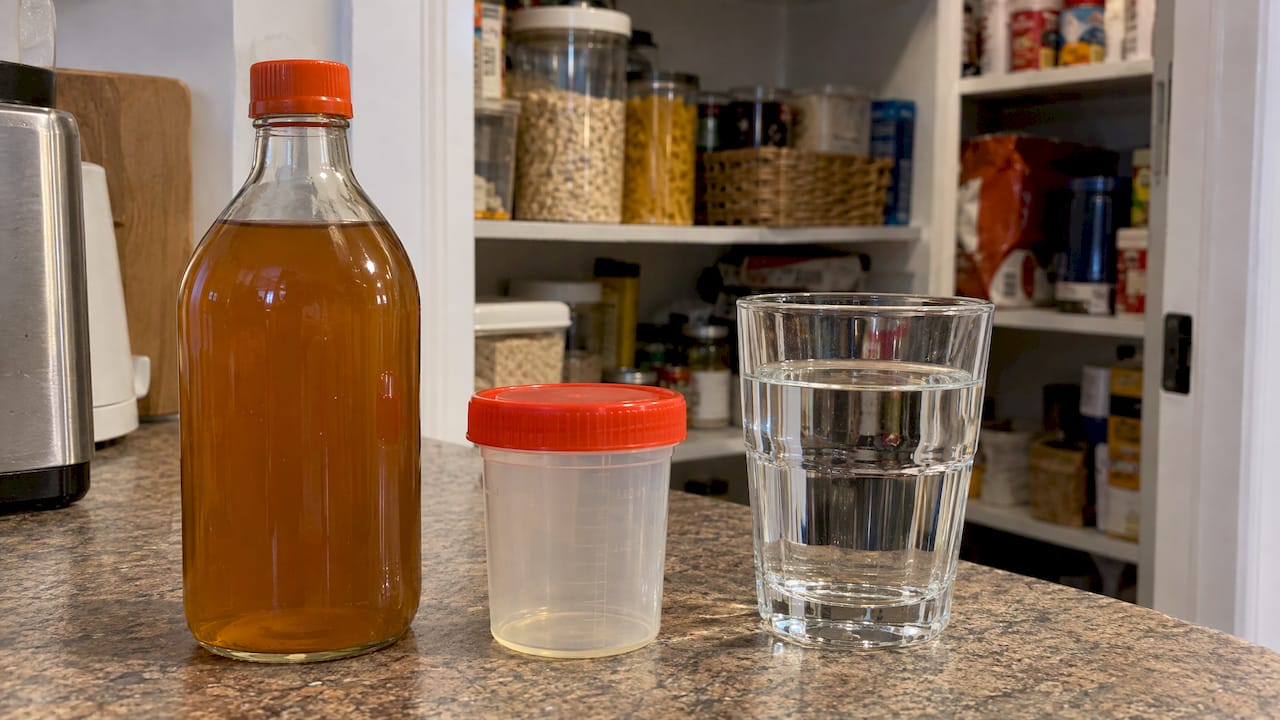
Apple Cider Vinegar and Your Drug Test: What the Evidence Shows
Apple cider vinegar (ACV) will not clear THC from your body or turn a positive urine test negative. Drinking it does not change the THC metabolite a urine test looks for, and putting it into a sample is tampering that labs are built to catch. If you have a test coming up, your time is better spent on the things that do decide the result: which kind of test you face, how long ago and how often you used, and what your sample looks like to the lab.
TL;DR
- No scientific evidence shows that ACV or any other vinegar “cleans” your system or helps you pass a drug test, according to Healthline’s review of the claim.
- Urine tests look for a THC metabolite. Your kidneys keep your body’s pH tightly controlled, so a few swallows of vinegar do not change that metabolite.
- Labs check every sample for pH, temperature, creatinine and specific gravity. An altered sample is treated as a refusal to test, which is worse than a plain result.
- Too much ACV can wear down tooth enamel, irritate the esophagus and interact with some medications.
- What actually matters is your test type and your timeline. We built our guides and product selection around exactly those questions.
Table of Contents
- Why people think vinegar works
- What the lab actually checks
- Drinking ACV: what it does and doesn’t do
- Why adding vinegar to a sample is the worst idea
- The health side: using ACV safely
- How long does ACV stay in your system?
- A better preparation plan than vinegar
- Where we can help
- Our perspective
- FAQ
- Sources
Why people think vinegar works
The vinegar story has been passed around forums for years, and it comes in two versions.
The first says that drinking ACV makes your urine acidic, and that acidic urine somehow “breaks” the chemistry of the test. The second says that ACV flushes toxins out faster. Both sound plausible because vinegar is acidic and because people associate it with “cleansing” diets.
The first version rests on a real piece of lab science. Most urine drug screens are immunoassays, which use antibodies to react to a drug or its metabolite. In theory, a big pH shift could interfere with that reaction. But the theory assumes the pH of your urine moves with what you drink, and it does not move much. Wisconsin’s consumer-protection agency, in its drug testing MythBusters sheet, explains that the body neutralizes the acid and dilutes it to a physiological pH, so ingested vinegar does not produce a negative result. The Ohio Supreme Court’s education series reaches the same conclusion in its 2020 MythBusters document, which flatly says that drinking vinegar or cranberry juice will not produce a negative urine drug test.
The second version fails for a simpler reason. There is no mechanism by which vinegar speeds up how your body eliminates THC metabolites.
What the lab actually checks
A urine drug test is two tests in one. The first looks for the drug. The second asks whether the sample is real, fresh and unaltered. That second check is called specimen validity testing, and it is where most shortcuts fail.
A 2025 review of detox methods by Dasgupta in a peer-reviewed journal describes the standard validity checks as pH, creatinine, specific gravity and temperature, plus specialized tests for known adulterants. It also notes that an adulterated specimen is treated as equivalent to refusing the test.
Here is what each check looks for:
| Check | What it tells the lab | Why vinegar and “flush” routines run into it |
|---|---|---|
| pH | Whether the urine is in a normal human range | The UNC School of Government’s training material gives the normal accepted range as 4.5 to 8.0. Healthline puts ACV’s own pH around 3.0. |
| Creatinine | How concentrated the urine is | Heavy water drinking lowers it, and dilution shows up here. |
| Specific gravity | Whether the sample is watered down | Another dilution flag. |
| Temperature | Whether the sample is fresh from the body | Tampering often changes it. |
| Adulterant screens | Whether foreign substances are present | Vinegar (acetic acid) is on the list of known urine adulterants in the American Family Physician review. |
For a deeper look at how these checks work in practice, including what the creatinine cutoff can and cannot catch, see our guide to urine validity checks.
Drinking ACV: what it does and doesn’t do
Say you drink a tablespoon or two of ACV the morning of the test. Here is what the evidence says happens.
Your pH stays where it was. The UNC training material explains that slight pH changes from drinking vinegar or fruit juice are easily corrected by the kidneys’ buffering system. It adds that a substance strong enough to push urine pH far enough to defeat an immunoassay would be highly toxic. That is the point: if vinegar could do it, it would hurt you first.
THC-COOH does not budge. A 2020 study of urine tampering among Turkish probationers, published on PubMed, found that vinegar did not affect THC-COOH screening results. The same study found that dilution attempts were picked up by evaluating creatinine.
The “cleanse” usually includes a lot of water. Healthline notes that most ACV cleanse instructions call for drinking at least a gallon of water before the test. That produces visibly diluted urine, which can trigger an automatic failure or a supervised retest. So the vinegar does nothing, and the water-loading puts a flag on your result.
Why adding vinegar to a sample is the worst idea
Some forum posts go a step further and suggest adding vinegar to the cup. We are not going to explain how that works, because it does not work in the way that matters: it is tampering.
Labs are trained to treat altered samples as altered. Collectors check temperature and appearance, and the lab checks pH and runs adulterant screens. The result is usually not a quiet negative. It is a rejected specimen, which employers and courts treat as a refusal. In many workplace and legal settings that carries the same consequences as a positive test, and sometimes harsher ones, because it reads as an attempt to deceive.
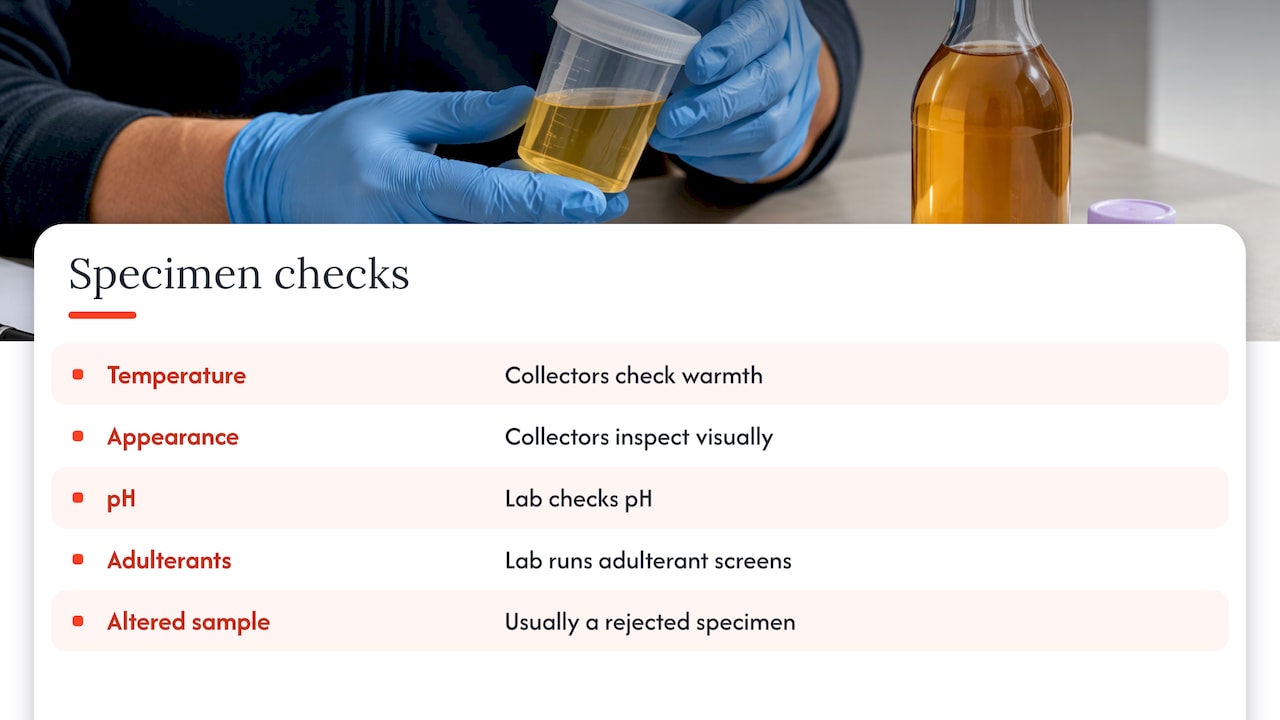
A 2023 review by Wissenbach and Steuer in a toxicology journal adds that collection staff are expected to check samples visually and for warmth, and that testing methods keep getting better at spotting manipulation.
Bottom line: a sample that comes back “invalid” or “adulterated” puts you in a worse position than a straight result and a conversation with the medical review officer.
The health side: using ACV safely
If you drink ACV as part of your normal routine, that is your call, and there are sensible limits. Do not take it in larger amounts hoping it will do something for a test.
MD Anderson’s guidance on apple cider vinegar says ACV is acidic and should be diluted. Regular or undiluted use can erode tooth enamel, damage the lining of the esophagus and upset the stomach, and it can change how certain medications work. Their dietitian suggests no more than a tablespoon in an 8-ounce serving, once a day.
Two more details worth knowing:
- Potassium. Gundersen Health System warns that more than 1 to 2 tablespoons a day can lower potassium levels, and that low potassium can cause weakness, muscle cramps and abnormal heart rhythms. It advises anyone on diuretics or insulin to talk to a doctor first.
- Tooth and throat damage. Prevention cites a 2021 study in which people who drank vinegar twice a day for eight weeks had 18% more tooth erosion than non-drinkers, and a case report of throat ulcers from regular undiluted ACV in a teenager.
If you take a diuretic, insulin, a blood thinner or any other daily medication, ask your doctor or pharmacist before adding ACV to your routine.
How long does ACV stay in your system?
This question comes up because people assume the vinegar is what the lab is hunting for. It is not. A urine test is not looking for vinegar at all. It is looking for a THC metabolite, and that is what sticks around.
That metabolite is called THC-COOH. It is what your body makes as it breaks THC down, and it lingers longer than THC itself, which is why labs target it. Our explainer on THC-COOH covers why a test aimed at an inactive byproduct still catches use from days or weeks ago.
Under federal workplace guidance, the American College of Medical Toxicology position statement says a confirmed THC-COOH concentration above 15 ng/mL counts as positive. That cutoff exists to separate actual use from environmental exposure. The same statement stresses that a positive result does not show impairment, timing, dose or route of use.
Columbia University’s health service, in its answer on detox kits, says that for daily users who quit, it usually takes up to 30 days for the metabolite to become undetectable on a urine test. It also notes that labs can detect dilution because it lowers the levels of other substances in urine.
The metabolite timeline is the thing to plan around, not the vinegar. Two of our guides help you place yourself on it:
- THC cutoff levels explains what the 50 and 15 ng/mL numbers mean on your result.
- The THC detox timeline helps you estimate your detection risk based on how often you use.
Occasional users have their own story. If you smoked once, see what one study found about positive rates after a single use. For general windows by test type, our marijuana urinalysis detection times page lays out the ranges.
A better preparation plan than vinegar
Here is what a sensible plan looks like when a THC test is coming.
- Find out the test type. Urine, hair and saliva tests look at different windows and different samples. Nothing you do for one applies to another. Ask the employer or the court officer which one it will be, and whether collection is observed.
- Count your time. Work out how long since your last use and how often you used. That sets your realistic risk far more than any home remedy. Use the timeline guide above.
- Do not tamper and do not flush. Skip the gallon of water and anything added to the cup. Dilution and altered samples are exactly what the lab checks for.
- Know your cutoff. Federal programs use 15 ng/mL for confirmation. Some employers use screening cutoffs of 50 ng/mL. The numbers change what a given level means for you.
- Match the product to the situation. If you decide to use a preparation product, choose one made for your test type rather than a kitchen ingredient. Our urine, hair and saliva categories are organized by test, and our phone support can help you sort out which fits your situation.
Where we can help
We sell products and publish guides built around the scenario you actually face. Our store covers urine drug testing products, hair drug testing and saliva drug testing, plus hair detox shampoo. Orders ship fast within the United States, and you can call us during our published business hours to talk through which product fits your test.
If your test is a urine screen, start with our clean urine drug test page, or browse everything at Pass My Drug Test.
Our perspective
Every week people ask us whether a pantry staple can do the job of a drug test product. We understand why. Vinegar is cheap, it is in your kitchen, and a forum post said it worked.
What we want you to see is that a drug test is not a single yes-or-no reaction you can nudge with an ingredient. It is a sample checked for the drug, for freshness, for dilution and for tampering. Plans built on one trick tend to ignore most of those checks.
That is why we put so much into explaining the test before we talk about any product. Know the sample type. Know your timeline. Know the cutoff. Then pick something designed for that situation. Our selection is organized by test type for that reason, and our phone team is there during business hours so you are not guessing.
If you are nervous about an upcoming screening, that is normal. Make your choices on facts, not on what you read in a comment thread.
MIchael
FAQ
Does apple cider vinegar help you pass a drug test?
No. Health agencies and courts that educate the public on testing say vinegar does not produce a negative urine result, and Healthline finds no scientific evidence that it cleans your system. Your kidneys keep your pH within a narrow range no matter what you drink.
Does apple cider vinegar change your urine?
Slightly, at most. Small shifts in urine pH from food and drink are normal, and the body corrects them. The UNC training material says the kidney’s buffering handles these changes. Labs consider urine valid in roughly the 4.5 to 8.0 pH range, so ordinary variation does not matter, while an unusually acidic sample gets flagged.
Can I use apple cider vinegar to clean urine for a test?
No, and adding it to a sample is tampering. Labs check pH, temperature, creatinine and specific gravity, and an adulterated specimen is treated as a refusal to test. That can carry consequences as serious as a positive result.
How long does apple cider vinegar stay in your system?
It does not matter for a drug test, because the test does not look for vinegar. It looks for THC-COOH, which can remain detectable in urine for up to about 30 days in daily users after they quit, according to Columbia University’s health service. Your own pattern of use sets that window.
Is it safe to drink a lot of apple cider vinegar before a test?
No. MD Anderson advises diluting ACV and keeping to about a tablespoon in 8 ounces, once a day. Larger amounts can harm tooth enamel and the esophagus and can lower potassium. Talk to your doctor first if you take diuretics, insulin or blood thinners.
Sources
- Does Vinegar Really ‘Clean’ Your System in 24 Hours? (Healthline)
- MythBusters, Drug Testing Myths (Ohio Supreme Court)
- MythBusters, Dispelling Drug Testing Myths (Wisconsin WATCP)
- Beating Drug Tests by Ingesting Detoxifying Agents (PubMed)
- Adulteration and Dilution Checks (UNC School of Government)
- Urine Drug Tests: Ordering and Interpretation (American Family Physician)
- Urine drug-testing tampering approaches: Turkish probationers (PubMed)
- Advances in testing for sample manipulation (PMC)
- Apple cider vinegar: health benefits and risks (MD Anderson)
- What you need to know about apple cider vinegar (Gundersen Health System)
- 6 Surprising Side Effects of Taking Apple Cider Vinegar (Prevention)
- ACMT Position Statement: Interpretation of Urine for THC (PMC)
- Marijuana and drug detox kits (Columbia University Go Ask Alice!)