
Creatine and Drug Tests: SAMHSA Cutoffs, Study Data, and Safe Steps
Creatine itself isn’t a substance any standard drug panel screens for, so taking it won’t produce a false positive for THC, opioids, or anything else. What it can do is raise your urinary creatinine level, which is the marker labs use to catch diluted or substituted samples. That’s a good thing if your levels are naturally low, but it’s not a trick for beating a test. If you’re worried, disclose your supplement use to the collector and ask what happens if your sample comes back dilute.
TL;DR:
- Taking creatine does not produce false positives on drug tests, but it can increase urinary creatinine levels, affecting specimen validity checks.
- Creatine supplementation raises creatinine levels within hours, potentially shifting samples from dilute to normal ranges, yet it does not mask drug presence.
- Labs often test for creatinine thresholds to detect dilution or substitution, with most programs using around 20 mg/dL as the cutoff for normal samples.
- Disclosing creatine use on intake forms and carrying documentation for medical conditions can prevent invalid results from appearing suspicious.
- Repeated dilute results typically lead to closer monitoring, but a single dilute or invalid sample is usually retested or deemed inconclusive depending on the program.
Table of Contents
- Creatine vs. Creatinine: What Labs Actually Measure
- How Labs Read Your Creatinine Number
- Does Creatine Actually Affect Your Results?
- What the Research and Official Guidance Actually Say
- Getting Ready for a Test While You’re Taking Creatine
- What Happens After a Dilute or Suspicious Result
- A Straight Answer From Someone Who’s Seen the Mistakes
- Products and Guidance for Test Preparation
- Sources
Creatine vs. Creatinine: What Labs Actually Measure
Creatine and creatinine sound alike, but they’re not the same molecule, and mixing them up is where most confusion about drug testing starts. Creatine is the supplement you buy in tubs at the gym, made largely from amino acids, and your body stores it in muscle tissue to help regenerate energy during short bursts of effort. Creatinine is the waste product left over after creatine breaks down. Your kidneys filter it out of your blood and into your urine at a fairly steady rate, which makes it useful for something drug tests were never originally designed to check: whether a urine sample is real, undiluted, human urine.
Labs measure urine creatinine because it correlates with muscle mass and kidney filtration, and it barely changes with hydration under normal conditions. A person with more muscle typically produces more creatinine. A person who just drank a gallon of water to try to dilute a positive sample will produce noticeably less, at least temporarily. That’s the whole basis for using it as a specimen-integrity check.
A few basics worth knowing:
- Creatinine is measured in milligrams per deciliter (mg/dL) of urine.
- Levels naturally fluctuate throughout the day based on hydration, exercise, and muscle mass.
- Testing labs run this check on nearly every regulated urine sample, not just ones that look suspicious.
How Labs Read Your Creatinine Number
Lab reports don’t leave creatinine interpretation to guesswork. SAMHSA’s specimen-validity guidance sets numeric bands that most workplace and legal testing programs follow, and understanding them tells you exactly what category your sample falls into.
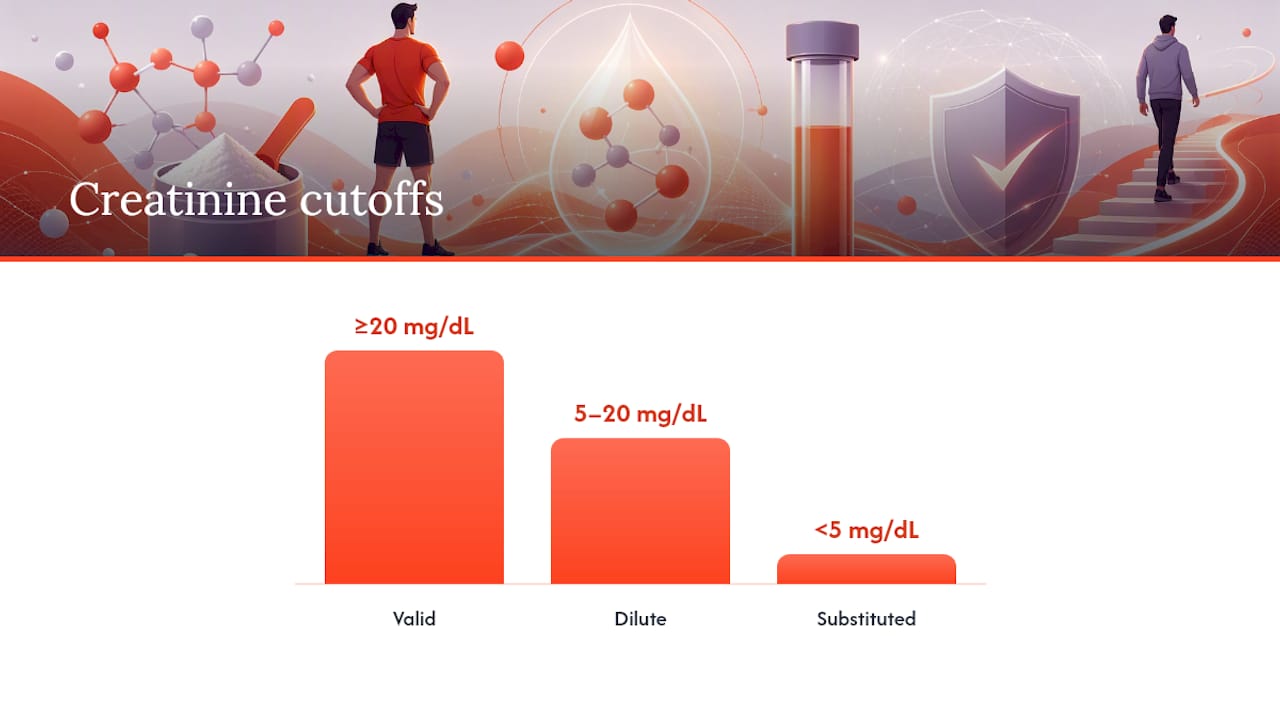
A normal urine creatinine reading falls within a range considered valid and unaltered for human urine samples. Readings noticeably below this range get flagged as dilute or substituted, suggesting the sample is either diluted by excess fluid intake or potentially substituted, meaning inconsistent with normal human urine.
What happens next depends on the classification:
- Dilute but still within testable range: the lab reports results as usual, but many employers or courts require a follow-up test.
- Substituted or invalid: this typically triggers a further test, often under observation.
- Repeated dilute results: programs may escalate monitoring or treat the pattern as a concern.
Individual employers and testing programs have some latitude here, but SAMHSA and groups like the National Association of Drug Court Professionals have pushed these thresholds into something close to an industry standard, so you’ll see the same 20 mg/dL and 5 mg/dL cutoffs referenced across most testing protocols.
Does Creatine Actually Affect Your Results?
No standard drug panel targets creatine as an analyte. It isn’t an illicit substance, and no employer or lab is screening your urine for it the way they’d screen for amphetamines or cannabinoids. Where creatine enters the picture is indirect: it changes the number tied to specimen validity, not the number tied to drug detection.
That distinction matters once you look at what creatine supplementation actually does to urinary creatinine concentration. Controlled research backs this up directly, and the effect is measurable, not theoretical. Here’s what that means in practice:
- A dilute sample can look less dilute after creatine intake, simply because creatinine concentration rises.
- This doesn’t remove drugs from your system or speed up metabolism of anything you’re being tested for.
- A lab that suspects supplementation may test specifically for creatine content alongside creatinine to check whether the numbers were artificially manipulated.
- Masking a dilute reading is not the same as proving sobriety, and labs and program administrators generally understand that.
If you’re taking creatine for training reasons and happen to get tested, the science suggests your creatinine reading might land closer to normal than it otherwise would. That’s a side effect of muscle metabolism, not a loophole worth building a strategy around.
What the Research and Official Guidance Actually Say
The clearest data point comes from a controlled study by Franz and colleagues, published in Drug Testing and Analysis, which measured urine creatinine before and after a 20-gram dose of supplemental creatine. Mean concentration jumped from 11.6 mg/dL, a level that would flag as dilute, to 22.5 mg/dL, comfortably inside the normal range, within about two hours of fluid intake.
| Condition | Approximate urine creatinine |
|---|---|
| No creatine supplementation | Low, typically below the dilute threshold |
| After 20 g creatine dose | Higher, often moving above the dilute threshold |
| Dilute threshold (guidance) | Defined as a creatinine level below which sample may be considered dilute |
| Substituted or invalid threshold | Defined as a very low creatinine level indicating possible invalid sample |
A 20-gram creatine dose was shown in a study to increase urinary creatinine concentration significantly within a couple of hours, enough to shift a sample from a dilute classification toward normal levels, according to the Franz et al. findings. That same research team notes labs can test for creatine itself when they suspect this kind of manipulation, which keeps the workaround from being reliable.
On the policy side, All Rise, the treatment-court advocacy group formerly known as NADCP, recommends testing creatinine on every urine sample collected in monitoring programs. Their guidance is explicit that a negative dilute result should never be read as proof of abstinence, only as inconclusive. Older foundational work, including Lafolie et al. in Clinical Chemistry, established the same principle decades earlier: creatinine testing exists to protect the integrity of the result, not to give test-takers a second chance at a clean reading.
Getting Ready for a Test While You’re Taking Creatine
You don’t need to stop supplementing to protect yourself here. You need to be upfront and avoid last-minute moves that look like manipulation even when they aren’t intended that way.
- List every supplement on your intake form. Most collection sites ask what medications or supplements you’re taking. Write down creatine. It costs you nothing and removes any question about intent if your creatinine reading looks unusual.
- Don’t load up on creatine right before a scheduled test hoping to fix a dilute sample. The effect measured in Franz et al.’s research came from controlled dosing under study conditions. Real-world timing, hydration, and individual metabolism vary enough that this isn’t something to bank on.
- Bring documentation if you have a medical condition affecting creatinine, such as kidney issues or a muscle-wasting condition. A note from a physician can prevent an invalid result from turning into a bigger problem.
- Expect a supervised or observed recollection if your first sample comes back dilute or invalid. This is standard procedure, not an accusation.
- Ask about retest policy before you’re in the room. Knowing whether a dilute result triggers an automatic second test, or just a note in your file, removes a lot of the guesswork.
Pro Tip: If you train heavily and use creatine regularly, mention it proactively rather than waiting to be asked. Collectors and program administrators see a lot of dilute samples from creatine users, and volunteering the information upfront reads very differently than explaining it only after a flag.
What Happens After a Dilute or Suspicious Result
A dilute or invalid classification doesn’t automatically mean trouble, but the response depends heavily on who’s running the test. Knowing the likely path keeps you from panicking or getting caught off guard.
- Standard workplace testing: most employers request a retest, sometimes with a shortened notice window, and treat a single dilute result as a non-event if the retest comes back clean.
- DOT-regulated and safety-sensitive jobs: these programs follow stricter federal rules through the Department of Transportation’s drug and alcohol policy office, often requiring an immediate observed recollection rather than a standard retest.
- Treatment courts and probation programs: a dilute negative is typically logged as inconclusive rather than passing, and a pattern of dilute results can lead to closer monitoring or sanctions, per All Rise’s guidance.
- Repeat occurrences: programs across the board tend to escalate scrutiny after a second or third dilute reading, even if each individual result was technically negative.
If you’re in a monitored program, talk to your case manager or probation officer before a scheduled test if you know your creatinine tends to run low. It’s a five-minute conversation that can save you a much longer one later.
A Straight Answer From Someone Who’s Seen the Mistakes
The biggest error I see isn’t creatine use itself, it’s the last-minute panic move. Someone hears that creatine “helps with drug tests,” so they load up on it an hour before a scheduled collection without ever having taken it regularly. That’s not how the Franz et al. data actually works, and it can look exactly like what it is: an attempt to alter a specimen right before it’s collected.
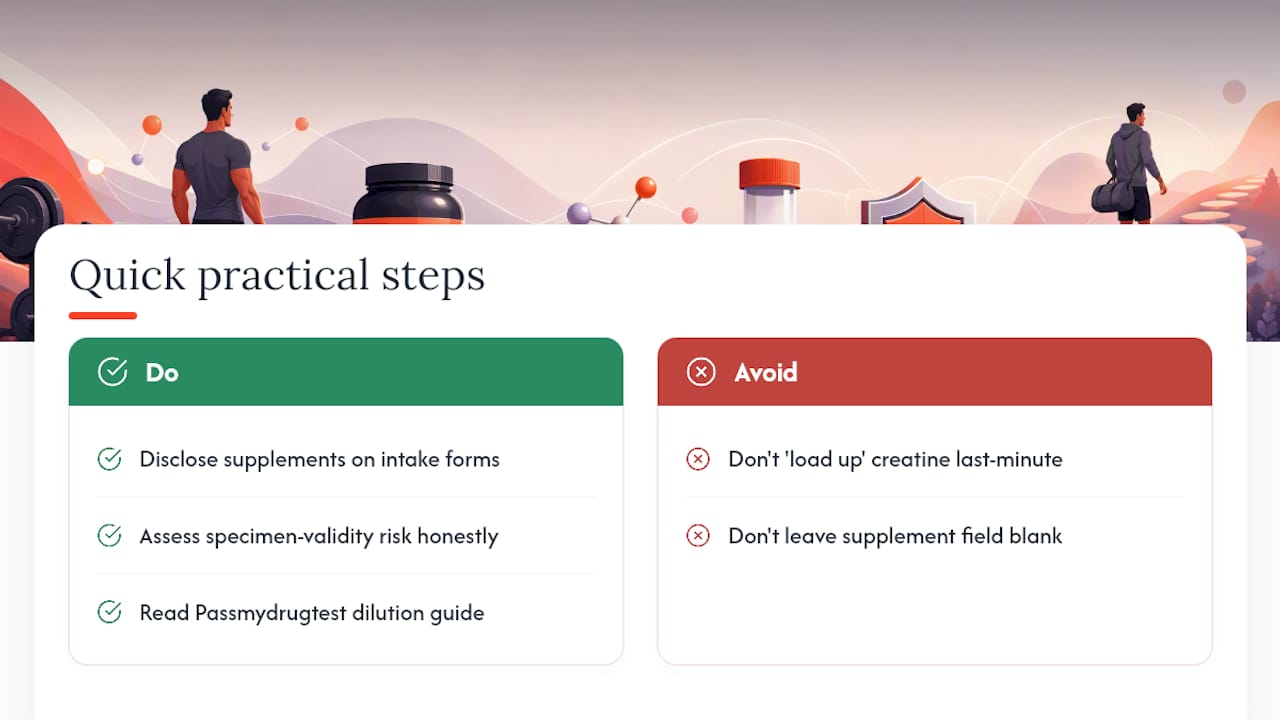
The second most common mistake is silence. People leave the supplement field blank on intake forms, then get flagged for a dilute or unusual reading with no context on file. Disclosure costs nothing and it’s the single easiest thing you can do to avoid a headache.
If you’re preparing for a test and want to understand your specimen-validity risk honestly, Passmydrugtest’s guide on dilution walks through the mechanics in more detail than most people realize they need until they’re already sitting in a waiting room.
— MIchael
Products and Guidance for Test Preparation
If you’d rather not leave any of this to chance, Passmydrugtest carries a full range of specimen-integrity resources and at-home test kits built specifically for people who want to know where they stand before a real screening. That includes home drug test kits you can use to check your own results privately, along with educational pages covering dilution, false positives, and specimen validity in far more depth than a single article can hold.
None of these products are designed to help you deceive a legitimate test, and using them that way isn’t the point. They’re for people who want a clear picture of their situation before a workplace, legal, or personal screening catches them off guard. If you’re facing an upcoming employer test, Passmydrugtest’s detox products for passing a drug test page is a practical place to start, with fast shipping on U.S. orders and phone support if you have questions about which option fits your timeline. Browse the options, read the specifics for your situation, and order what actually applies to you rather than guessing.
Sources
- Franz et al. — The effect of creatine ingestion on urinary creatinine concentration (Drug Testing and Analysis, 2022)
- All Rise (NADCP) — Use of urine creatinine concentrations for abstinence monitoring (Paul Cary, Aug 2021)
- Franz et al. — The effect of creatine ingestion on urinary creatinine concentration: Does supplementation mask a heavy dilution? (Drug Testing and Analysis, 2022)