
Abstain Before a Drug Test: How Long to Stop and What Helps
Stopping THC is the foundation of every plan for a drug test, and the number of days that takes depends mostly on how often you use. Occasional users often clear a urine test within about a week. Daily and heavy users can need a month or more. Water, fasting and a last-minute workout will not move that clock, and too much water can trigger a retest.
This guide gives you the timelines from labs and federal sources, explains why two people who quit on the same day get different results, and covers the hydration questions that come up before a screen. It is written for U.S. THC users who have a workplace, probation or pre-employment test coming and want to plan around real numbers instead of forum guesses.
TL;DR
- Abstinence is the baseline. Lab ranges for urine run from about 3 days after a single use to about 30 days for chronic heavy use, and they vary by person.
- Your use pattern is the biggest factor: how often, how much, and how long you have been using.
- Drinking lots of water before a test does not clear THC. It can produce a dilute sample, which labs flag and which can lead to a recollection.
- Fasting does not speed THC elimination. A 24-hour fast and a hard workout showed no meaningful change in urine cannabinoid levels in a small study.
- Your test type matters. Urine, saliva and hair look back over very different windows, so match your plan to the test you were actually given.
Table of Contents
- How long to stop smoking before a drug test
- Does drinking water help you pass a drug test?
- Fasting, exercise and other routine changes
- Other things to avoid before the test
- Know your test type before you count days
- Where we can help you plan
- Our perspective
- If your result looks wrong
- FAQ
- Sources
How long to stop smoking before a drug test
There is no single safe number of days, and any site that gives you one without asking how often you use is guessing. What labs publish are ranges tied to use pattern.
Mayo Clinic Laboratories gives approximate urine detection times for the THC metabolite, and they are a good starting frame:
| Use pattern | Approximate urine detection (Mayo Clinic Laboratories) |
|---|---|
| Single use | Up to 3 days |
| Moderate use (about 4 times a week) | Up to 5 days |
| Heavy daily use | Up to 10 days |
| Chronic heavy use | Up to 30 days |
Those are averages for a population, not promises for you. Dose, frequency and individual metabolism all shift the result, and Mayo says so directly.
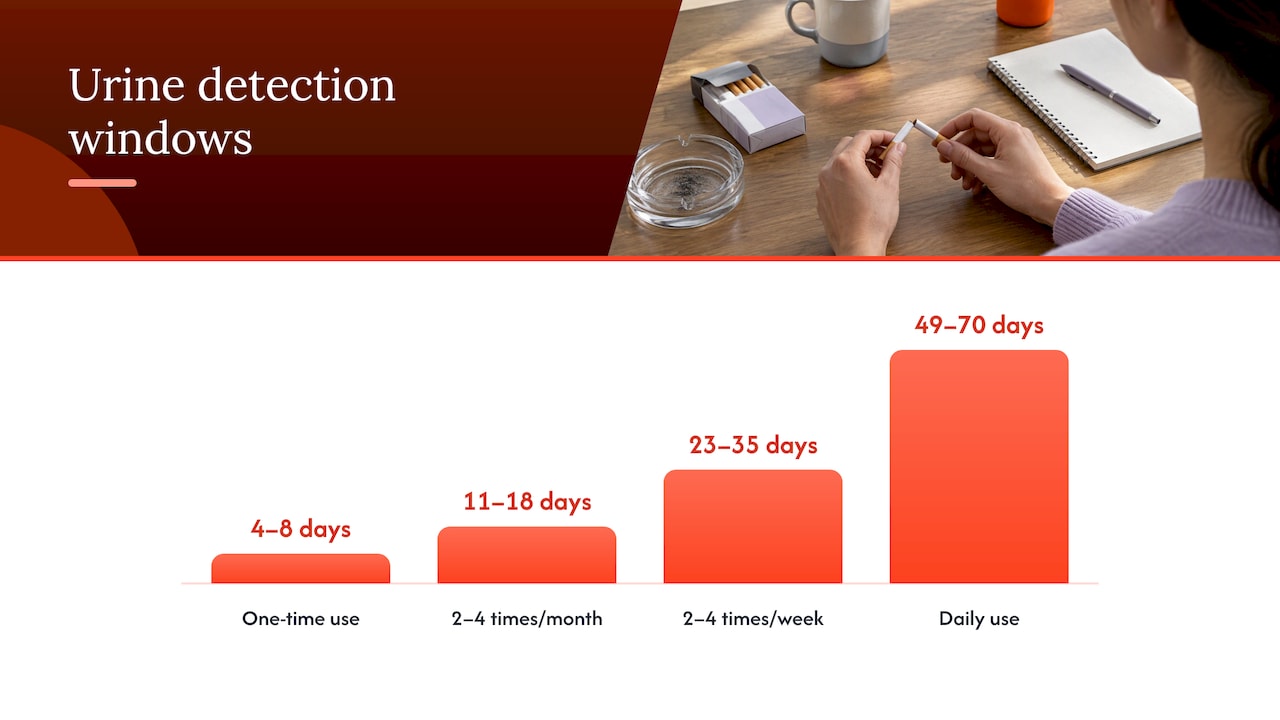
Other sources run longer. Drugs.com’s medically reviewed estimates put one-time use at 4 to 8 days, two to four times a month at 11 to 18 days, two to four times a week at 23 to 35 days, and daily use at 49 to 70 days. The gap between those figures and Mayo’s table is itself the lesson: published windows disagree because people and tests disagree. Plan on the longer end if you use often.
The CDC’s advisory on urine testing sits in between. It says 80% to 90% of a smoked THC dose is excreted within 5 days, and that a urine test should detect prior use up to 2 weeks in casual users and possibly longer in chronic users.
A practical way to use all this: find your row, add a buffer, and treat the buffer as part of the plan. If your test date is closer than your row suggests, you are not out of options, but you need to know that early, not the night before.
Why the same quit date gives different results
THC is stored in body fat, which is why regular use stretches the window. The CDC advisory notes that THC accumulates in body fat, producing higher excretion concentrations and longer detectability.
A urine test does not look for THC itself. It looks for a breakdown product called THC-COOH. Mayo explains that the parent drug clears quickly, in less than 30 minutes by half-life, and that the metabolite is what shows up in urine, appearing within about an hour of a dose. Our own explainer on why urine tests target this inactive metabolite goes deeper if you want the chemistry.
What drives your personal window:
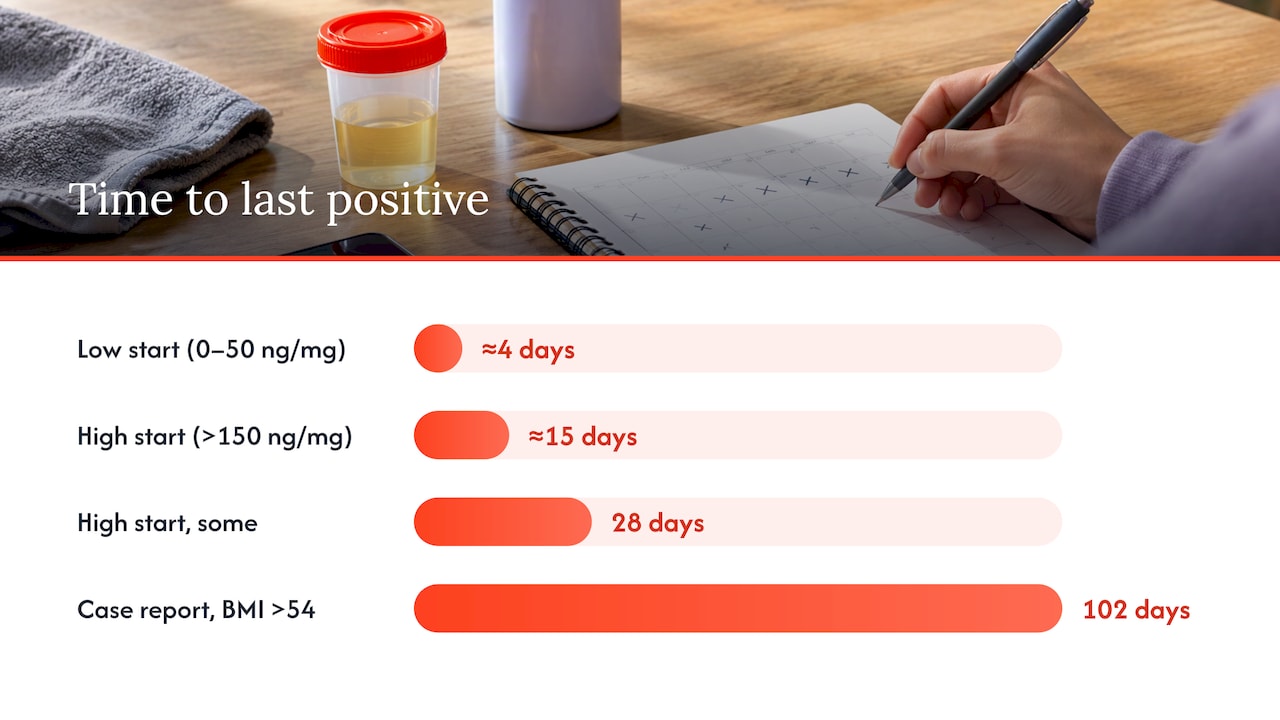
- Where you started. A study that followed 60 cannabis users through up to 30 days of abstinence found the starting concentration was the key predictor. Users who began above 150 ng/mg (creatinine-normalized) had their last positive sample at about 15 days on average, and some kept testing positive for 28 days. Those who began at 0 to 50 ng/mg averaged about 4 days.
- Frequency and duration of use. Weekly-to-daily users stay above standard thresholds far longer than occasional users.
- Body fat, genetics and general health. Drugs.com lists body fat, fluid intake, genetics, exercise, test type, health, other drugs and potency among the variables.
- Potency and how you consume. A 2026 systematic review found that low single doses of 1 to 5 mg THC were sometimes enough to exceed the 15 ng/mL workplace threshold, particularly when taken orally. Edibles count.
The outliers are real, too. A 2022 case report documented a man with long-term dependence and a BMI above 54 who tested positive 102 days after his last use. That is the extreme end, not the norm, but it shows why a published average is never a guarantee.
Cutoffs: what counts as positive
A positive is not any trace. Federal agencies define a positive urine cannabis result as THC-COOH above 15 ng/mL on the confirmation test, a level set to separate use from environmental exposure. The initial screen typically uses a higher cutoff. We break down the numbers in our guides on THC cutoff levels and federal drug test cutoff levels.
Your result can also bounce. During the tail end of elimination, the Goodwin study notes, a person can produce positive, then negative, then positive samples. One clean test along the way does not mean you are done.
Does drinking water help you pass a drug test?
No. Water does not remove THC metabolites from your body faster. What it can do is lower the concentration in a single urine sample, and labs are built to notice that.
The ACMT position statement explains that if a urine sample is too dilute from excess water, the analyte concentration may fall below the screening threshold and a negative result may occur. Labs know this, so they check the sample itself. A dilute sample is flagged by low creatinine (a waste product normally present in urine) and low specific gravity (a measure of how concentrated the urine is).
The Alabama Board of Nursing’s guidance on avoiding a dilute urine says samples with creatinine below 20 mg/dL are called abnormal, and called dilute if specific gravity also falls between 1.0010 and 1.0030. The same guidance is practical about what to do instead:
- Skip caffeine and other diuretics on the day of collection until after the sample is given.
- Use first-morning urine when possible.
- Keep fluid to no more than about 24 oz in the roughly two hours before you arrive.
- Do not count on a creatinine supplement to fix it.
What a dilute result can cost you
A dilute result is not a pass. It is a flag. In court-ordered or probationary testing, FMA Health says a dilute result is treated as highly suspect and may require a second test. The Merck Manual adds that people who drink large quantities of fluid or take diuretics can have samples rejected when specific gravity is very low.
A recollection is also often harder than the first sample. Under federal workplace rules, a dilute sample with very low creatinine can require an immediate recollection under direct observation. If you have a federally regulated (DOT) test, ask the collection site or your employer which rules apply.
There is a health side too. Drinking excessive water in a short window can cause hyponatremia, a dangerous drop in blood sodium. LegalClarity summarizes Cleveland Clinic guidance that some people can develop symptoms after as little as a gallon over one to two hours, with symptoms from nausea and confusion up to seizures. Drink normally, to thirst, and do not chase a number.
A hydration routine that keeps the sample valid
The goal on test day is a normal, concentrated-enough sample, not a clever one.
- Drink water normally through the days before, the way you usually do.
- On test morning, have a regular meal and your usual amount of fluid, staying under that roughly 24 oz in the two hours before you arrive.
- Skip coffee, energy drinks and alcohol until after you have given the sample.
- Use first-morning urine if your appointment allows it. The VA/DoD guidance summary notes that early-morning urine is the most concentrated and reliable.
Fasting, exercise and other routine changes
A lot of advice online says to fast or sweat it out. The research says neither shortens your window.
In a Norwegian study of six chronic daily users, 45 minutes of moderate exercise and 24 hours without food produced no major changes in serum or urine cannabinoid levels. A separate study of 14 regular users found overnight fasting did not significantly change blood cannabinoid levels, while 35 minutes of cycling caused a small but statistically significant rise in plasma THC. The practical takeaway: skip the heavy workout right before your appointment, and eat normally.
Other things to avoid before the test
Beyond the THC itself, a few ordinary habits can muddy a result or raise questions.
- Other people’s prescriptions and new supplements. Avoid taking medication that is not yours. Over-the-counter products such as pseudoephedrine can also interfere. If you take a prescription, tell the collector and, in a workplace test, the medical review officer who reviews positives.
- Alcohol. If an alcohol test is part of your screen, one source advises stopping 3 to 4 days ahead, and about 80 hours when an EtG urine test is used.
- Poppy seeds. The AFP review says casual poppy seed ingestion will not cause a positive opioid urine test, though some labs advise skipping them for a day or two anyway.
- Secondhand smoke. The same review says casual passive cannabis-smoke exposure is unlikely to cause a positive THC result.
Know your test type before you count days
Everything above is about urine, the most common workplace and probation screen. If your employer or court ordered a different sample, the timeline is different.
- Saliva tests generally look at much more recent use. Our page on how to pass a saliva drug test covers what to expect.
- Hair tests look back across a much longer period, and urine abstinence does not translate. See our hair follicle drug test guide.
- Urine is the one with the detection times in the table above.
If you are not sure which one you are getting, find out when you schedule. Asking the employer or collection site is normal and expected.
Where we can help you plan
Counting days only works if you know where you stand. Our site brings together detection-time guides, urine drug testing and saliva drug testing products, hair testing, and hair detox shampoo in one place, so you can match what you buy and read to the kind of test you were given. Orders ship fast within the United States, and our team answers by phone during published business hours if you want help picking the right product for your situation.
A good place to start is our marijuana urinalysis detection times page and our THC detox timeline, which help you estimate your own risk. When you are ready to shop, the Pass My Drug Test homepage lays out each test category.
Our perspective
Most people who write to us are not asking whether abstinence works. They know it does. They are asking how much time they have, and what to do with it.
Our view is that the best result comes from a plan built around your actual situation: how often you use, which kind of test you were given, and how many days you have. That is why we pair the product catalog with detailed guides instead of just selling a box. A person facing a urine screen in a week and a person facing a hair test next month need different things, and the right choice starts with knowing which one you are.
We built the site to put that research and the products in one place, with live phone support during business hours and fast U.S. shipping, so you can match your plan to your test and not lose days to guesswork. Start abstaining as early as you can, drink normally, keep the sample valid, and use our guides to size up your timeline.
MIchael
If your result looks wrong
A positive urine result is a screen, not the final word. The AFP review says immunoassay screens can give false positives and false negatives, and positive or unexpected results should be verified by confirmatory testing. NIDA notes that urine tests cannot tell how long ago you last used, how long you have used, or whether you are intoxicated.
If you take a lawful prescription, or you believe the procedure was flawed, the route is the confirmation test and the medical review. One employment law summary says a challenge should be supported by confirmation testing, medical review, prescription documentation, or evidence of a chain-of-custody error. For an employment dispute, talk with an employment attorney in your state.
FAQ
How many days should I stop using THC before a urine test?
It depends on how often you use. Mayo Clinic Laboratories lists about 3 days after a single use, 5 days for moderate use, 10 days for heavy daily use and up to 30 days for chronic heavy use. Other medically reviewed sources run longer for frequent users, so build in a buffer.
Can I drink a lot of water the day before to pass?
Water does not remove THC metabolites from your body. Excess water can produce a dilute sample, which labs flag, and in some testing programs a dilute result means a second collection. Drink normally and stay under about 24 oz in the two hours before you arrive.
Does fasting or exercising help clear THC faster?
No. In a study of daily users, 24 hours without food and a moderate workout did not change urine cannabinoid levels in any major way. Another study found that exercise slightly raised plasma THC in regular users, so skip a hard workout right before your test.
Can one clean test mean I am done?
Not necessarily. During the tail of elimination, a person can test positive, then negative, then positive again. Count your days from your last use and keep abstaining until the real test.
Sources
- Drug Testing: Marijuana, Mayo Clinic Laboratories
- Urine Testing for Detection of Marijuana: An Advisory, CDC
- How long does Marijuana stay in your system?, Drugs.com
- Urinary Elimination of 11-Nor-9-carboxy-THC, PMC
- Urinary Δ9-tetrahydrocannabinol and metabolite systematic review, PubMed
- Prolonged detection of cannabis in urine, ScienceDirect
- ACMT Position Statement: Interpretation of Urine for Cannabis, PMC
- Avoiding a Dilute Urine, Alabama Board of Nursing
- The Most Common Questions We Get About Drug Testing, FMA Health
- Drug Testing, Merck Manual Professional
- What Can You Drink to Pass a Drug Test, LegalClarity
- VA/DoD urine drug screen interpretation summary
- Can Physical Exercise or Food Deprivation Cause Release of THC, PMC
- Exercise increases plasma THC concentrations in regular users, PubMed
- How to Prepare for a Drug Test, National Background Check
- What Not to Do Before a Drug and Alcohol Test, AACS Atlanta
- Urine Drug Tests: Ordering and Interpretation, AFP
- Drug Testing, NIDA
- Drug Testing: Employee Rights and Employer Rules at Work